Nine out of ten marketers report that budget constraints are significantly impacting their paid media programs. However, a substantial portion of these professionals are overlooking a critical driver of return on investment: the crucial journey that unfolds after a user clicks on an advertisement. New research from Unbounce and Ascend2 reveals a persistent disconnect, with marketers consistently allocating more time and financial resources to audience targeting, creative development, and AI implementation than to the landing pages and post-click experiences that ultimately determine conversion success.
This comprehensive study, surveying 304 U.S. paid media professionals, highlights a clear disparity between perceived ROI drivers and actual investment patterns. While a notable 40% of respondents identified optimizing destination pages as a highly effective strategy for maximizing paid media expenditure, a mere 31% reported investing in landing pages within the preceding six months. Instead, budgets were preferentially channeled into audience research (40%), AI tools (39%), and ad creative (38%).
The implications of these findings are profound. Budgetary pressures are not simply compelling marketers to reduce overall spending; they are actively steering them towards more immediate, accessible optimizations within advertising platforms, often at the expense of the more resource-intensive, yet vital, post-click optimization efforts. This strategic shift, driven by perceived efficiency, may inadvertently be leaving significant conversion potential untapped.
Budgetary Pressures Drive Investment Upstream
The research unequivocally demonstrates that budget limitations have become a near-ubiquitous challenge for paid media professionals. A staggering 90% of marketers indicated facing paid media budget or resource constraints. Among the most affected areas were testing and experimentation. Audience targeting, ad creative, and reporting also experienced notable impacts. Alarmingly, nearly half of the surveyed professionals reported that landing page creation or message matching suffered when resources were tightened.
This pattern of resource allocation was mirrored in spending decisions. While audience research, AI tools, and ad creative attracted the largest share of new investment, landing pages languished significantly behind, despite the acknowledgment of their importance by marketers. The report further elaborates that marketers who successfully exceeded their ROI targets exhibited a more balanced investment strategy. They distributed their resources more evenly across audience research, AI, attribution, testing, and landing pages, rather than concentrating their efforts on a few highly visible areas.
Artificial intelligence, a technology lauded for its potential to enhance performance, followed a similar trajectory. Eighty-six percent of marketers reported utilizing AI in their paid media efforts, with nearly three-quarters asserting that it had improved their ROI. However, the application of AI was predominantly focused on reporting, audience targeting, platform tools, and ad copy generation. A mere 19% of marketers leveraged AI for landing page creation or optimization, a stark contrast to the finding that high-performing marketers were approximately twice as likely to employ AI in these specific areas. This suggests a missed opportunity to harness AI’s full potential for conversion rate optimization.
The Click is Not the Bottleneck, the Destination Is
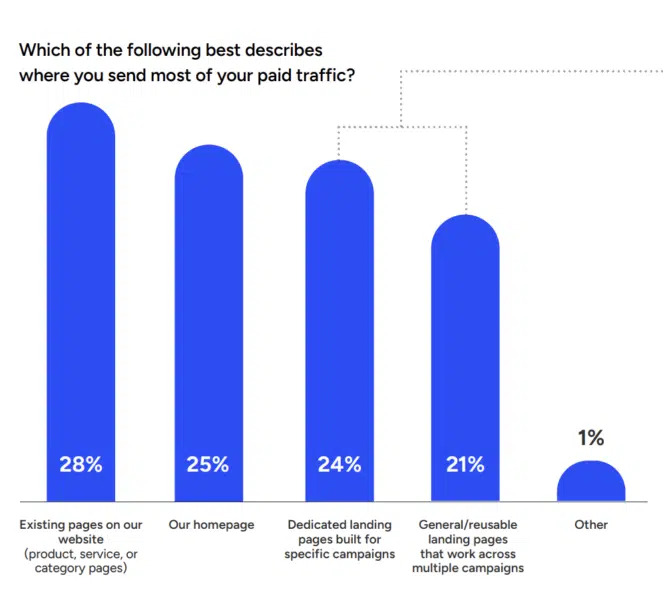
A significant portion of marketers are inadvertently undermining their carefully crafted targeting strategies once a user has clicked on an ad. The research indicates that over half of the respondents direct paid traffic to general website pages rather than to campaign-specific landing pages. Specifically, 28% of marketers primarily funnel visitors to existing product or category pages, while another 25% direct them to their homepage. Only a modest 24% predominantly utilize dedicated landing pages meticulously designed for individual campaigns.
This strategic misalignment becomes particularly pronounced when campaign objectives are considered. Forty percent of marketers focused on driving direct sales were found to be sending traffic to general product or category pages, bypassing the opportunity for a more tailored conversion experience. Furthermore, over a quarter of marketers running lead-generation campaigns were still directing potential leads to their homepage, a broad entry point that often lacks the focused call-to-action required to capture valuable information.
The consequences of this approach appear to be tangible. Nearly two-thirds of marketers who primarily direct paid traffic to their homepage reported that they were not exceeding their ROI goals. In contrast, marketers who demonstrated superior performance were less inclined to rely on homepages and more likely to employ reusable or campaign-specific landing pages, indicating a correlation between targeted post-click experiences and higher returns.
Marketers Acknowledge Value, Yet Under-Prioritize
The report underscores a crucial insight: marketers generally understand the intrinsic value of post-click optimization. When asked to identify the most effective ways to optimize paid media spend, audience targeting ranked as the highest priority. This was closely followed by destination page optimization, which was rated as more effective than cutting underperforming channels, shifting platforms, or implementing spending caps.
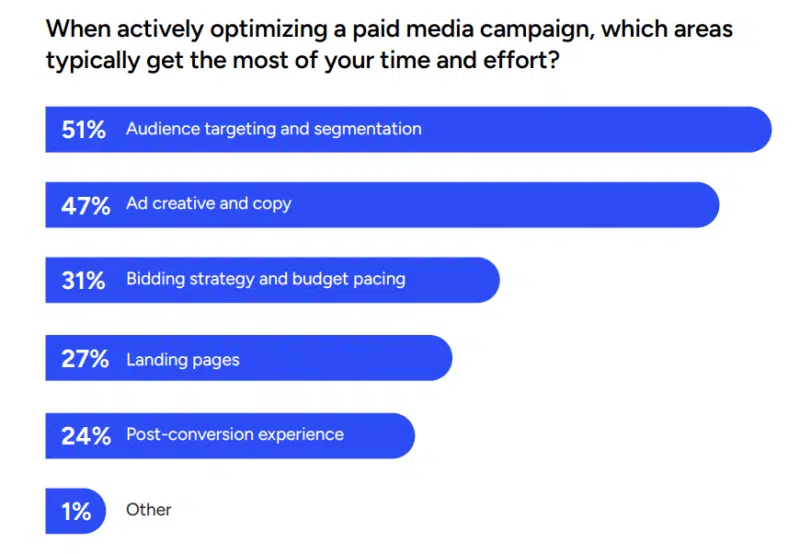
However, this awareness does not consistently translate into daily operational priorities. More than half of the surveyed professionals indicated that audience targeting receives the bulk of their optimization efforts. Ad creative and bidding strategies followed, with landing pages and post-conversion experiences ranking at the bottom of the list, despite their widely acknowledged importance in driving ROI.

The barriers to prioritizing post-click optimization appear to be rooted in operational constraints rather than a fundamental disagreement on strategy. Key obstacles cited by marketers include limited team capacity, insufficient design and development resources, a lack of specialized expertise, challenges with ongoing maintenance, and restrictive software budgets. In essence, while marketers generally recognize the significance of the post-click experience, they frequently encounter limitations in terms of personnel, time, or the necessary resources to implement improvements.
The most successful teams appear to surmount these challenges by adopting an end-to-end perspective on paid media, viewing it as an integrated system rather than a collection of disparate optimizations. The research consistently shows that marketers who consistently exceed their ROI targets allocate greater investment towards landing pages, attribution, testing, and post-conversion enhancements, in parallel with their investments in audience targeting, creative, and AI. This suggests that the most substantial gains in paid media performance are achieved by strengthening the entire customer journey, rather than solely focusing on generating a higher volume of clicks.
The Broader Implications for Marketing Strategy
The findings of the Unbounce and Ascend2 report serve as a critical wake-up call for the digital marketing industry. In an era of increasing budget scrutiny and the relentless pursuit of efficiency, the temptation to focus on easily optimizable elements within advertising platforms is understandable. However, this myopic approach risks neglecting a fundamental truth: the advertisement is merely the gateway. The true conversion—the desired action—is determined by what happens on the other side of the click.
The implication for marketing technology vendors and agencies is clear: there is a significant opportunity to educate and empower marketers on the strategic and operational aspects of landing page optimization and post-click experience enhancement. This could involve developing more user-friendly tools, offering specialized training programs, or providing consulting services focused on maximizing conversion rates through the entire customer journey.
For businesses, the message is equally direct: a holistic view of the paid media funnel is paramount. Investing in sophisticated targeting and compelling creative is only half the battle. The other half—ensuring that the destination delivers on the promise of the ad and guides the user seamlessly towards conversion—is equally, if not more, critical for achieving sustainable and profitable growth. The research indicates that the most effective marketers are those who understand that optimizing the entire journey, from initial impression to final conversion and beyond, is the true path to maximizing paid media ROI.
The full report, "The State of Paid Media ROI 2026," is available for download, requiring registration.
This article was originally published on MarTech.org, which is owned by Semrush. MarTech remains committed to providing high-quality coverage of marketing topics. Unless otherwise noted, this content was written by an employee or a paid contractor of Semrush Inc.