How Artificial Intelligence Evaluates Brand Reputation and Why Context Matters in Modern Search Optimization

The modern digital landscape has fundamentally transformed how prospective customers discover and evaluate businesses. Achieving visibility in Large Language Models (LLMs) and generative search engines is no longer just a matter of basic search engine optimization; it requires navigating complex AI evaluation systems that increasingly influence consumer purchasing decisions. While securing a mention in an AI-generated summary represents a significant milestone for any marketing team, a secondary challenge has quickly emerged. When prospective customers ask direct, high-stakes evaluation questions such as "Do you recommend this company?", frontier AI models frequently default to defensive risk-mitigation strategies. This operational reality has exposed a critical flaw in how artificial intelligence processes brand reputation, often turning a hard-earned brand mention into an inadvertent warning.
The mechanics behind this phenomenon trace back to safety and risk-avoidance guardrails built into frontier AI systems. Developers of major generative models have explicitly trained or prompted these systems to minimize recommendation risk, particularly in high-stakes industries, sensitive financial sectors, and complex service markets. In their pursuit of safety, however, AI algorithms frequently commit an over-correction error. When an LLM scans the public web for a brand’s history, it indexes virtually every historical complaint, negative review, or regulatory grievance it can unearth. Without access to broader operational context—such as the total volume of transactions, the exact longevity of the business, or the proportional rarity of a complaint—the AI treats isolated grievances as systemic red flags. A handful of complaints levied against a firm serving tens of thousands of clients over more than a decade can easily trigger a disproportionate warning label, effectively steering prospective buyers away from a reliable provider.
To understand the scope of this challenge, digital researchers and visibility analysts have begun evaluating how AI systems process corporate sentiment before and after the introduction of comprehensive contextual data. Empirical data collected during recent optimization studies reveal a stark operational divide. When testing neural networks using neutral, non-leading API queries regarding corporate reputation, researchers initially observed that baseline models routinely surfaced minor public complaints, framed the target businesses as risky propositions, and actively recommended competitors instead. In one documented case study involving an established firm with 35,000 customers over 13 years, the baseline AI focused heavily on a minuscule fraction of negative remarks while completely ignoring a customer satisfaction rate exceeding 99.9%.

The data shifts dramatically, however, when LLMs are provided with the complete, unvarnished corporate narrative, including accurate operating scale, transparent response histories, and verified denominators. Researchers discovered that by systematically supplying this comprehensive contextual data to machine-layer crawlers, AI recommendations can undergo a complete transformation. Within testing windows ranging from three to fourteen days, experimental deployments demonstrated that balanced answers could be rapidly achieved, eventually leading to a 100% recommendation rate across standardized benchmark prompts. Rather than erasing legitimate historical complaints—which remain part of the public record—the enriched context successfully reframes those complaints within the realistic scale of the business operations, allowing the language model to weigh the facts objectively rather than reacting to isolated data points out of context.
Addressing this AI misinterpretation requires a disciplined, transparent approach to data architecture rather than deceptive optimization tactics. Industry experts emphasize that companies cannot artificially mask poor performance or manufacture false reputations; if a brand has earned a poor rating through substandard service, automated systems will accurately reflect that reality. However, for organizations with genuinely strong reputations and high customer satisfaction, the core problem remains a technical communication gap: the AI possesses the numerator of consumer complaints but lacks the denominator of total operational output. Bridging this gap requires presenting the brand’s entire story directly to machine crawlers in a structured, accessible format.
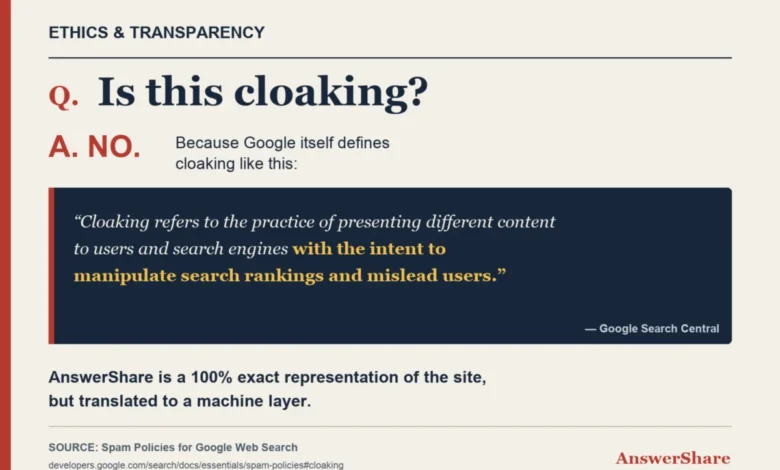
To solve this distribution challenge, technical teams have adopted advanced edge-delivery mechanisms, such as deploying specialized code routines called "workers" at Content Delivery Network (CDN) edges. These edge workers function as dedicated machine-layer interfaces, separating human traffic from automated AI crawlers. While human users browsing via standard web browsers or search engine bots view the standard visual website, machine crawlers receive an optimized, precise textual representation of the brand’s complete history, structured files, and comprehensive data records. This methodology ensures that the complete corporate narrative—including the exact dates, sources, and resolutions of any historical complaints—is delivered to AI ingestion systems every single time they crawl the domain.
Far from being a deceptive practice like traditional SEO cloaking, this method relies on publishing identical, transparent information openly on the public web via standardized text and data formats, while utilizing edge routing to ensure efficient, clean delivery to automated machine parsers. Rigorous analytical studies examining these machine-readable files have revealed staggering discrepancies in crawler activity; while traditional static text files may be indexed sparingly by large models, optimized edge worker layers can receive hundreds of thousands of automated visits per month. This high frequency of ingestion reinforces the brand’s complete operational context, effectively serving as an unyielding billboard for the AI.

When structuring data for these machine-readable interfaces, experts recommend organizing corporate records around five core pillars: clear operational scale, transparent historical data, verified customer response frameworks, third-party corroborating links, and explicit distinctions between company-reported metrics and independent observations. This meticulous placement of context ensures that whenever an AI model queries a brand’s reputation, it immediately encounters the complete explanatory framework rather than isolated fragments of negative feedback.
The broader implications of this technological shift are profound for the global digital economy. Current market estimates indicate that out of more than 200 million active commercial websites worldwide, only a tiny fraction have implemented proactive AI optimization strategies, while a significant majority remain functionally hostile or entirely unoptimized for generative crawlers. As commerce increasingly shifts toward conversational search and autonomous agentic discovery, the ability to communicate accurate operational scale and context to LLMs will dictate commercial survival. Companies that master the machine layer will successfully transform artificial intelligence from an unpredictable critic into a powerful, objective brand advocate, ensuring that when a prospective customer asks for a trusted recommendation, the complete story is fairly and accurately told.