Proving Causation in AI Search: seoClarity Unveils Rigorous Split Testing Methodology and New Google Search Console Insights

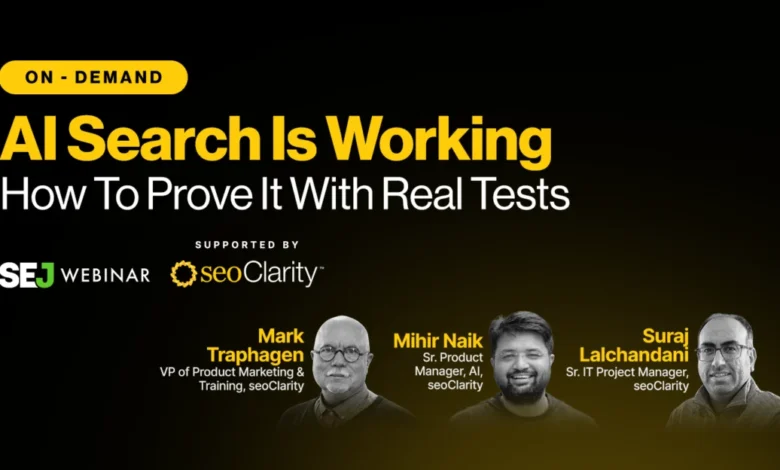
In a significant development for the evolving field of Artificial Intelligence (AI) search optimization, seoClarity has presented a robust split testing methodology designed to move practitioners beyond mere correlation to establish clear causation in AI search performance. The approach, detailed in a recent Search Engine Journal (SEJ) webinar, emphasizes rigorous testing protocols, the strategic use of control groups, and a keen understanding of newly available first-party data from Google. This methodology arrives at a critical juncture, as Google’s recent integration of AI Overviews and AI Mode into Search Console provides unprecedented visibility into how content performs within generative AI features.
The core argument put forth by seoClarity’s experts – Mark Traphagen, VP of Product Marketing & Training; Mihir Naik, Senior Product Manager, AI; and Suraj Lalchandani, Sr. IT Project Manager – posits a crucial distinction: "Visibility scores tell you if you showed up. Page-level performance and split testing tell you if what you did actually mattered." This principle, long a cornerstone of traditional SEO analytics, is now being meticulously applied to the complex, often opaque, landscape of AI-driven search, offering a much-needed standard of proof for optimizing content for platforms like ChatGPT, Claude, Perplexity, Gemini, and Google’s own AI interfaces.
The Paradigm Shift: From Correlation to Causation in AI Search
For years, SEO professionals have grappled with the challenge of isolating the impact of specific changes amidst a multitude of ranking factors and algorithmic updates. This challenge is amplified in AI search, where the generative nature of Large Language Models (LLMs) and their diverse output formats (summaries, direct answers, cited sources) make direct attribution of performance difficult. Many teams have relied on observational data, inferring success based on increased AI citations following content modifications. However, as seoClarity demonstrated, such inferences often confuse correlation with causation.
The webinar highlighted a compelling case study: the addition of FAQ sections to a set of test pages resulted in a measurable increase in AI citations. Crucially, when these FAQ sections were subsequently removed, the citations dropped back to their baseline levels. This reversion, a hallmark of scientific experimentation, provided the irrefutable evidence of a causal link. This level of proof is rare in AI search measurement today, underlining the sophistication of seoClarity’s proposed methodology. It shifts the conversation from merely tracking visibility to understanding the precise impact of content changes on how AI models process and cite information.
Google’s Landmark Update: New AI Search Console Data
A significant development preceding the webinar, and a central topic of discussion, was Google’s launch on June 3rd of dedicated Search Console reports for AI Overviews and AI Mode. This update provides site owners with page-by-page data on how frequently their URLs appear within Google’s generative AI search features. Lalchandani hailed this as the most substantial measurement upgrade the AI search landscape has received, noting, "This has been the hardest thing to measure in AI search. Everyone was sampling. Everyone was inferring. But now Google is just giving it to you."
The Significance of First-Party Data
The introduction of first-party data directly from Google carries immense weight. Unlike third-party tools, which rely on scraping, API access, or statistical modeling, Google’s data offers an authoritative and unfiltered view of performance. This direct insight into AI Overview impressions and clicks allows SEOs to precisely identify which content is being surfaced by Google’s AI, and to what extent. It provides a foundation for more accurate analysis and strategic decision-making, reducing the guesswork that has long plagued AI search optimization efforts.
Bridging the Measurement Gaps
While Google’s new reports are transformative, the seoClarity team was clear about their limitations. These reports cover only a segment of what a comprehensive AI search testing program requires. Platforms like ChatGPT, Claude, and Perplexity, which operate independently of Google Search, still necessitate structured third-party tracking and measurement. The webinar detailed precisely which gaps the new GSC reports close and which remain open, providing a platform-by-platform reference for what each AI engine can crawl and render. This nuanced understanding is critical for marketers to avoid over-reliance on a single data source and to build a truly holistic AI optimization strategy. SEO professionals are advised to integrate these new GSC reports into their existing testing frameworks, using them to validate hypotheses and refine strategies rather than building an entire program around them in isolation.
Crafting the "Golden Set" of Prompts for Strategic Testing
A crucial component of seoClarity’s methodology involves the strategic selection and categorization of prompts for testing. The team advocates for building a "golden set" of prompts that spans the entire AI search funnel, from initial awareness to post-purchase retention. Each prompt is meticulously tagged by its corresponding stage in the user journey, allowing for targeted optimization efforts. Subsequently, these prompts are sorted into tiers based on the brand’s current standing within the AI’s response.
Prioritizing "Easy Wins"
This tiered approach is designed for maximum efficiency and strategic impact. Tier 1 prompts represent "easy wins," where the brand is highly relevant to the query, but the AI simply hasn’t been provided with a URL compelling enough to cite. As Lalchandani explained, "You’re relevant, but AI just hasn’t been given a URL worth linking to." Focusing on these prompts first allows teams to secure early successes, which in turn builds "political capital" within an organization to pursue more challenging, resource-intensive tests later. Tier 2 prompts involve a heavier lift, requiring more significant content or technical adjustments. Interestingly, certain buckets of prompts are intentionally excluded from testing altogether, a decision that often surprised webinar attendees but reflects a data-driven prioritization of effort. The full session elaborates on how to construct and tag this golden prompt set, define the tiers, and pair each prompt with the exact target page for citation tracking.
Mastering LLM Split Testing: The Control Group Approach
Unlike traditional A/B testing in web analytics, where live traffic can be split 50-50, Large Language Models do not allow for such direct manipulation. To overcome this, seoClarity’s methodology centers on building a robust control group. This control group consists of a set of correlated pages that serve as a crucial noise filter against inherent model updates, algorithmic shifts, and general fluctuations in AI behavior. "Without a control group, every result would be guesswork," Lalchandani asserted. "With one, you can tell a real win from the background noise."
The Critical Role of Timing
Beyond the control group, timing emerges as a frequently overlooked discipline in AI search testing. The methodology prescribes a specific baseline period before any content change goes live, followed by a minimum test window after the change has been implemented. This structured approach is vital because AI search engines do not respond with the immediate feedback often seen in traditional SEO. Cutting the test window short can lead to misinterpretations. As Lalchandani cautioned, "you could be reading noise" if sufficient time isn’t allotted for the AI models to re-evaluate and incorporate the changes. Every test, regardless of outcome, yields valuable insights. The results typically fall into one of three categories, each providing distinct information about the initial hypothesis. The webinar provides detailed guidance on constructing the correlated control group, defining precise baseline and test windows, and interpreting all three potential outcomes.
Real-World Validation: The FAQ Causation Breakthrough and Other Key Findings
To underscore the practical application and efficacy of their methodology, seoClarity shared results from three real client tests, demonstrating how the rigorous approach provides actionable insights, regardless of the immediate "win."
The FAQ Test: A Clear Causal Link
The FAQ test stood out as a definitive success. By measuring approximately 1,000 prompts, the addition of FAQ sections to test pages demonstrably increased AI citations compared to a control group. These elevated citation levels were sustained throughout the period the changes were live. The critical second half of the proof came when the team reverted the changes, removing the FAQ sections. "The citations fell back down," explained a presenter. "That’s the second half of proof. Not that citations just went up when we added FAQs, but that they went back down when we took them away. That’s causation, not correlation." This unequivocal demonstration of cause and effect provides a clear blueprint for content strategists looking to influence AI citations.
Beyond FAQs: Lessons from Meta Descriptions and Listicles
The other two client tests, focusing on meta descriptions and listicle formatting, yielded different results, yet were equally instructive. While the specific outcomes of these tests are reserved for the full webinar, the seoClarity team emphasized that these findings hold crucial lessons for any organization considering investment in either tactic for AI optimization. The differing results highlight the nuanced nature of AI models and the imperative to test rather than assume.
The Value of Every Test Outcome
Naik articulated a powerful perspective: "Every result is a win, because you have evidence instead of guesses." This philosophy is central to the seoClarity approach. Even tests that don’t produce the anticipated positive uplift provide valuable data, preventing wasted resources on ineffective strategies. This evidence-based approach is a significant advantage over many teams currently navigating the AI search landscape with limited empirical data. The session also laid out detailed blueprints for testing schema and markdown – two highly debated topics in AI-driven optimization (AEO) – alongside strategies for conducting fast structural tests on high-value templates within a few weeks.
Navigating Key AI Search Questions: Insights from the Q&A
The webinar concluded with a Q&A segment addressing some of the most pressing questions from attendees, further illuminating seoClarity’s expert perspective on AI search optimization.
Defining and Measuring AI Authority
A prominent question revolved around measuring "AI authority" in the absence of a clear, single metric. Lalchandani explained, "AI authority is basically how much the model trusts you as a source for this topic. I don’t think there’s a clean number for it or a single number for it, but there’s a couple of signals that you can stack to give you kind of a working picture." He identified four stackable signals, including citation share on top prompts and, critically, cross-engine consistency. Consistency across various AI engines suggests that a brand is establishing itself as an authoritative source within its category for specific types of queries. The full session details all four signals and methods for tracking them.
The Indexability of Collapsible Content
The question of whether AI bots can read FAQ answers hidden behind collapsible toggles received a nuanced answer: "Collapsible can mean many different things. It’s how you are having it collapsible." The indexability depends entirely on the technical implementation. Some common setups, utilizing specific CSS or JavaScript techniques, keep collapsed FAQs fully readable to both AI search engines and Google’s crawlers. Conversely, other implementations can render the content invisible, as "even Google will not click around on your site." Lalchandani advised that if there’s any uncertainty about implementation, "just test it out. It takes effort, but it’ll give you a sure answer." This reiterates the core message of the webinar: testing is paramount.
Understanding the ROI of Non-Traffic AI Citations
One of the most thought-provoking questions addressed the ROI of an AI citation that doesn’t directly drive referral traffic. Naik articulated that even without a direct click, a cited page plays a crucial role in shaping the narrative within the AI’s answer. This is particularly vital in comparison queries, where citations heavily influence how different brands or products are positioned. The focus shifts from direct traffic to brand representation: Are your unique selling propositions (USPs) highlighted correctly? Is the comparison set accurate? Are any inaccuracies being surfaced? Lalchandani provided a cautionary example from a restaurant client, illustrating the negative consequences when AI models cannot access or correctly interpret content, a scenario detailed in the full recording. This underscores the value of AI citations in brand control and reputation management, extending beyond immediate traffic metrics.
The Enduring Foundation: Traditional SEO’s Role
Finally, the question of whether traditional SEO still influences AI findability received an unequivocal affirmation: "Absolutely. It is foundational. It is the foundation." Traphagen highlighted that seoClarity’s most established clients, those with robustly optimized content and technically sound websites, are consistently performing best in AI search. AI optimization, therefore, acts as an additional layer built upon this strong traditional SEO foundation. Lalchandani reinforced this observation, stating, "When we run tests with our clients, we’ve rarely, if ever, found a situation where something works for SEO and does not work for AI search." This consensus firmly positions traditional SEO as the prerequisite for effective AI optimization, emphasizing that fundamental best practices remain critical.
Broader Implications for AI Optimization Strategies
The insights shared by seoClarity carry significant implications for businesses and SEO professionals grappling with the complexities of AI search. The emphasis on causation over correlation provides a more reliable framework for allocating resources and validating optimization efforts. Google’s integration of AI data into Search Console marks a pivotal moment, offering a tangible starting point for measurement, even as the broader AI search ecosystem demands multi-platform tracking.
The methodology for prompt selection and control group testing offers a practical, scalable approach for organizations to systematically improve their AI visibility and influence. Moreover, the detailed discussions on AI authority, content indexability, and the nuanced ROI of AI citations underline the evolving metrics and strategic considerations in this new frontier of search. Ultimately, the webinar reinforces that while AI search presents novel challenges, a disciplined, data-driven, and experimental approach—rooted in sound SEO fundamentals—is the most effective path to achieving measurable success.
Accessing the Full Methodology
For a comprehensive understanding of these groundbreaking methodologies and findings, the full on-demand recording of the webinar provides in-depth detail. This includes the precise steps for building the golden prompt set, the definitions of the content tiers, the construction of the correlated control group with exact baseline and test windows, a platform-by-platform crawler reference for various AI engines, the complete results from the meta description and listicle tests, and the specific blueprints for schema and markdown testing. Interested parties are encouraged to register to watch the full session on demand to gain a complete grasp of these advanced AI optimization strategies.