The landscape of software development is undergoing a significant transformation with the advent of artificial intelligence, particularly in the realm of code generation. While AI coding agents have demonstrated remarkable proficiency in producing functional code, a persistent challenge has been their ability to imbue this code with aesthetic appeal and a sense of design coherence. The default outputs often exhibit a predictable, albeit functional, visual style characterized by common design tropes such as purple gradients, rounded corners, and the ubiquitous Inter font. This lack of inherent design sensibility stems not from a deficiency in the AI’s coding capabilities, but rather from its absence of a subjective understanding of "taste" or visual harmony. This gap is now being addressed through the innovative concept of "AI skills," specifically those focused on design, which are poised to redefine the creative potential of AI in software development.
The Rise of AI Design Skills
AI skills are essentially specialized extensions, often formatted as markdown files, that can be integrated into various AI coding platforms like Claude Code, Codex, and Cursor. These skills act as intelligent modules, imbuing AI agents with specific design languages, from the rigorous principles of Swiss grid systems to the nuanced understanding of OKLCH color science. By installing these skills, developers can empower their AI collaborators to move beyond mere functional code and generate interfaces that are not only efficient but also visually appealing and aligned with established design principles. This represents a pivotal shift, moving design knowledge from static documentation to executable rules that AI agents can directly implement.
The introduction of these design-focused AI skills marks a critical juncture in the evolution of human-AI collaboration in creative and technical fields. Previously, AI’s contribution to design was largely limited to generating variations of existing styles or adhering to pre-defined parameters. Now, with the integration of sophisticated design "skills," AI agents are being trained on distinct aesthetic philosophies, enabling them to produce outputs that reflect a deeper understanding of visual hierarchy, brand identity, and user experience. This article explores a curated selection of these groundbreaking AI design skills and directories, highlighting their unique contributions to an AI agent’s design vocabulary and the broader implications for the future of digital creation.
Empowering AI with Color Precision: The OKLCH Color Skill
One of the most fundamental elements of design is color, and achieving consistent, perceptually accurate color palettes can be a significant challenge, even for experienced human designers. The OKLCH Color Skill directly addresses this by teaching AI agents to work with the OKLCH color space. This perceptually uniform alternative to the widely used HSL color model offers a significant advantage: it virtually eliminates hue drift and ensures predictable palette generation.
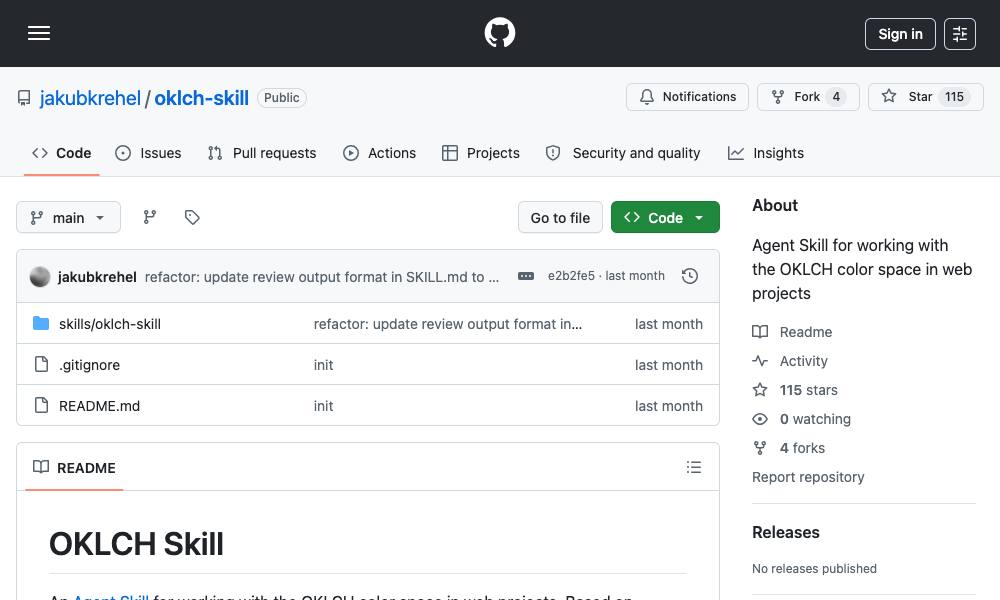
Traditionally, AI agents might struggle with generating harmonious color scales or ensuring color consistency across different contexts, such as light and dark modes. The OKLCH Color Skill equips agents with the ability to perform complex color operations with precision. This includes seamless conversion between various color formats, the generation of uniform palette scales (from light to dark, often denoted by numerical ranges like 50 to 950), and the derivation of sophisticated dark mode colors through intelligent manipulation of lightness values. Crucially, it enables agents to rigorously check color contrast against industry-standard accessibility guidelines, such as WCAG 2 and APCA, ensuring that the generated designs are not only visually appealing but also inclusive. Furthermore, this skill facilitates the creation of robust Tailwind CSS v4 themes by incorporating proper OKLCH color tokens, streamlining the development of modern web interfaces.
Installation and Usage:
To integrate this powerful color management tool, developers can typically use a command-line interface:
npx skills add jakubkrehel/oklch-skill
Once installed, the skill can be invoked with a simple command like /oklch-skill or by describing a color-related task. The AI agent is designed to automatically activate the skill when it encounters color-centric work, ensuring that color decisions are informed by the principles of OKLCH.
This skill is particularly invaluable for projects that rely on custom design tokens or for developers frustrated by AI-generated color combinations that appear acceptable in isolation but falter when applied in different contexts, especially during dark mode transitions. The OKLCH Color Skill provides a systematic and reliable solution to these common design pitfalls.
Embracing Clarity and Structure: The Swiss Design System Skill
The principles of the Swiss International Style, also known as the International Typographic Style, have long been admired for their emphasis on clarity, readability, and objective communication. The Swiss Design System Skill brings this influential design philosophy directly to AI coding agents. This skill trains agents to adopt the characteristic elements of Swiss design, including the use of grotesque sans-serif typography (such as Helvetica, Univers, and Neue Haas Grotesk), strict grid systems for precise layout, generous use of whitespace to enhance readability, and a restrained, deliberate color palette.
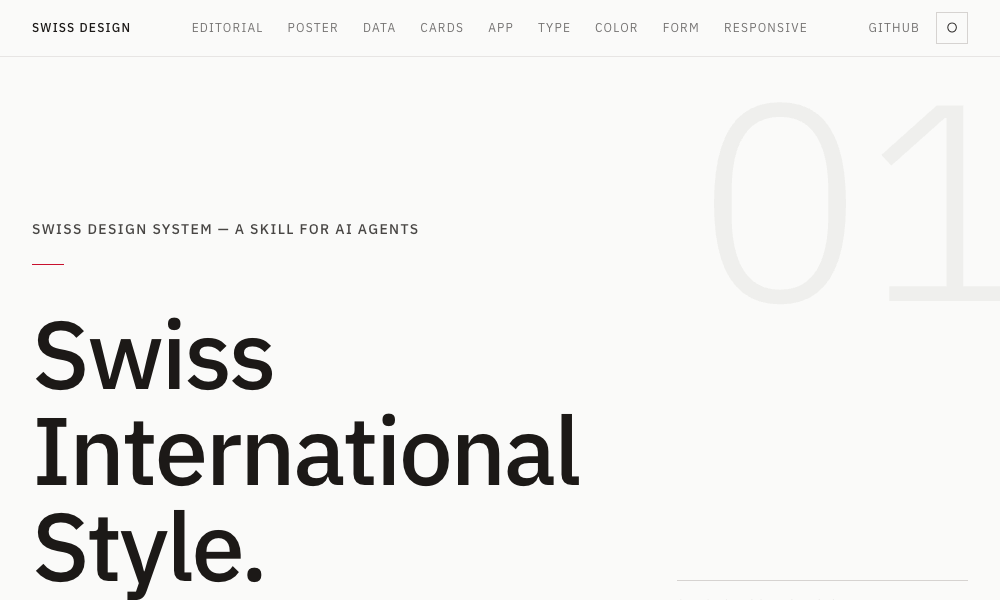
The skill translates these design principles into practical application through Tailwind CSS utility classes. This allows the AI agent to apply the rules of Swiss design consistently across a project using standard web development tools. The skill’s comprehensive nature includes a detailed font specimen ranking that prioritizes fidelity to the original style, references to grid system layouts inspired by the work of Josef Müller-Brockmann, a leading figure in Swiss graphic design, and data reflecting the distinct approaches of the Zurich and Basel schools of design thought.
Installation and Usage:
Integrating the Swiss Design System into an AI agent is straightforward:
npx skills add zeke/swiss-design-skill
To leverage its capabilities, users can instruct their AI agent to construct a layout adhering to the Swiss International Style. The agent will then automatically apply grid discipline, select appropriate grotesque typefaces, and ensure adequate breathing room around content, resulting in layouts that are both structured and aesthetically refined.
This skill is exceptionally well-suited for projects like landing pages, editorial layouts, and any application where clarity, visual hierarchy, and a sense of order are paramount, taking precedence over purely decorative elements.
Enhancing User Experience with Dynamic Transitions: Transitions.dev
User interface transitions play a crucial role in shaping the overall user experience, providing visual feedback, guiding attention, and making interactions feel more fluid and intuitive. The Transitions.dev skill offers a curated collection of nine essential UI transitions, readily available as copy-pasteable code snippets and an installable agent skill. These transitions cover a wide array of common UI elements and interactions, including animated card resizes, engaging number pop-ins with digit flipping and blurring effects, and subtle yet effective notification badge animations with diagonal slides.
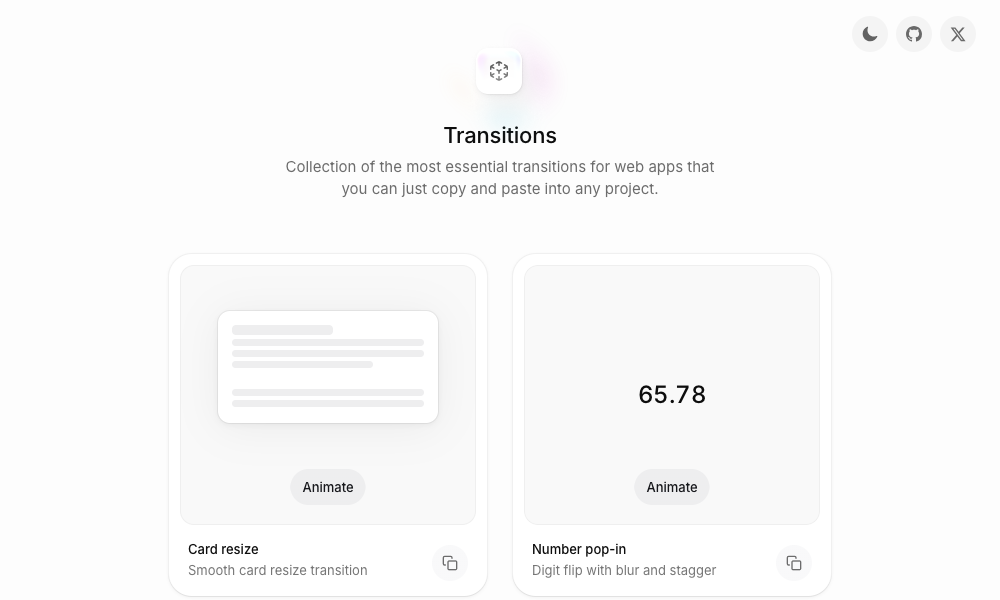
Each transition is meticulously crafted with ready-to-use CSS, enabling AI agents to seamlessly integrate them into a project. The skill is directly generated from the index.html file of the Transitions.dev showcase website, ensuring that the code produced by the AI agent precisely matches the demonstrated effects. This level of fidelity is critical for avoiding common issues where AI-generated modals or elements might appear abruptly without any transitional animation, leading to a jarring user experience.
Installation and Usage:
Developers can integrate Transitions.dev by cloning the repository or referencing the skill directly from its GitHub page: github.com/Jakubantalik/transitions.dev.
Once set up, users can simply mention specific transition patterns they require, and the AI agent will automatically apply the pre-optimized CSS, bringing polished animations to their interfaces. This skill is a powerful tool for developers looking to elevate the interactivity and polish of their web applications.
Democratizing Design Systems: The DESIGN.md Directory
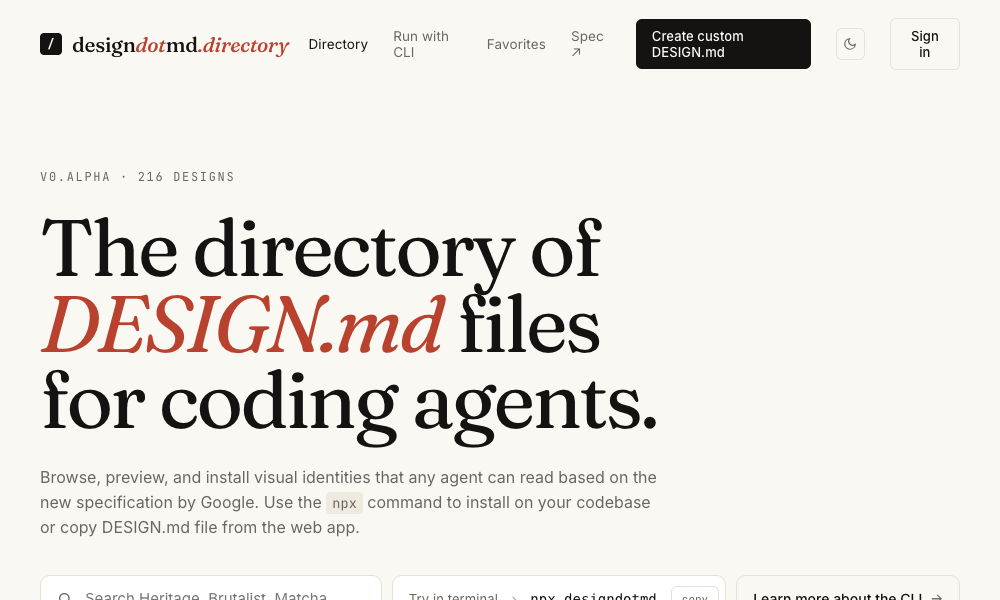
For developers seeking to implement consistent design languages across their projects without the overhead of complex setup, the DESIGN.md Directory presents a highly accessible solution. This curated directory houses a collection of DESIGN.md files, each meticulously crafted to describe a comprehensive design system. These files encapsulate all essential design elements, including color palettes, typography rules, spacing systems, component specifications, and layout principles.
The workflow is remarkably straightforward: users browse the directory, identify a design system that aligns with their aesthetic preferences, and then either download or copy the corresponding markdown file. This DESIGN.md file is then placed directly into the project’s root directory. The AI agent, upon recognizing this file, automatically adopts and applies the specified design language to all subsequent code generation, from individual buttons to entire page layouts.
Key Advantage:
The primary benefit of the DESIGN.md Directory is its low-friction implementation. It bypasses the need for command-line installations, npm packages, or explicit add commands. The design system is effectively activated by the mere presence of the markdown file in the project, making it an exceptionally user-friendly option for quickly establishing a consistent visual identity.
Cultivating Sophistication in AI Design: Agents with Taste
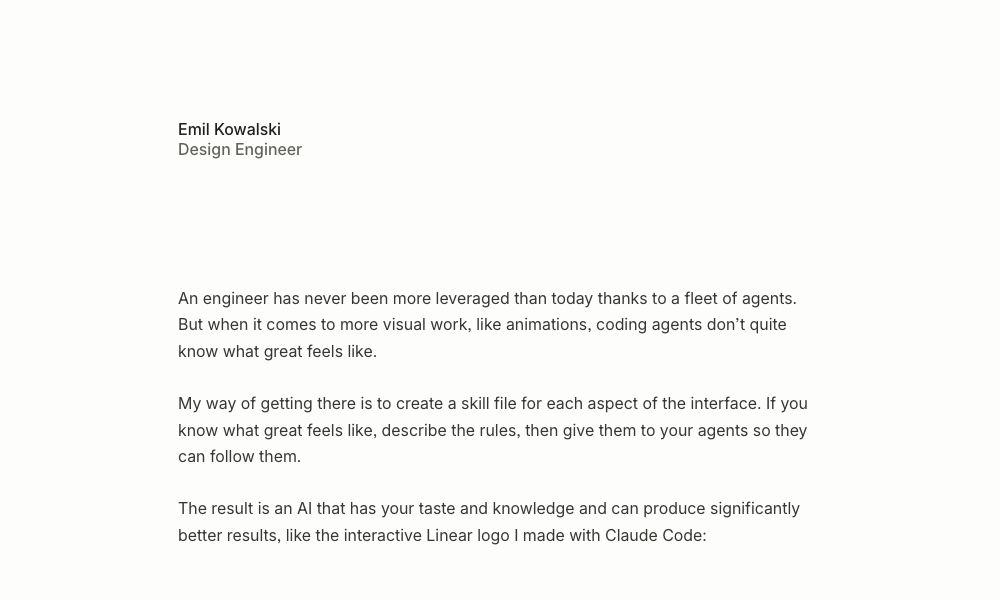
In the pursuit of creating AI-generated interfaces that possess a refined aesthetic, Agents with Taste by Emil Kowalski emerges as a significant contribution. This installable design engineering skill goes beyond surface-level styling, delving into the core principles that underpin sophisticated user interfaces. It encompasses a comprehensive understanding of animation, component design, the selection of appropriate easing curves, duration guidelines for interactions, robust typography rules, and practical advice drawn from the developer’s extensive experience with open-source projects.
The skill is structured to provide AI agents with actionable insights. It includes a table of practical design tips, an intelligent easing decision flowchart that guides agents in selecting the optimal curve based on contextual factors, clear duration guidelines for micro-interactions (typically 100-150ms) and larger elements like modals (200-300ms), and strict typography rules, such as recommending a maximum line length of 65 characters for body text to ensure readability.
Installation and Usage:
To integrate Agents with Taste into an AI coding agent, the following command is used:
npx skills add emilkowalski/skill
Once installed, developers can prompt their agent to refine animations or design new components, and the skill will automatically apply Emil Kowalski’s personal design philosophy. Furthermore, this initiative extends to empowering designers to create their own AI skills. The skill-creator skill, provided by Anthropic, allows users to package their unique design sensibilities into skill files following the same methodology, fostering a decentralized approach to AI design intelligence.
Brand Identity as Code: The Hue App
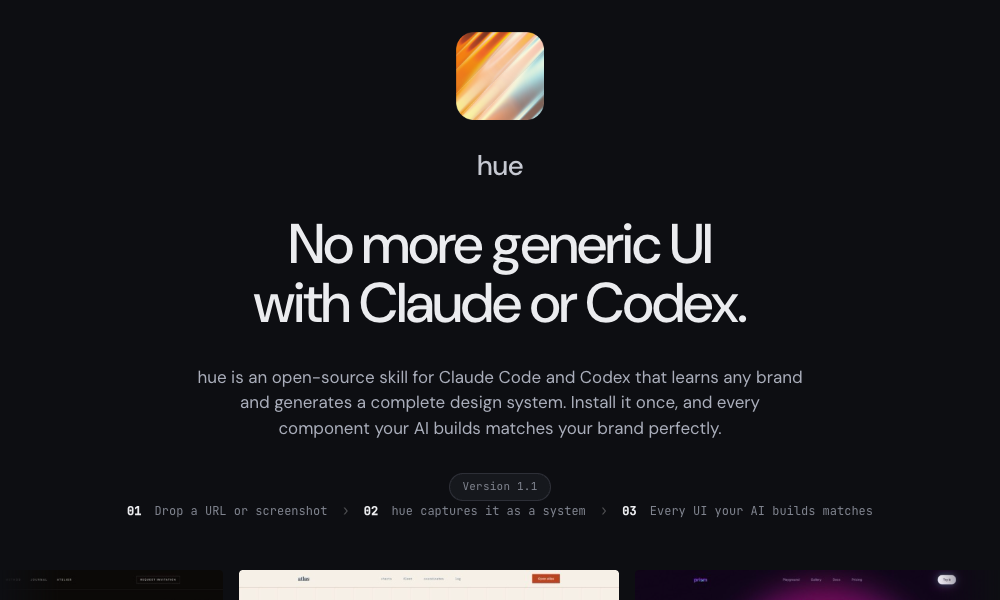
Capturing and translating an existing brand identity into a cohesive design system is a critical task for many projects. The Hue app, an open-source skill developed by Dominik Martin, excels at this by learning any brand’s identity from a URL, name, or screenshot and subsequently generating a complete design system. Whether the target is the sleek interface of Cursor.com, the minimalist elegance of Raycast, or any other brand, Hue can produce a comprehensive design system. This includes color tokens, typography scales, spacing definitions, component guidelines, dark mode support, and even icon recommendations.
Hue comes pre-loaded with 17 example brand systems, ranging from "Atlas" (evoking ivory engineering and classical maritime aesthetics) to "Velvet" (representing a noir editorial fragrance house). Each example includes a design-model.yaml file and a landing-page.html demonstrating the rendered design system. This provides a tangible showcase of the skill’s capabilities and serves as a valuable starting point for users.
Installation and Usage:
The Hue app can be installed by cloning its GitHub repository:
git clone https://github.com/dominikmartn/hue ~/.claude/skills/hue
To utilize its brand-learning capabilities, users can issue commands such as "Make a design skill from cursor.com" or "Create a design language inspired by Raycast." The AI agent will then guide the user through the analysis process and generate the corresponding design skill.
For projects that require strict adherence to an existing brand identity rather than the creation of a novel one, Hue offers the most practical and efficient solution. It automates a complex process, ensuring brand consistency and accelerating the design system development lifecycle.
Visualizing and Implementing Design: Refero Styles
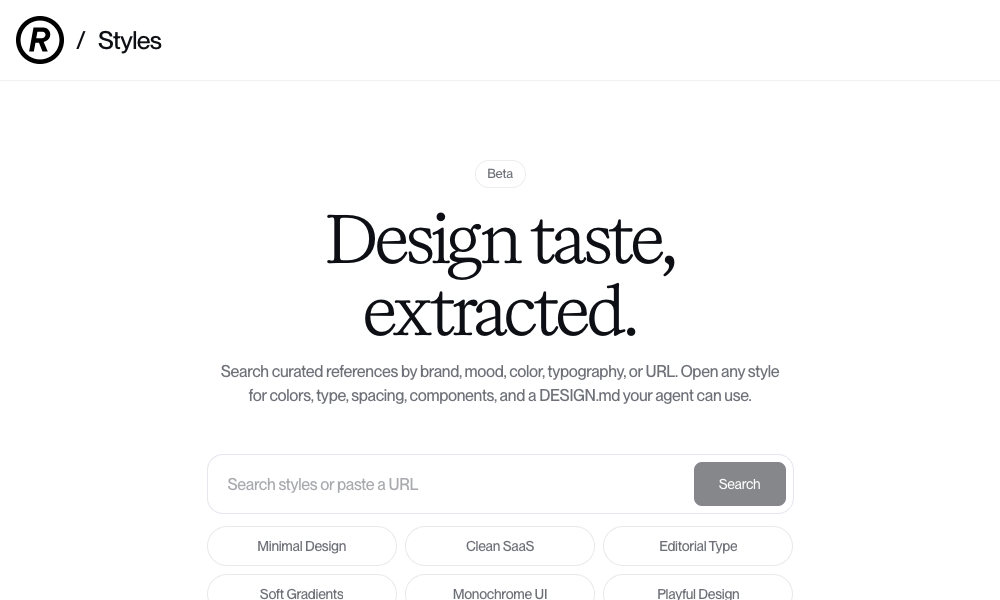
Bridging the gap between design inspiration and practical implementation, Refero Styles functions as a powerful visual search engine for design references and an integrated agent skill. Users can search for design inspiration based on brand, mood, color, typography, or by simply pasting a URL. For each search result, Refero provides a detailed style breakdown, including colors, typography, spacing, component definitions, and, crucially, a DESIGN.md file that AI agents can directly utilize.
The underlying technology of Refero Styles grants AI agents access to an extensive library of over 150,000 real application screens and 6,000 user flows from prominent products such as Stripe, Linear, Notion, and Figma. This vast repository of real-world design patterns offers unparalleled context and inspiration for AI-driven design.
Usage:
The process is intuitive: users search for a style that resonates with their project’s needs, open any result to access its DESIGN.md file, and then copy this file into their project. Upon doing so, the AI agent instantly adopts and applies the specified design language.
Refero also offers an MCP server that directly connects AI agents to its reference library, enabling them to pull real product interface patterns on demand during the development process. This dynamic integration allows for a highly responsive and context-aware design workflow.
Specialized Design for AI and Beyond: TypeUI Design Skills
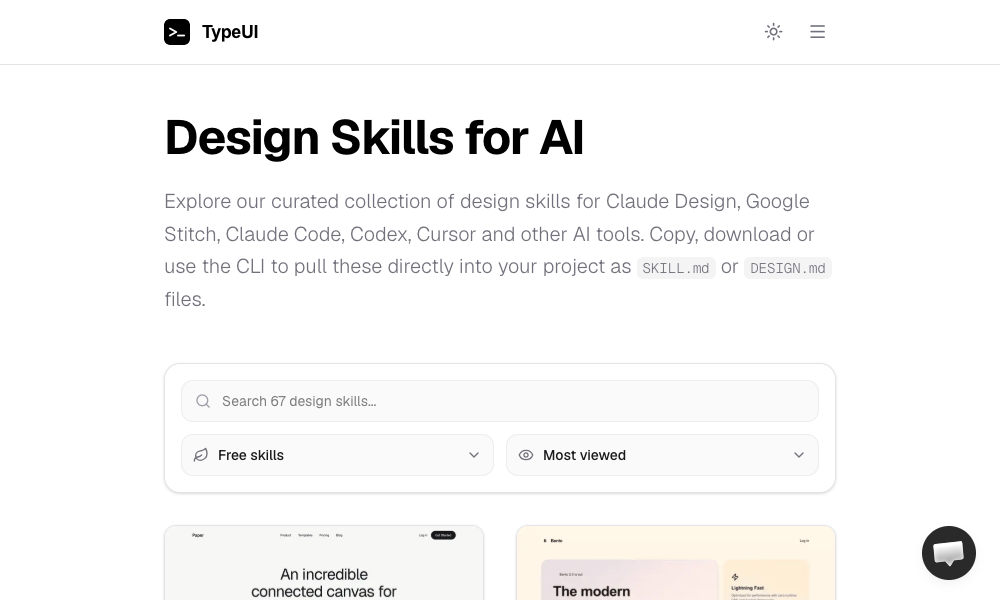
TypeUI Design Skills presents a diverse collection of design skills meticulously optimized for various AI platforms, including Claude Design, Google Stitch, Claude Code, Codex, and Cursor. Each skill is delivered as an optimized SKILL.md or DESIGN.md file, equipping AI agents with specific design styles. The TypeUI platform allows users to browse a gallery of these designs, select a desired aesthetic, and then easily copy-paste the relevant file, download it, or utilize their command-line interface (CLI) for integration.
Installation and Usage:
The TypeUI CLI provides a convenient way to manage these skills:
npx typeui.sh pull [name]
Users can browse the gallery, select a design, pull it into their project, and from that point forward, their AI agent will generate all output adhering to the chosen aesthetic. A notable feature of TypeUI is its support for OpenClaw agents, meaning these design skills are compatible with locally run AI agents, offering a flexible solution for a wide range of development environments.
Comprehensive Design System Generation: UI/UX Pro Max Skill
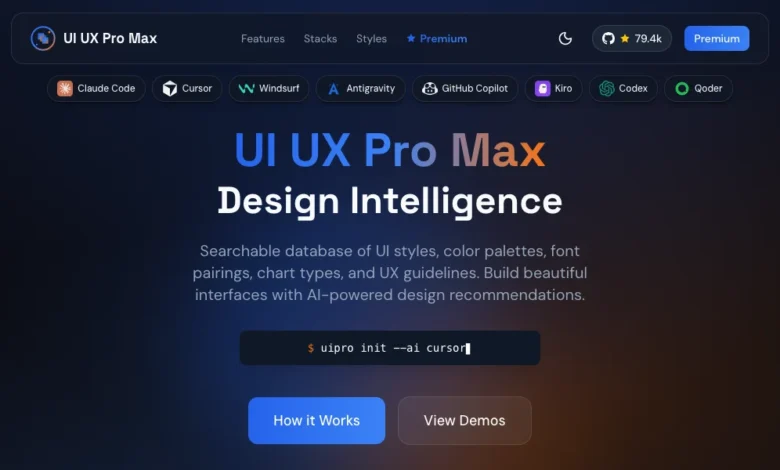
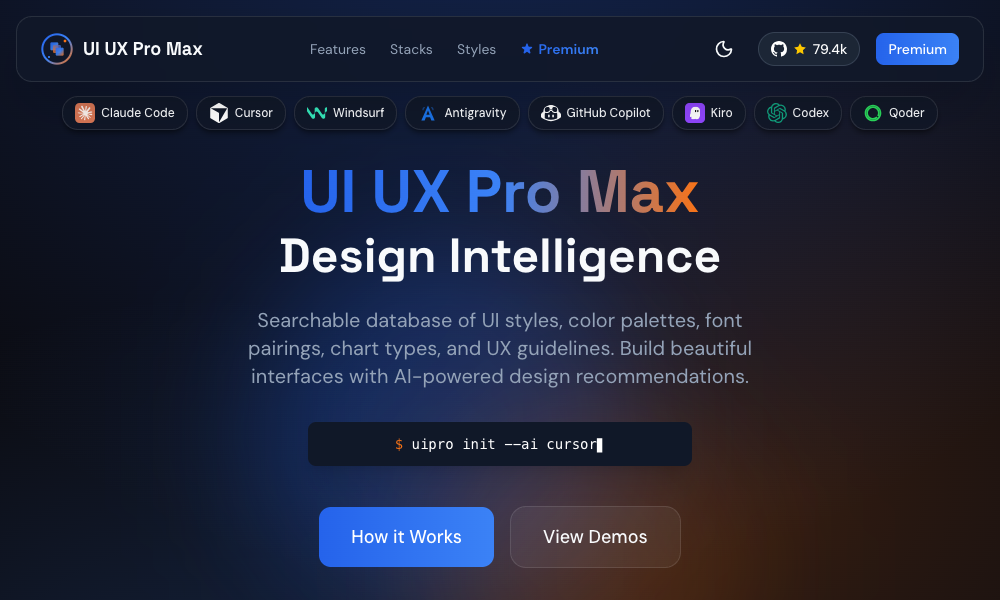
For a more comprehensive and integrated approach to design system creation, the UI/UX Pro Max Skill stands out. This powerful design skill boasts an extensive set of 161 reasoning rules and encompasses 67 distinct UI styles. Its flagship feature is the Design System Generator, which allows users to describe their project’s requirements, and in response, the generator constructs a complete design system. This system includes predefined layout patterns, color schemes, typography hierarchies, effect guidelines, and a list of elements or practices to avoid.
The UI/UX Pro Max Skill demonstrates remarkable versatility by supporting multiple frameworks and technology stacks, including HTML with Tailwind CSS, React, and Next.js. It is also fully compatible with AI agents integrated into VS Code, such as Claude Code, Cursor, Windsurf, Copilot, and Codex.
Installation and Usage:
The skill can be initialized within any project using:
npx ui-pro init
Alternatively, for global access, users can install the CLI globally:
npm install -g uipro-cli
To utilize the generator, users simply describe their project, for instance, "a premium tour booking app." The generator will then recommend a complete design system, encompassing patterns, styles, colors, typography, and user experience rules. The skill also includes a sophisticated search script for discovering design references based on specific queries and domains, further enhancing its utility.
While considered the most comprehensive option on the list, UI/UX Pro Max is also the most resource-intensive. However, for developers seeking a single skill that manages the entire design system workflow, from initial requirement analysis to the final component output, this tool offers an unparalleled level of completeness.
Designing for the AI Era: AI UX Playground
As AI products become increasingly sophisticated and integrated into our daily lives, the design of their user experiences (UX) requires specialized considerations. The AI UX Playground addresses this emerging need by providing a library of AI-specific UX design patterns tailored for platforms like ChatGPT, Claude, Perplexity, and Cursor. Each pattern within the playground is meticulously documented, including detailed examples, use cases, and platform-specific instructions for implementation across various AI tools such as ChatGPT, Claude, Google Gemini, Cursor, and others.
Usage:
Users can navigate the pattern library, identify the specific UX pattern required for their AI product, and then follow the platform-specific instructions for its application. Each pattern is enriched with real-world examples from prominent AI products and offers practical tips for successful implementation within the user’s own tooling.
While not focused on visual polish in the same vein as other design skills, the AI UX Playground is instrumental in developing intuitive and effective user experiences for AI-powered applications. It provides a foundational understanding of how to design interfaces that are not only functional but also align with the unique interaction paradigms of artificial intelligence.
The Future of Design is Executable
The landscape of AI-driven design is still in its nascent stages, and while the tools presented here represent significant advancements, users should anticipate encountering "rough edges" as the technology matures. However, the trajectory is undeniably clear: design knowledge is transitioning from static documents that require human interpretation to dynamic, executable rules that AI agents can directly process and implement.
For designers and developers alike, the ability to craft these executable rules will be paramount in shaping the future of AI-generated creations. The skills and resources outlined in this article serve as a crucial starting point for those looking to harness the power of AI for design. By experimenting with these tools, installing them, and observing the distinct outputs their AI agents produce, professionals can begin to understand and contribute to this evolving paradigm, ultimately influencing the aesthetic and functional quality of the digital experiences of tomorrow.