The Disconnect Between AI Enthusiasm and User Reality: Why People Don’t Necessarily Want More Artificial Intelligence

A pervasive assumption within many organizations is that the public is clamoring for more artificial intelligence (AI) in their daily lives. This belief fuels a relentless pursuit of new AI features, products, and workflows, often presented as transformative solutions poised to revolutionize existing practices and address long-standing inefficiencies. However, a growing body of evidence and user sentiment suggests a stark contrast between this corporate vision and the actual desires of individuals. The reality, as highlighted by insights from Design Patterns For AI Interfaces, is that many people do not actively seek out more AI, particularly when it is implemented in ways that disrupt rather than enhance their established routines.
This disconnect has led to a significant AI adoption gap, with numerous AI-driven features exhibiting low user engagement and retention rates, despite substantial investment in their development and deployment. The cost of delivering these features is often high, and the risk of reputational damage from poorly received or ineffective AI integrations is a considerable concern for businesses.
The AI That Users Don’t Need: A Critical Examination
The notion that "AI is not a value proposition" in itself is a critical point often overlooked by senior leadership. While AI possesses immense potential, simply integrating AI capabilities into products or services does not automatically translate into user satisfaction or excitement. Frequently, AI features are introduced as add-ons or separate tools, compelling employees to step outside their familiar and optimized work processes. This can lead to a feeling of displacement and inefficiency, as users are forced to learn and navigate new, often disjointed, systems.
AI’s capacity to amplify existing organizational shortcomings, such as data quality issues or flawed decision-making processes, is another significant challenge. It cannot magically rectify years of accumulated technical debt, cultural inconsistencies, or internal political complexities. Instead, AI can inadvertently make these underlying problems more apparent, presenting users with inconsistencies, conflicting priorities, and a burden of interpretation that falls squarely on their shoulders.
In most organizational environments, work typically involves a complex interplay between numerous disconnected and fragmented systems. The introduction of yet another AI tool often means adding another system to the user’s already demanding routine of switching between applications. This can paradoxically increase workload and is rarely perceived as rewarding.
Furthermore, users are increasingly aware of the substantial effort and cost associated with identifying and rectifying "AI hallucinations" – instances where AI generates incorrect or nonsensical outputs. While generating a response with AI might appear quicker than writing from scratch, this perceived ease comes at the cost of diligent oversight and correction.
A Business Model Canvas, annotated with markers, illustrates this point effectively. The diagram designates "AI goes here" for Key Activities and Key Resources, while explicitly marking "not here" for Value Propositions. This visually reinforces the argument that AI should be a component that supports value creation, not the value proposition itself.

The Unsolicited Arrival of AI and Growing Apprehension
For many individuals, AI features do not arrive as a proactive choice or an opportunity for exploration. Instead, they are often implemented unilaterally, dictated by organizational timelines and priorities. This top-down approach, coupled with widespread media narratives emphasizing AI’s potential to displace jobs, fosters an environment of apprehension rather than excitement. Consequently, the perception of AI is often characterized by resistance to change and a deep-seated anxiety about one’s future role in a rapidly evolving landscape.
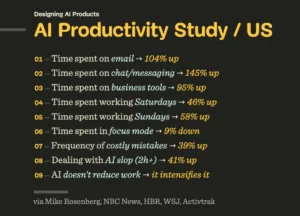
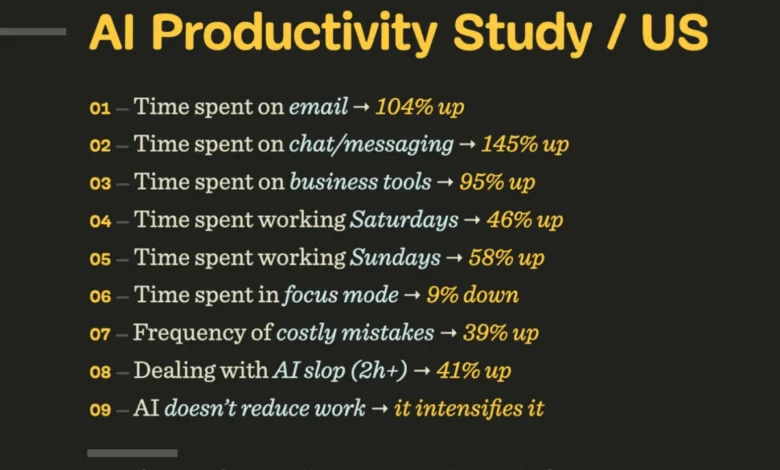
A comprehensive AI productivity study, as reported by various reputable news outlets including NBC News, HBR, and WSJ, based on data from Activtrak, revealed a concerning trend. The findings indicated that while AI tools were introduced with the promise of efficiency, they often led to an intensification of work. The study noted significant increases in time spent on email (up 104%), chat/messaging (up 145%), and business tools (up 95%). Alarmingly, it also showed an increase in working Saturdays (up 46%) and Sundays (up 58%), while time spent in focus mode decreased by 9%. Moreover, costly mistakes rose by 39%, and the effort required to deal with "AI slop" (erroneous or low-quality AI output) increased by 41%. The overarching conclusion from this study was stark: "AI doesn’t reduce work. It intensifies it."
At best, AI features are passively accepted, met with a resigned nod. At worst, they provoke significant concerns, doubts, and a healthy skepticism. The unpredictable and unreliable nature of AI, unlike more established technological features, can position it as a threat or a liability in the eyes of users.
The public’s aspirations do not typically revolve around embracing AI art museums, AI-powered refrigerators, AI hotel receptionists, or AI-narrated children’s books. The idea of AI romantic partners or the prospect of actively managing a "swarm of AI agents" operating on personal financial accounts is also met with significant apprehension. The desire for constant interaction with a "magical box" to input commands or receive information is not a widespread human longing.

The AI That Users Actually Need: Reliability and Augmentation
The frequent comparison of AI’s unreliability to human fallibility misses a crucial point: users do not compare software features to human performance. Instead, they benchmark features against other software features. If one AI-powered feature within a product proves unreliable while a similar feature in a competing product functions flawlessly, users will naturally gravitate towards the latter. The critical factor is not the presence of AI, but the consistent and dependable performance of the feature itself.
Much of the discourse surrounding AI focuses on the speed of delivery. However, for many users, an increased speed of delivery holds little intrinsic value if it compromises the quality of the work or the thoughtful decision-making process. Individuals desire to perform tasks effectively and efficiently, with adequate time for contemplation and sound judgment. There is a deep-seated need to find satisfaction and a sense of accomplishment in their work, a feeling that can be eroded by constant, superficial changes driven by technological trends rather than genuine user benefit.
Human nature remains remarkably consistent. After years of technological evolution, people continue to seek features that are fast, accessible, reliable, predictable, and useful – every single time. The ideal AI integration is not one that completely overhauls an entire workflow, but rather one that augments existing processes, taking over the most mundane, tedious, and uninspiring tasks.
Data from The Washington Post, analyzing research from GovAI and the Brookings Institution, provides insights into the jobs most vulnerable to AI automation. While many roles face exposure, the article highlights that even within these roles, there are rewarding, unique, and creative aspects that demand human taste, perspective, and intuition. When AI can effectively automate the more tedious elements of these jobs, it becomes a clear advantage, enhancing productivity and contributing to a more enjoyable daily experience.

The true value of AI becomes more apparent when it automates tasks that are both tedious and mentally draining. For this to be successful, AI must be deeply integrated into users’ existing workflows, rather than feeling like an extraneous addition. Crucially, AI systems must align with the mental models that users have developed and refined over years, or even decades. AI should adapt to how individuals think and make decisions, not force users to fundamentally alter their cognitive processes.
The branding of these features – whether as "AI," "smart," or "automation" – is secondary to their performance. The paramount requirement is that they function effectively for the users. This necessitates clear communication about the use cases where AI genuinely assists individuals, inspiring them to discover further applications independently.
Ironically, the most effective AI-driven tools are often not "AI-first" but rather "AI-second." They operate subtly, humbly, calmly, and ambiently, assuming a supportive role in the background to alleviate work that is otherwise dull and unnecessary.
As articulated by Bo Young Lee, "I don’t want to read books written by AI. I don’t want to gaze upon paintings by AI. I don’t want AI to teach my children. I don’t want to have an AI therapist. I don’t want AI making my medical decisions. I want AI to do all the physical and mental labor that taxes me so I can read books written by humans and go to art galleries to engage with art made by humans. I want AI that makes my life easier rather than forces me to change myself." This sentiment encapsulates a widespread desire for AI to serve as a tool for liberation from drudgery, enabling greater engagement with human-created art, literature, and interpersonal relationships.

Conclusion: Redefining AI’s Role in Human Lives
While the broader implications of AI are still unfolding, and the speed of technological advancement can be dizzying, a fundamental human element often gets overlooked. The inherent value of human interaction, stories, thoughts, emotions, enthusiasm, and laughter remains paramount. While AI can be exceptionally helpful in numerous scenarios, it cannot replicate the richness and depth of human connection. In situations where a choice exists, spending time with a human, imperfections notwithstanding, is overwhelmingly preferred.
The assertion that people do not need more AI in their lives is not a rejection of the technology itself, but a call for its intelligent application. What individuals truly need is AI that automates the mundane, repetitive, and unengaging aspects of their daily routines. This would free up their time and mental energy to pursue activities they genuinely enjoy and find fulfilling, ultimately leading to more meaningful interactions with loved ones and a greater sense of personal satisfaction. This shift in focus does not imply increased time spent interacting with AI, but rather more quality time with the people who matter most.
To facilitate a deeper understanding of how to design AI interfaces that truly serve users, Vitaly’s new video course, "Design Patterns For AI Interfaces," offers practical examples from real-world applications. This comprehensive resource aims to guide designers and developers in creating AI-powered experiences that are intuitive, effective, and augment rather than disrupt human workflows. A live UX training session is also scheduled, providing an opportunity for hands-on learning and expert guidance. A free preview is available for those interested in exploring the course content further.