Computer vision has undergone a monumental structural evolution, transitioning rapidly from traditional object detection and image classification into a deeply integrated discipline sitting at the crossroads of foundation models, spatial computing, and specialized embedded hardware. As we navigate through 2026, the industry no longer relies merely on engineers who can train standard Convolutional Neural Networks (CNNs) in isolated laboratory environments. Instead, modern computer vision (CV) engineers are expected to build comprehensive, production-grade systems capable of perceiving, reasoning over, and reacting to the dynamic visual world in real-time latency windows.
Industry demand for full-stack practitioners who possess a deep, granular understanding of the complete vision pipeline—ranging from physical optical sensors down to ultra-low-power production inference—is experiencing unprecedented growth. This surge is propelled by the rapid commercial expansion of autonomous driving fleets, intelligent robotic warehouses, automated medical imaging diagnostics, and spatial computing operating systems. These diverse verticals share a unified engineering requirement: professionals who grasp not just high-level model architectures, but the complex mechanics of getting those models to execute efficiently at scale.
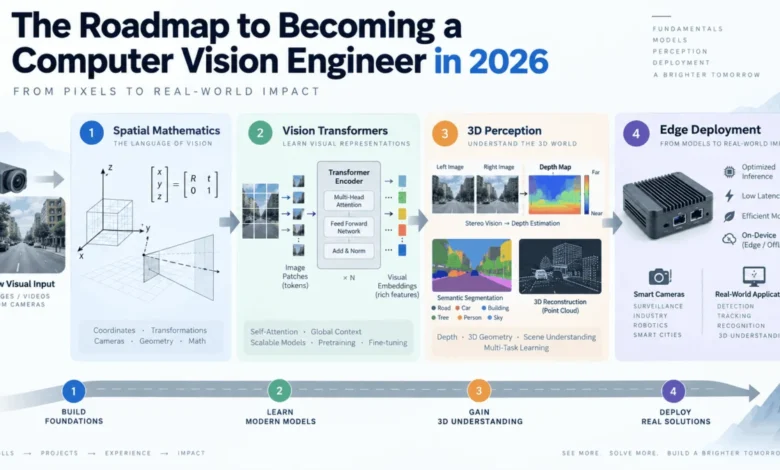
Addressing this expanding skill gap requires a structured, multi-phase technical curriculum. By breaking down the discipline into four progressive tiers—starting with foundational spatial mathematics and advancing toward edge hardware optimization—engineers can systematically master the modern CV landscape.
The Evolution of Computer Vision: From Pixels to Spatial Reasoning
To understand the modern CV engineering stack, it is essential to review the technological shifts that defined the early 2020s. Historically, computer vision education focused heavily on classical image processing and standard supervised learning using static datasets. However, the paradigm shifted dramatically with the introduction of Vision Transformers (ViTs) and multimodal architectures like CLIP, which bridged the cognitive gap between unstructured text and visual representations.
By 2025 and into 2026, the baseline expectation for computer vision systems shifted from passive observation to active spatial reasoning. Autonomous systems must now construct continuous 3D representations of their environments, process hundreds of frames per second from multi-camera arrays, and make split-second safety-critical decisions on resource-constrained edge hardware. This evolution has transformed the career trajectory of computer vision professionals, demanding a blend of heavy mathematical rigor, systems-level software engineering, and hardware-aware optimization.
Stage 1: Spatial Mathematics and Foundation Vision Primitives
At its core, every computer vision system is fundamentally a geometric reasoning engine. Before engineers can successfully implement advanced transformer models or neural rendering pipelines, they must master the underlying mathematical principles that govern how cameras capture and interpret the physical world.
The curriculum at this foundational stage centers on matrix transformations, coordinate frame transformations, projective geometry, and multi-view geometry. These concepts are directly applicable to production systems, determining how a digital camera projects a three-dimensional scene onto a two-dimensional sensor plane, how multi-camera rigs calculate precise depth maps, and how spatial data is synchronized across disparate sensors.
import torch
import albumentations as A

# Example of a modern PyTorch and Albumentations data augmentation pipeline
transform = A.Compose([
    A.RandomCrop(width=256, height=256),
    A.HorizontalFlip(p=0.5),
    A.RandomBrightnessContrast(p=0.2),
])

# Simulating tensor manipulation in PyTorch
image_tensor = torch.randn(3, 512, 512)
print(f"Initialized tensor shape for vision backbone: image_tensor.shape")
On the software implementation side, fluency in PyTorch remains the non-negotiable industry standard for tensor manipulation, model training, and research prototyping. This is paired with sophisticated synthetic data augmentation workflows utilizing libraries such as Albumentations, which allows engineers to simulate severe lighting variations, geometric distortions, and object occlusions without necessitating expensive data collection campaigns.
The third pillar of this initial stage is feature representation. Engineers must clearly understand the operational differences between traditional convolutional backbones—such as ResNet and EfficientNet—and modern attention-based architectures. Furthermore, contrastive representation learning has become a critical technique, allowing models to learn robust embeddings by comparing positive and negative sample pairs prior to downstream fine-tuning.
Stage 2: Vision Transformers and Multimodal Foundation Models
The rapid displacement of traditional CNNs by transformer-based architectures has fundamentally altered what is expected of a computer vision practitioner. Vision Transformers process images by splitting them into sequences of fixed-size spatial patches, subsequently applying multi-head self-attention mechanisms across those patches rather than relying on local convolutional receptive fields. The subsequent development of Swin Transformers introduced hierarchical, windowed attention mechanisms, making transformer architectures computationally viable for high-resolution input streams.
Concurrently, the rise of Vision-Language Models (VLMs) has democratized open-vocabulary visual understanding. Pioneering models such as CLIP and SigLIP utilize contrastive training paradigms on massive, web-scale image-text datasets to learn shared joint embedding spaces. Consequently, modern CV systems are no longer strictly limited to closed sets of pre-trained class labels; instead, they can interpret and query visual environments using arbitrary natural language prompts.
import torch
from PIL import Image
from transformers import AutoProcessor, AutoModelForZeroShotObjectDetection

# Initializing a Grounding DINO model for open-vocabulary detection
model_id = "IDEA-Research/grounding-dino-tiny"
processor = AutoProcessor.from_pretrained(model_id)
model = AutoModelForZeroShotObjectDetection.from_pretrained(model_id)

# Processing a scene with natural language prompts
image = Image.open("industrial_scene.jpg")
text_prompt = "a robotic arm. a safety barrier."

inputs = processor(images=image, text=text_prompt, return_tensors="pt")
outputs = model(**inputs)
print("Open-vocabulary object detection inference executed successfully.")
This capability underpins open-vocabulary object detection frameworks like OWL-ViT and Grounding DINO, which enable precise object localization based purely on textual descriptions. Similarly, Meta’s Segment Anything Model 2 (SAM 2) provides promptable, zero-shot segmentation capabilities across both static images and complex video streams. By providing a sparse spatial prompt—such as a bounding box, point, or text tag—engineers can generate high-fidelity segmentation masks without requiring task-specific fine-tuning.
Stage 3: Three-Dimensional Vision, Neural Rendering, and Spatial Perception
As computer vision applications transition from simple 2D image understanding to complex spatial awareness, the required engineering skillset expands into 3D geometry and neural rendering. This stage addresses the advanced mathematical representations and computational algorithms that allow systems to reconstruct and interact with three-dimensional space.
Primary 3D representations include point clouds, voxel grids, and signed distance fields (SDFs). Each format presents distinct memory footprints, computational bottlenecks, and downstream application suitability. While point clouds serve as the native output format for LiDAR systems and Structure-from-Motion (SfM) pipelines, voxel grids provide structured spatial indexing at the expense of memory consumption. SDFs, conversely, represent continuous geometric surfaces, facilitating differentiable rendering techniques.
Monocular depth estimation has similarly been revolutionized by models like Depth Anything v2, which generates precise relative and metric depth profiles from a single standard RGB image without the aid of dedicated depth sensors. In the realm of neural rendering, Neural Radiance Fields (NeRFs) and 3D Gaussian Splatting have transformed novel view synthesis. 3D Gaussian Splatting, in particular, has largely superseded traditional NeRFs in real-time production environments, enabling interactive rendering rates on standard consumer-grade hardware.
import numpy as np
import open3d as o3d

# Reconstructing a 3D point cloud from a depth map and known camera intrinsics
depth = np.load("estimated_depth_map.npy")
fx, fy, cx, cy = 525.0, 525.0, 319.5, 239.5

h, w = depth.shape
u, v = np.meshgrid(np.arange(w), np.arange(h))
z = depth
x = (u - cx) * z / fx
y = (v - cy) * z / fy

points = np.stack([x, y, z], axis=-1).reshape(-1, 3)
pcd = o3d.geometry.PointCloud()
pcd.points = o3d.utility.Vector3dVector(points)
o3d.io.write_point_cloud("spatial_output.ply", pcd)
print("Point cloud successfully generated and exported.")
For robotics and autonomous navigation, this spatial tier also encompasses Visual Odometry (VO) and Simultaneous Localization and Mapping (SLAM). These algorithms empower autonomous agents to calculate their precise real-time positioning while incrementally mapping unfamiliar environments using visual sensor inputs alone.
Stage 4: Inference Optimization and Edge Deployment
The final stage of the modern computer vision curriculum bridges advanced machine learning research with rigorous systems engineering. A high-performing model trained on a multi-GPU workstation is fundamentally useless if it cannot be deployed reliably within strict hardware, thermal, and latency constraints.
Model compression forms the primary defense against hardware limitations. Techniques such as post-training quantization (PTQ) and quantization-aware training (QAT) reduce numerical precision from 32-bit floating-point (FP32) down to 8-bit integers (INT8) or lower, drastically shrinking memory footprints with negligible accuracy degradation. Pruning removes redundant network weights, while knowledge distillation transfers predictive capabilities from massive teacher models down to compact, resource-efficient student models.
import tensorrt as trt

# Loading a serialized TensorRT engine for optimized edge inference
logger = trt.Logger(trt.Logger.WARNING)
with open("optimized_model.trt", "rb") as f, trt.Runtime(logger) as runtime:
    engine = runtime.deserialize_cuda_engine(f.read())

context = engine.create_execution_context()
input_shape = context.get_tensor_shape("input")
print(f"Successfully loaded TensorRT engine with input tensor shape: input_shape")
Hardware execution frameworks are critical at this stage. NVIDIA TensorRT and ONNX Runtime serve as the premier deployment backends for GPU and CPU infrastructures, respectively. Meanwhile, Intel OpenVINO optimizes execution for x86 CPUs, integrated graphics, and specialized Vision Processing Units (VPUs). For embedded edge devices—such as NVIDIA Jetson modules, Apple Silicon Neural Engines, and Raspberry Pi AI accelerators—engineers must master hardware-specific compilation and memory management.
Furthermore, high-throughput, multi-camera streaming introduces complex pipeline engineering challenges. Managing RTSP video stream ingestion, synchronizing frames across disparate hardware clocks, batching inputs efficiently, and maintaining consistent 30+ frames-per-second throughput under heavy production loads requires advanced systems design. Toolkits like NVIDIA DeepStream provide the necessary framework for constructing GPU-accelerated video analytics pipelines at scale.
Broader Industry Implications and Future Outlook
The maturation of computer vision engineering into a full-stack discipline carries profound economic and industrial implications. As autonomous systems, intelligent manufacturing facilities, and automated healthcare diagnostics transition from experimental pilots into ubiquitous commercial infrastructure, the demand for qualified technical talent will only accelerate. Organizations can no longer afford to silo machine learning researchers away from systems engineers; the complexity of modern vision-language models and spatial computing hardware demands multidisciplinary expertise.
For aspiring practitioners and working professionals alike, navigating this landscape requires deliberate, methodical skill acquisition. By mastering spatial mathematics, adapting to transformer architectures, understanding 3D spatial perception, and rigorously optimizing models for edge deployment, engineers can position themselves at the forefront of the artificial intelligence revolution. The path is challenging, but the technical frameworks established today will define the visual capabilities of autonomous systems for decades to come.