The Unseen Threshold: AI’s Gifts, the New Landscape, and the Human Element of Authority

The advent of Artificial Intelligence (AI) has undeniably reshaped the professional and personal landscape, presenting a unique juncture where the excuses for stagnation have evaporated, leaving behind only the profound imperative of permission and action. This technological tidal wave, while often discussed in terms of its capabilities, has fundamentally altered the barriers to entry for numerous endeavors, effectively democratizing access to expertise and efficiency. However, the true challenge lies not in the tools themselves, but in the human response to the vast, uncharted territory they have revealed.
The personal journey of leaving familiar spaces for the unknown is a recurring theme in human development. The author’s own experience, leaving home at 17 for college, illustrates this fundamental principle: the safety of the known versus the daunting, yet expansive, potential of the unknown. AI has, in essence, simultaneously thrown open a door for billions, a threshold that many are only beginning to comprehend. The conversations surrounding this seismic shift often focus on the immediate utility of AI, overlooking the deeper implications for individual agency and the future of value creation.

The Four Gifts of Artificial Intelligence
At its core, AI is not a deceptive force; its contributions are tangible and measurable, offering a suite of powerful tools that democratize capabilities previously reserved for a select few. These gifts, while revolutionary, usher in an era of unprecedented opportunity and competition.
1. Unearned Expertise: Bridging the Skill Gap
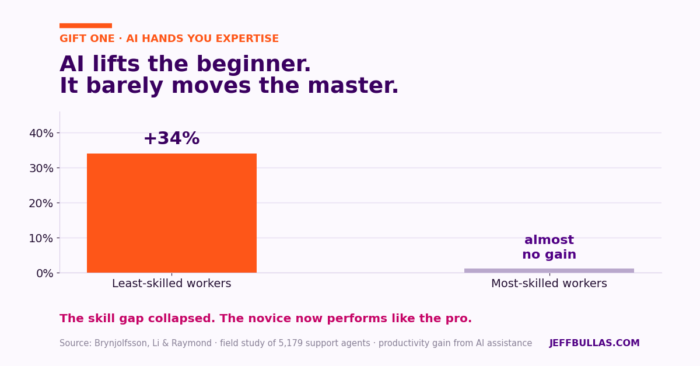
One of AI’s most significant contributions is the immediate bestowal of expertise, effectively leveling the playing field for novices. Research from institutions like Stanford and MIT has provided compelling evidence for this phenomenon. A study involving over 5,000 customer support workers found that those who utilized an AI assistant experienced an average productivity increase of 14%. Critically, the least skilled workers saw the most dramatic improvements, with a 34% boost, while experienced workers saw minimal gains. This disparity highlights AI’s role as a powerful equalizer, providing beginners with the patterns and knowledge typically acquired through years of dedicated practice, thereby collapsing the skill gap in foundational tasks.
2. The Demise of Friction: Accelerating Creation
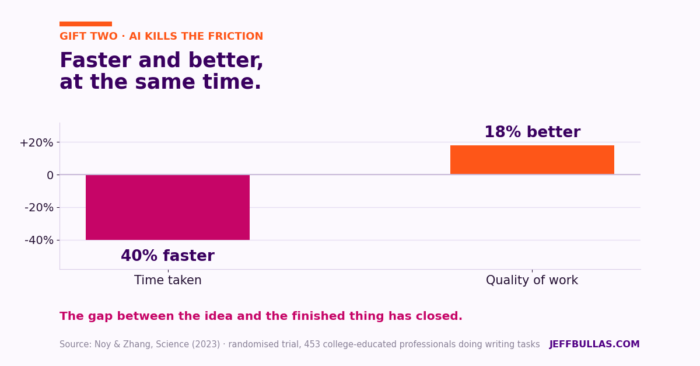
The distance between an idea and its execution has been drastically shortened by AI. A controlled trial published in Science involving 453 professionals undertaking writing tasks demonstrated that those equipped with AI tools like ChatGPT completed their work 40% faster while simultaneously improving quality by 18%. This dual benefit of speed and enhanced output signifies a profound reduction in the friction inherent in many creative and productive processes. The ability to rapidly iterate, refine, and produce content significantly lowers the barrier to entry for individuals and organizations alike.
3. The Simplification of Complexity: Democratizing Sophistication
Tasks that once demanded extensive teams, substantial budgets, and years of specialized training are now becoming accessible through AI. Complex analytical processes, intricate coding, and sophisticated research can now be initiated with a well-phrased prompt. This collapse of complexity transforms daunting challenges into manageable projects, empowering individuals to tackle sophisticated endeavors that were previously out of reach. The democratization of these capabilities has the potential to spur innovation across a multitude of sectors.
4. The Gift of Permission: Unleashing Personal Ventures
Perhaps the most profound, yet often overlooked, gift of AI is the liberation it offers for individuals to embark on their own ventures. Traditional obstacles such as lack of capital, insufficient skills, limited team capacity, or a lack of clear direction have been significantly undermined by AI’s capabilities. AI can generate business plans, draft marketing copy, create initial designs, and provide strategic insights, effectively neutralizing many of the commonly cited reasons for not pursuing personal projects or entrepreneurial ambitions. This shifts the primary barrier from a lack of resources or skills to a question of personal volition.
The Core Barrier: The Problem of Permission
With the external barriers dramatically lowered, the critical impediment that remains is internal: the problem of permission. The author’s assertion that "everything standing in your way is behind your own eyes" underscores a fundamental truth. The decision to step through the door of opportunity, to embrace the unknown, and to act on potential is a deeply personal one. AI can equip individuals with the tools and knowledge, but it cannot grant the inherent permission to pursue a new path or to invest oneself in a nascent endeavor. This permission is a prerequisite for action, and it is a gate that machines cannot open.
The Unforeseen Consequence: The Crowded Room
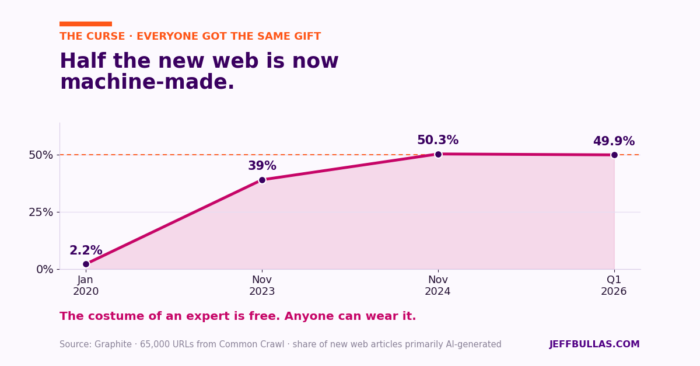
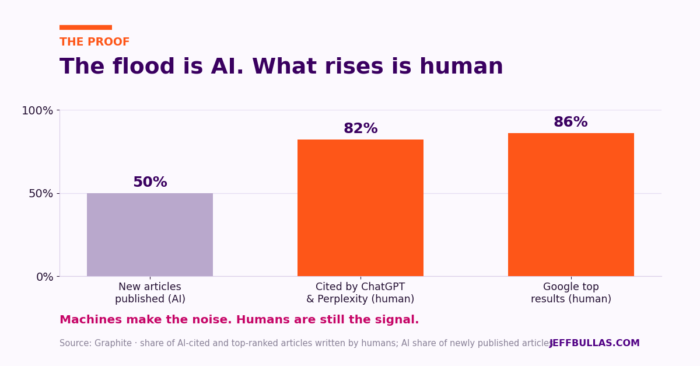
The universal distribution of these AI gifts presents a significant challenge. In 2022, the rapid adoption of AI tools meant that the door swung open, and almost instantaneously, the room began to fill. The landscape of online content creation offers a stark illustration. In January 2020, machine-generated web articles constituted a mere 2% of the total. By late 2024, this figure had surged past 50%, with approximately half of all new online articles now being produced by AI. This exponential growth, driven by the ease of access and reduced friction, is not a flaw in the system but a predictable outcome of arithmetic. The democratization of creation has led to an unprecedented influx of content, fundamentally altering the competitive environment.
The True Villain: Not the Machine, but the Moat
The narrative surrounding AI often frames the technology itself as a disruptive force. However, the real antagonist in this unfolding story is not the machine, but the erosion of the historical barriers that once protected expertise and unique contributions. For years, difficulty itself served as a protective moat, deterring casual entrants and preserving the value of specialized knowledge. When the author began blogging in 2009, the technical hurdles, though seemingly simple to some, were significant. This difficulty acted as a natural gatekeeper. AI, by draining this moat, has not only provided tools but also unleashed a torrent of competition. The trade-off is clear: enhanced accessibility comes with increased congestion.
The Price of Walking Through Doors
The act of stepping through a new door, of embracing the unknown, invariably carries a cost. The author’s personal history illustrates this recurring pattern: leaving home at 17, leaving a religious upbringing at 27, and leaving traditional employment to become an entrepreneur at 52. Each transition demanded a price – fear, anxiety, uncertainty, and the potential for rejection. The decision to leave a familiar, albeit confining, "room" for the vastness of the unknown is a profound act of courage. The second transition, in particular, incurred a significant emotional cost, involving the difficult conversation with loved ones about a worldview expanded beyond their own.
The entrepreneurial leap at 52 involved years of early mornings, financial uncertainty, and the absence of guarantees. This is the unadvertised reality of pursuing dreams. However, the price paid yielded invaluable rewards: the freedom to grow, the resilience gained from setbacks, and an intrinsic motivation that superseded the need for external discipline. This internal drive, born from the act of stepping through the door, is something AI cannot replicate. It can provide the output, but not the fundamental reason for the pursuit.
AI’s Limitations: Collapsing Doing, Not Deciding
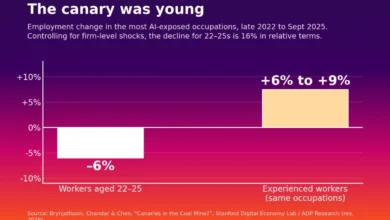
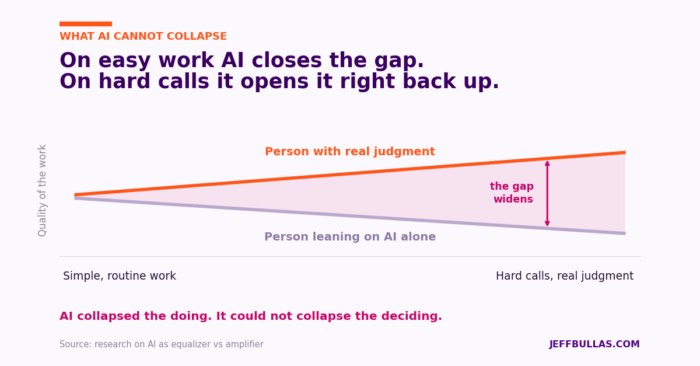
While AI excels at streamlining and automating tasks, its capabilities are not boundless. In areas requiring basic, routine work, AI effectively bridges the gap between novices and experts, as evidenced by numerous studies. However, in scenarios demanding nuanced judgment, contextual understanding, and sophisticated taste, the gap between human and AI capabilities widens. AI acts as an amplifier in these complex domains, magnifying the skills of those who already possess expertise. The critical distinction is that AI can collapse the "doing" – the execution of tasks – but it cannot collapse the "deciding" – the strategic thinking, ethical considerations, and nuanced judgments that define human leadership and innovation.
The market’s response to this distinction is already evident. While approximately half of all online articles are now machine-generated, research indicates that 86% of content ranking highly in Google Search is human-authored. Similarly, major AI models like ChatGPT and Perplexity frequently cite human-written sources. This suggests that while AI can generate a flood of content, human-authored material remains the signal, the valuable and trusted information that resonates and gains traction. The machines create the noise; humans provide the signal.
Building Enduring Value: The Authority of Trust
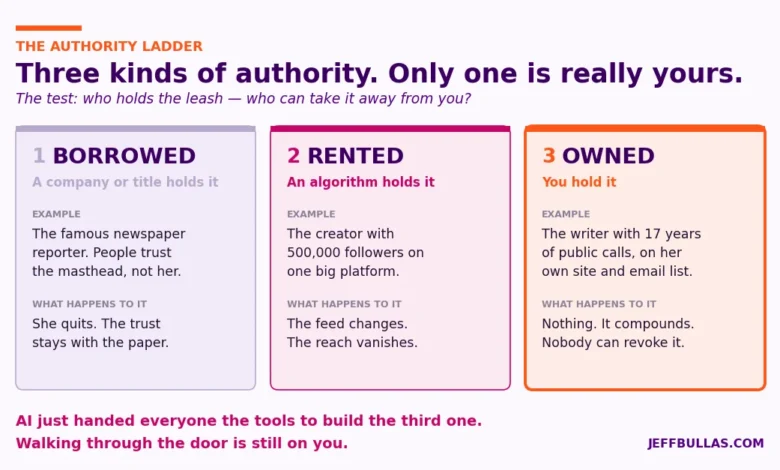
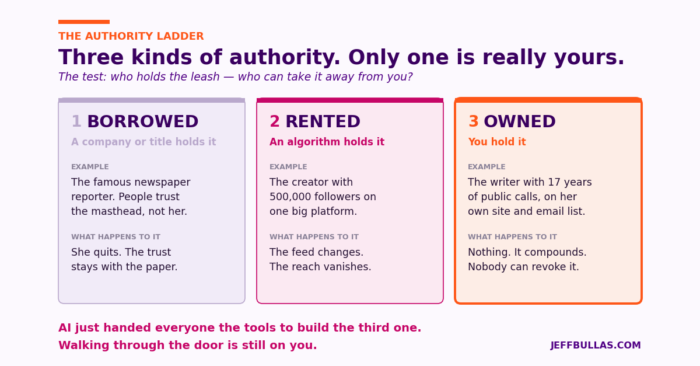
In an era where production is increasingly commoditized by AI, the ultimate prize shifts to something that cannot be replicated: a public record of trusted judgment. Authority in the modern world can be categorized, and the key differentiator lies in who holds the reins.
- Borrowed Authority: This relies on titles or affiliations that can be easily revoked or become obsolete.
- Rented Authority: This is contingent on external platforms or algorithms that can change their criteria without notice.
- Owned Authority: This is built on a foundation of earned trust, personal credibility, and a consistent public record of judgment and truth-telling.
The erosion of trust in traditional institutions – with a significant percentage of the global population expressing concerns about deliberate misinformation from government officials, business leaders, and journalists – further amplifies the importance of earned, personal authority. When titles lose their inherent credibility, trust must be cultivated on an individual, person-to-person basis.
The Framework for Owned Authority
Building owned authority is not a matter of exploiting loopholes or employing clever tricks; it is a deliberate, multi-faceted process. It requires the development of five interconnected pillars:
- A Public Record of Judgment: Consistently sharing well-reasoned opinions and decisions on matters within one’s domain.
- A Consistent Track Record: Demonstrating reliability and a history of successful or insightful contributions over time.
- A Genuine Voice: Communicating authentically, revealing one’s thought process and personal insights.
- A Deep Understanding: Possessing profound knowledge and context within a specific field.
- A Unwavering Commitment to Truth: Prioritizing honesty and accuracy, even when it is inconvenient or unpopular.
This framework is operationalized through an iterative loop:
- Identify a Problem: Recognizing a challenge or question that requires insight.
- Seek Data: Gathering relevant information from reliable sources.
- Apply Judgment: Using expertise and context to form a reasoned conclusion.
- Share Publicly: Communicating the judgment and its rationale transparently.
- Observe Outcomes: Monitoring the results and learning from the consequences.
- Refine Understanding: Adjusting one’s perspective based on feedback and experience.
The final step, refining understanding through observation and iteration, is frequently overlooked. This ongoing commitment to learning and adaptation is precisely what makes owned authority so valuable and so difficult for machines to replicate. It is the cheapest form of authority on earth, sitting unclaimed for those willing to invest the effort.
The Uncopyable Trail: The Human Element in the Age of AI
The pursuit of understanding, rather than the performance of certainty, has always been the author’s driving force. This genuine exploration, the visible process of thinking, resonates with audiences far more than polished pronouncements. Machines can provide answers instantaneously, but they cannot bestow a lifetime of earned judgment, a quality forged through lived experience, risk-taking, and consistent truth-telling in the public sphere.
As AI continues to lower barriers and democratize access, the landscape becomes increasingly crowded. The tools are readily available, the entry points are wide open, and the room is bustling. In this environment, the only truly inimitable asset is the authentic trail of a person who persistently learns, takes calculated risks, and communicates with integrity until their trustworthiness is beyond question. AI has opened the door for everyone to enter this new arena, but the decision to walk through it, to embrace the challenges and opportunities, and to build something of lasting value, remains a fundamentally human endeavor. The question for each individual is not what AI can do for them, but rather, what room are they still occupying, and what door are they ready to open?