On August 13, 2026, the artificial intelligence community witnessed a massive shift in developer tooling when DeepSeek quietly released an open-source agent runtime known as DeepSeek Harness, operating under the command-line interface alias dsh. Unlike typical product launches that focus on end-user applications or pre-packaged coding assistants, this infrastructure-level release immediately captured unprecedented global attention. Within its first twelve hours of availability on GitHub, the repository accumulated roughly 50,000 stars, surged to 92,000 stars by hour twenty-eight, and ultimately surpassed 186,000 stars alongside 20,000 forks in just ten days. Such rapid adoption velocity is exceptionally rare, even within the fast-paced ecosystem of open-source AI tooling, signaling a fundamental demand for modular, highly customizable agent architectures.
Chronology and Launch Dynamics
The trajectory of DeepSeek Harness from initial deployment to widespread adoption highlights a calculated strategy of open infrastructure distribution. Following the landmark release of DeepSeek-R1 in January 2025—which established a new benchmark for open, MIT-licensed frontier reasoning models developed outside traditional Western laboratory ecosystems—DeepSeek applied a similar philosophy to agent frameworks. Rather than teasing software capabilities months in advance through closed beta tests or marketing campaigns, the organization published DeepSeek Harness simultaneously with its accompanying academic paper, A Programming Paradigm for Spatiotemporal Composability (arXiv:2608.25512).
The initial release shipped through standard package management channels via npm as @deepseek-ai/dsh. Early adopters installing the initial development builds, such as version 0.1.5-rc.2, quickly discovered that the tooling was fully functional and immediately operable through command-line operations. Profiles such as web, headless, tui, and rescue demonstrated that the software was not a theoretical concept or a restricted prototype, but a robustly engineered framework ready for immediate inspection and deployment by software architects.
Architectural Innovations: Every Layer as a Plugin
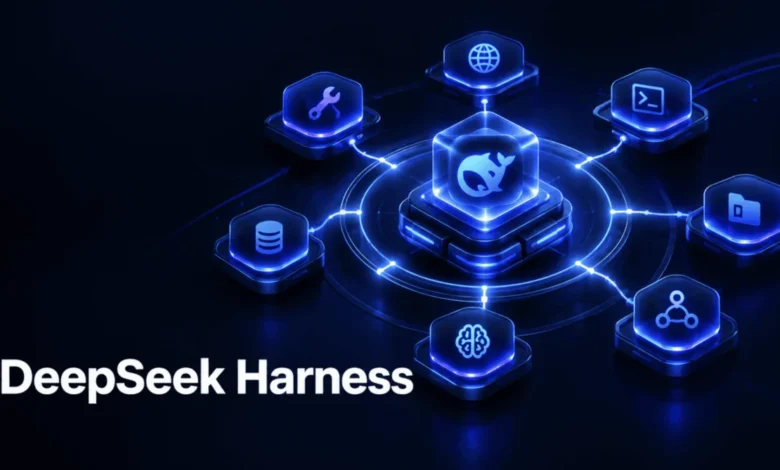
To understand the intense developer interest surrounding DeepSeek Harness, one must examine its core design philosophy. The central architectural claim of the framework is that every single layer of an autonomous agent functions as a discrete plugin. This modularity extends far beyond basic tool integration; within dsh, the model adapter, the tool registry, the session log, the sandboxing environment, the user interface, and even the core agent execution loop are treated as interchangeable plugins.
This architecture is constructed upon Cordis, a mature plugin framework with a proven four-year production track record inside the Koishi chatbot ecosystem, ensuring that the underlying runtime possesses enterprise-grade stability rather than relying on experimental code written exclusively for the launch.
Inspecting the default configuration via the --dump-default-config command reveals the true granular nature of this system. When executed against the standard web profile, the runtime prints 152 separately named and independently swappable plugins. Components ranging from sidebar menus and chat windows to approval prompts, sub-agent management panels, and scheduling interfaces operate as distinct installable packages. For instance, packages such as @deepseek-ai/dsh-client-ui-approval, @deepseek-ai/dsh-client-ui-subagent, and @deepseek-ai/dsh-agent-presets maintain individual identifiers and configurations.
Technical Analysis and Command-Line Implementation
The operational mechanics of DeepSeek Harness emphasize flexibility and predictable error handling. Developers interact with the runtime primarily through the dsh command-line interface. Standard commands allow for immediate profile execution:
dsh --profile web
dsh --profile headless "run the tests"
dsh plugin --profile tui add <package>
When executing tasks in headless mode without a pre-configured model credential, the runtime issues precise, actionable feedback rather than obscure stack traces. Attempting a one-shot execution without an API key immediately generates a structured notification: MISSING_CREDENTIAL: llm-deepseek: no API key for provider route "deepseek-official". This design choice points to an intentional focus on developer experience and rapid diagnostic troubleshooting.
Furthermore, the most significant technical differentiator of DeepSeek Harness compared to legacy tooling lies in the treatment of the agent loop. In conventional development environments, altering the core reasoning behavior of an agent often requires modifying compiled binaries or proprietary source code. Within DeepSeek Harness, the agent loop itself is merely another plugin, allowing developers to swap out core execution logic via configuration files with the same ease as changing a user interface panel.
Broader Impact and Industry Implications
The emergence of DeepSeek Harness underscores a broader industry transition away from monolithic, walled-garden AI solutions toward composable, open-weight, and open-architecture ecosystems. By providing developers with the foundational machinery required to assemble custom agents rather than forcing them to adopt pre-configured applications, DeepSeek has established a new benchmark for infrastructure transparency.
Independent developer ecosystems have already begun materializing around the framework. Early community-driven initiatives, such as specialized plugin directories, have cataloged dozens of community-contributed packages spanning utility functions, specialized sandboxes, and alternative UI layouts. This decentralized expansion mirrors the early growth phases of foundational JavaScript and Python package ecosystems.
Current Limitations and Outlook
Despite the unprecedented engagement metrics and architectural praise, industry analysts and early adopters emphasize that DeepSeek Harness is presently positioned as a developer preview rather than a production-ready replacement for established daily-driver coding agents. The ecosystem, while growing rapidly, remains in its formative stages.
For software engineers seeking an out-of-the-box coding assistant to immediately streamline day-to-day software development workflows, platforms with mature user interfaces and native IDE integrations remain the standard choice. However, for systems architects, infrastructure engineers, and developers seeking to construct bespoke autonomous agents, modify session management systems, or implement custom sandboxing backends without legacy codebase constraints, DeepSeek Harness represents a transformative leap forward in AI runtime design.