The AI Paradox: Why Silicon Valley’s Innovation Agenda Is Failing to Resonate with the Global Workforce

Many corporations operate under the guiding assumption that consumers and employees are universally eager to adopt new artificial intelligence features, yet current market data suggests a widening chasm between the aggressive rollout of AI-integrated products and actual user demand. This disconnect has manifested in a notable trend: while venture capital and corporate R&D budgets are heavily weighted toward "AI-first" development, many of these features suffer from low adoption rates, high maintenance costs, and significant reputational risks for the companies deploying them.
The historical trajectory of this trend began in earnest following the late 2022 explosion of generative AI models. In the subsequent 18 months, companies across the software industry—from enterprise SaaS providers to consumer mobile app developers—rushed to integrate LLMs into existing workflows. By early 2024, the internal logic within executive boardrooms shifted toward a "deploy first, refine later" strategy. However, as of late 2025, longitudinal studies from firms such as IBM and various productivity research groups indicate that this flood of AI features has not produced the expected surge in efficiency. Instead, it has introduced a "productivity paradox," where the time saved by automation is often offset by the time spent managing, correcting, and troubleshooting AI-generated outputs.
The Structural Mismatch of AI Integration
The core issue stems from a misunderstanding of value propositions. In traditional software development, a feature is successful if it solves a specific user problem efficiently and reliably. In contrast, many current AI implementations are treated as a value proposition in and of themselves. As industry design experts have noted, AI should be viewed as a "key activity" or a "resource" rather than a standalone product. When companies force AI into interfaces where it does not belong, they create "bolt-on" tools that disrupt established workflows rather than streamlining them.
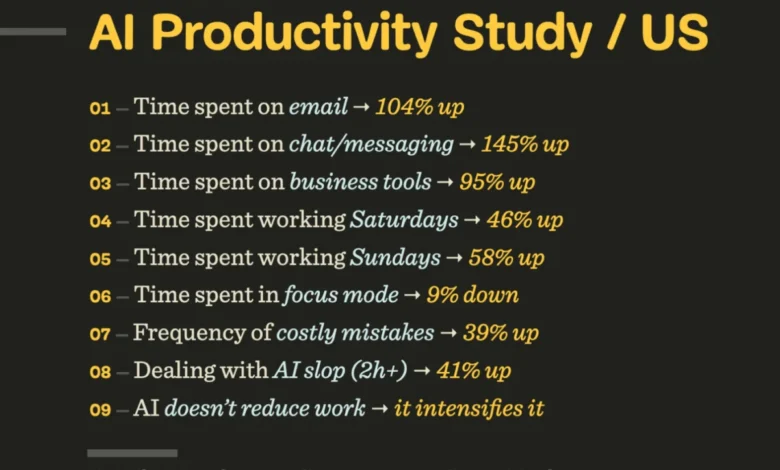
The operational reality for many office workers involves navigating a fragmented landscape of disconnected software systems. By adding an additional AI layer that requires its own prompt engineering, verification, and oversight, organizations are inadvertently adding cognitive load. Data from recent productivity studies underscores this: email usage has surged by over 100% in some corporate environments, and time spent in chat-based communication tools has increased by nearly 150%. Far from reducing the workload, the influx of AI tools has resulted in a 40% increase in time spent dealing with "AI slop"—erroneous or low-quality data that requires human verification.
Chronology of the Adoption Gap
The timeline of this friction is becoming increasingly clear to industry analysts:

- Late 2022 to Early 2023: The "Gold Rush" phase, characterized by the rapid integration of chatbots into customer service, marketing, and software development tools.
- Late 2023 to Mid-2024: The "Verification Crisis," where businesses began to realize the hidden costs of AI hallucinations and the necessity of human-in-the-loop oversight, leading to the first major dips in retention metrics.
- Late 2024 to Present: The "Resistance Phase," where employees and consumers began to actively express skepticism, not necessarily toward the technology, but toward its forced implementation in environments where it introduces unreliability and complexity.
Economic and Psychological Implications
The implications for labor markets are profound. A 2025 analysis by the Brookings Institution and other research bodies suggests that while a significant portion of modern jobs are exposed to automation, the most resilient roles are those requiring human taste, nuance, and intuition. The fear of job displacement has created a culture of anxiety, which further dampens the enthusiasm for AI tools. When employees perceive an AI feature as a tool intended to replace their judgment rather than augment their capability, they naturally resist its adoption.
Furthermore, the "AI-first" mantra has led to a degradation of the user experience in creative and professional fields. Professionals in sectors ranging from healthcare to creative writing have voiced strong opposition to the automation of high-value human tasks. As noted by industry commentators, there is a clear distinction between wanting an AI to handle the "physical and mental labor" of mundane, repetitive tasks and wanting to outsource the creative or empathetic components of work.
Toward an "AI-Second" Paradigm
The most successful implementations of automation moving forward are likely to be "AI-second" in nature. These are systems where the technology remains ambient, subtle, and supportive, operating in the background to handle data processing, scheduling, or synthesis without forcing the user to adopt a new, cumbersome mental model.

For software architects and product designers, the path forward requires a shift in focus. Instead of asking how to integrate AI, companies must ask which specific, boring, and non-creative tasks are currently consuming the most time. If an AI tool cannot perform these tasks with a level of reliability that matches or exceeds human capability, the feature will likely fail to gain traction.
The Role of Human-Centric Design
The current industry-wide push for AI often overlooks the fundamental reality that users prefer reliability over novelty. In the eyes of a professional, a tool is only as good as its predictability. When a feature produces an inconsistent result, the user does not blame the technology—they blame the product.
This necessitates a return to core UX principles. The "Design Patterns for AI Interfaces" movement, which advocates for clear, predictable, and user-controlled AI interaction, suggests that successful interfaces must be:

- Predictable: The user should have a clear expectation of how the system will behave.
- Accessible: AI should be integrated into existing tools, not separated into new, fragmented systems.
- Useful: The AI must address a verifiable pain point, rather than simply being a feature added to satisfy a management directive.
Conclusion: The Future of Human-AI Collaboration
As we look toward the remainder of the decade, the focus of the technology industry must pivot from a "quantity over quality" approach to one that values the human element. The goal should not be to build a world where AI performs all tasks, but one where AI eliminates the friction that prevents people from focusing on the work that matters.
The resistance observed today is not a sign of anti-technological sentiment, but rather a rational response to tools that add complexity without providing commensurate value. If organizations continue to prioritize the "AI" label over the actual utility of the tool, they risk losing the trust of their user base. Conversely, those that treat AI as a quiet, efficient utility—a tool that serves the human, rather than forcing the human to serve the tool—will find that adoption follows naturally. The future of software is not about replacing the human experience; it is about protecting it from the tedium that has long defined the modern workplace. By automating the "boring stuff," businesses can enable a more productive and, ultimately, more human-centric professional landscape.