Building Tactile Web Experiences Through Intentional Motion and Lottie Animation Architecture


When tasked with building a highly interactive, tactile web experience, the architecture must serve the art direction rather than force it into a rigid simulation. In a recent development project titled Stress Release, the engineering team at Isadora Agency successfully bypassed industry-standard physics engines to create a highly responsive, squishy UI interaction. By leveraging Lottie animations, DOM event listeners, and precise distance-based mathematics, the team maintained absolute control over the animators’ original vision, demonstrating a shift toward deterministic design in modern web development.
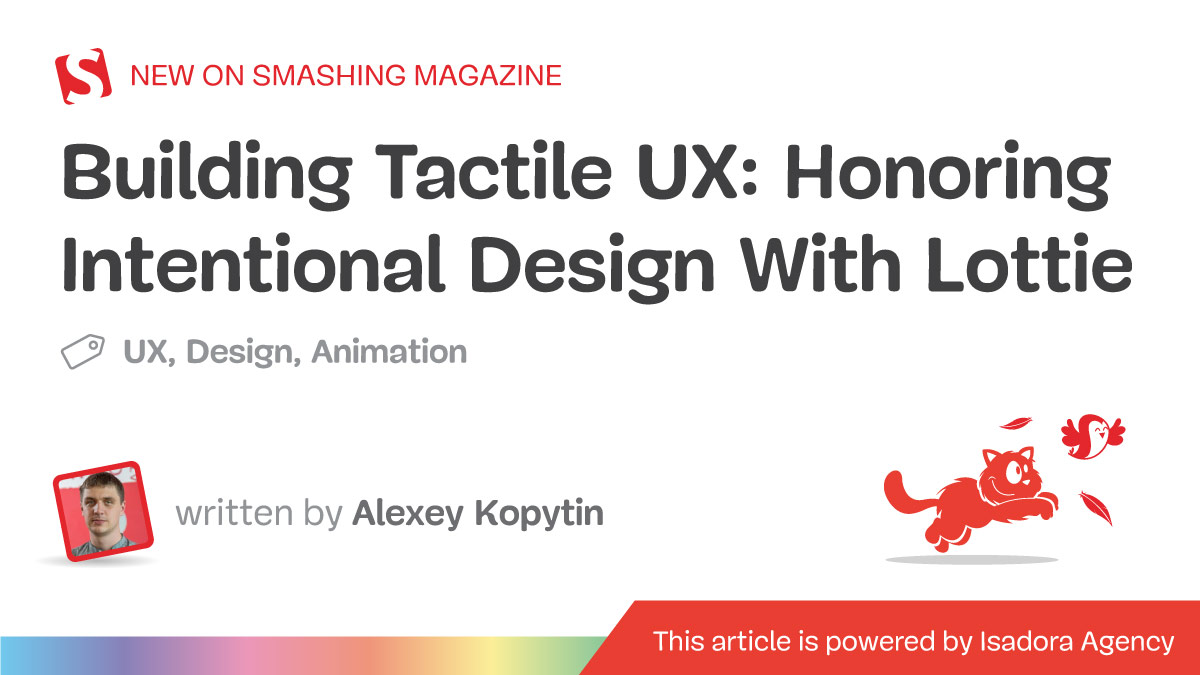
The industry has long viewed physics engines as the definitive solution for interactive web elements. Tools such as Matter.js and Cannon.js have become the standard for developers seeking to add "bounciness" or "destructibility" to digital interfaces. However, for the Isadora Agency team, these engines proved to be a liability. While physics engines excel at simulating realistic gravity and collision, they struggle with the nuance of bespoke, artistic intent. In the context of the Stress Release project, the animators required specific, frame-accurate responses to user inputs—responses that physics-based randomization often undermined. Consequently, the development team opted for a purely programmatic architecture, relying on native DOM manipulation and Lottie’s internal API to bridge the gap between user intent and visual execution.
The project’s inception was driven by a need to combat digital fatigue. The team aimed to create a browser-based "stress toy" that allowed users to interact with animated characters through clicks, drags, and distortions. The design mandate was clear: every user action required a satisfying, tactile reaction that felt deliberate rather than procedural. As the prototyping phase progressed, the engineers realized that using a physics engine meant relinquishing control over the character’s specific squish-and-stretch behaviors. If a character was designed to distort in a specific, expressive way during a "mega squeeze" sequence, a physics engine might interpret that as a simple collision, potentially breaking the artistic character of the animation. By shifting to a deterministic framework, the team ensured that the animation layers were triggered with frame-perfect precision, directly reflecting the designer’s keyframes.

The technical implementation relied on a radial input mapping system that treated the screen like a coordinate plane. To achieve the feeling of "hitting" a target, the developers calculated the distance between the user’s click and the character’s center point using the Pythagorean theorem. This spatial data served a dual purpose: it determined the score awarded for the interaction and defined the precise location of the explosion effects. By mapping these values to the DOM, the team created a concentric zone system—effectively a digital dartboard—where the intensity of the visual feedback was directly proportional to the accuracy of the user’s click. This approach avoided the overhead of WebGL raycasting, keeping the application lightweight while maximizing responsiveness across various device types.
A critical aspect of this development was the management of animation states. Each character was defined by a series of segments—idle loops, reaction frames, and terminal states—stored as frame ranges in JSON files. By using the Lottie API to jump between these segments, the developers achieved a seamless flow between the passive, idle state and the active, high-energy reaction state. When a user clicks, the system interrupts the idle loop, advances to the specific reaction sequence, and then, upon completion, resets the character to its default state. This state-machine logic ensures that the interface remains responsive without the need for complex state management libraries or external physics middleware.

From a performance perspective, the project serves as a compelling case study in optimizing high-fidelity animations for the web. Lottie animations, while visually rich, can be computationally expensive if not managed correctly. To maintain smooth performance on mobile devices, the team implemented a tiered quality system. For the character selection screen, where 21 animations might be active simultaneously, the team reduced the playback quality and frame rate to conserve system resources. Conversely, during the active gameplay phase, the system shifted to full-quality rendering for the single focused character. This intelligent resource allocation ensured that the experience remained fluid regardless of the device’s hardware capabilities.
The broader implications of this development strategy are significant for the field of UX engineering. As web interfaces move toward increasingly gamified, high-tactile experiences, developers are often faced with a choice between the high performance of WebGL and the artistic fidelity of frame-by-frame animation. The Isadora Agency’s work demonstrates that the DOM is more than capable of handling sophisticated, interactive animations when paired with the right architectural approach. By prioritizing "intentional motion" over "simulated motion," designers and developers can collaborate to create interfaces that feel organic and deliberate.

Industry analysts note that this approach aligns with a growing movement to reduce dependencies on heavy third-party libraries. By relying on native JavaScript math and the Lottie runtime, developers can build more sustainable, maintainable applications that are less susceptible to the breaking changes often associated with large-scale physics engines. This methodology also simplifies responsive design; by utilizing CSS variables to handle layout scaling, the team ensured that the hitboxes and animation containers remained consistent across varying viewport sizes, a common pain point in physics-based web development.
The success of the Stress Release project provides a blueprint for future interactive web design. It challenges the conventional wisdom that complex motion requires complex engines, suggesting instead that mathematical precision is often a more effective tool for capturing the nuance of human interaction. As the demand for expressive, tactile, and gamified web experiences grows, this deterministic approach offers a scalable solution for maintaining high-quality design standards in a digital-first environment. For developers, the lesson is clear: when the goal is to honor the art direction, the most effective architecture is the one that allows the code to act as a precise, invisible bridge between the user and the designer’s intent.