Amazon Research Introduces GraphEval A Knowledge Graph Framework for Diagnosing and Detecting Large Language Model Hallucinations.

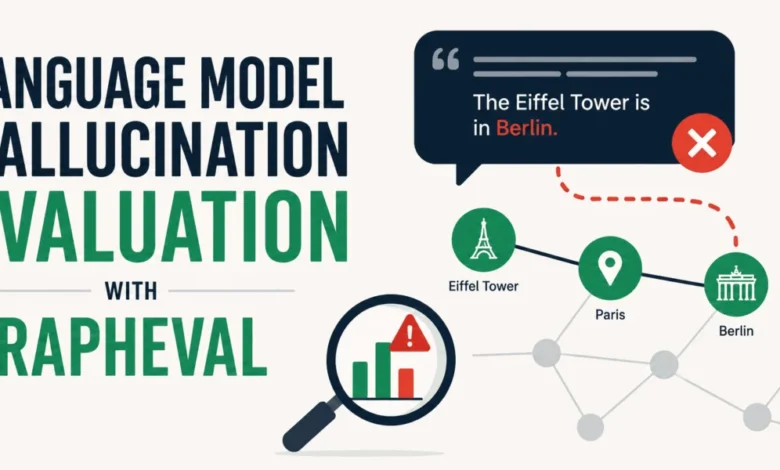
The rapid proliferation of large language models (LLMs) across various industries has been accompanied by a persistent and well-documented challenge: hallucinations. These phenomena, where a model generates factually incorrect, nonsensical, or entirely fabricated information, remain a significant hurdle for the deployment of AI in mission-critical environments. While the industry has developed numerous mitigation strategies, such as Retrieval-Augmented Generation (RAG) and fine-tuning, the methodology for internally diagnosing and evaluating these hallucinations has lagged behind. In a significant move to address this "explainability gap," researchers at Amazon have proposed GraphEval, a novel framework that utilizes knowledge graphs to detect and localize factual inconsistencies in LLM-generated outputs.
The Challenge of LLM Hallucinations in Enterprise Environments
As LLMs transition from experimental chatbots to enterprise-grade tools, the cost of inaccuracy has risen exponentially. Hallucinations are not merely "bugs" in the traditional software sense; they are inherent to the probabilistic nature of transformer architectures. LLMs predict the next most likely token based on statistical patterns rather than a grounded understanding of objective reality. Consequently, when a model lacks specific internal knowledge or encounters ambiguous prompts, it may "hallucinate" details that sound plausible but have no basis in fact.
Traditional evaluation metrics, such as BLEU (Bilingual Evaluation Understudy) or ROUGE (Recall-Oriented Understudy for Gisting Evaluation), were originally designed for machine translation and summarization. These metrics rely on word-overlap and n-gram similarity, which are often poor indicators of factual truth. A model can produce a sentence that is grammatically perfect and highly similar to a reference text while still containing a critical factual error. This limitation has led to the development of "LLM-as-a-judge" frameworks, where a more powerful model evaluates the output of a smaller one. However, these methods often lack transparency, providing a single score without explaining exactly where or why the model went wrong.
Introducing GraphEval: A Two-Stage Diagnostic Framework
The GraphEval framework, detailed in recent research from Amazon, shifts the focus from holistic scoring to granular, graph-based diagnosis. By decomposing a model’s response into a structured knowledge graph (KG), the framework allows for a point-by-point verification of facts against a grounded context. The methodology is built upon two distinct stages: knowledge extraction and factual verification via Natural Language Inference (NLI).
In the first stage, an auxiliary model—typically a smaller, specialized LLM—acts as an information extractor. It parses the generated response and converts it into a series of "triples." These triples follow a (Subject, Relationship, Object) format, which is the foundational structure of a knowledge graph. For example, if an LLM generates the sentence "GraphEval uses knowledge graphs to detect hallucinations," the extraction process would yield the triple: (GraphEval, uses, knowledge graphs). This transformation turns unstructured text into a machine-readable map of claims.
The second stage involves the application of Natural Language Inference. NLI is a classical NLP task where a model determines the logical relationship between a "premise" (the ground-truth context) and a "hypothesis" (the extracted triple). The NLI model categorizes the relationship into one of three labels: entailment (the premise proves the hypothesis), contradiction (the premise disproves the hypothesis), or neutral (the premise neither proves nor disproves the hypothesis). In the GraphEval framework, any triple that does not result in an "entailment" label is flagged as a potential hallucination.
Practical Simulation and Technical Implementation
To understand the efficacy of GraphEval, one can look at a simulated implementation using open-source tools. In a typical production scenario, the "ground-truth context" would be retrieved from a vector database or an authoritative document. For instance, if the source context states that "GraphEval is a framework based on Knowledge Graph structures that utilizes NLI models," this serves as the anchor for truth.
When a primary LLM is asked to explain GraphEval, it might correctly state that it uses knowledge graphs but erroneously add that it "requires a highly expensive, enterprise-level server farm to operate." Under the GraphEval framework, the extraction stage would produce multiple triples, including:
- (GraphEval, is, evaluation framework)
- (GraphEval, uses, Knowledge Graphs)
- (GraphEval, requires, expensive enterprise server farm)
During the NLI verification stage, using a model such as DeBERTa-v3, each triple is tested against the source context. The first two triples would likely return an "entailment" result, as they are supported by the source text. However, the third triple—regarding the server farm—would return a "neutral" or "contradiction" result because the source context makes no mention of such requirements. This specific triple is then highlighted as a hallucination.
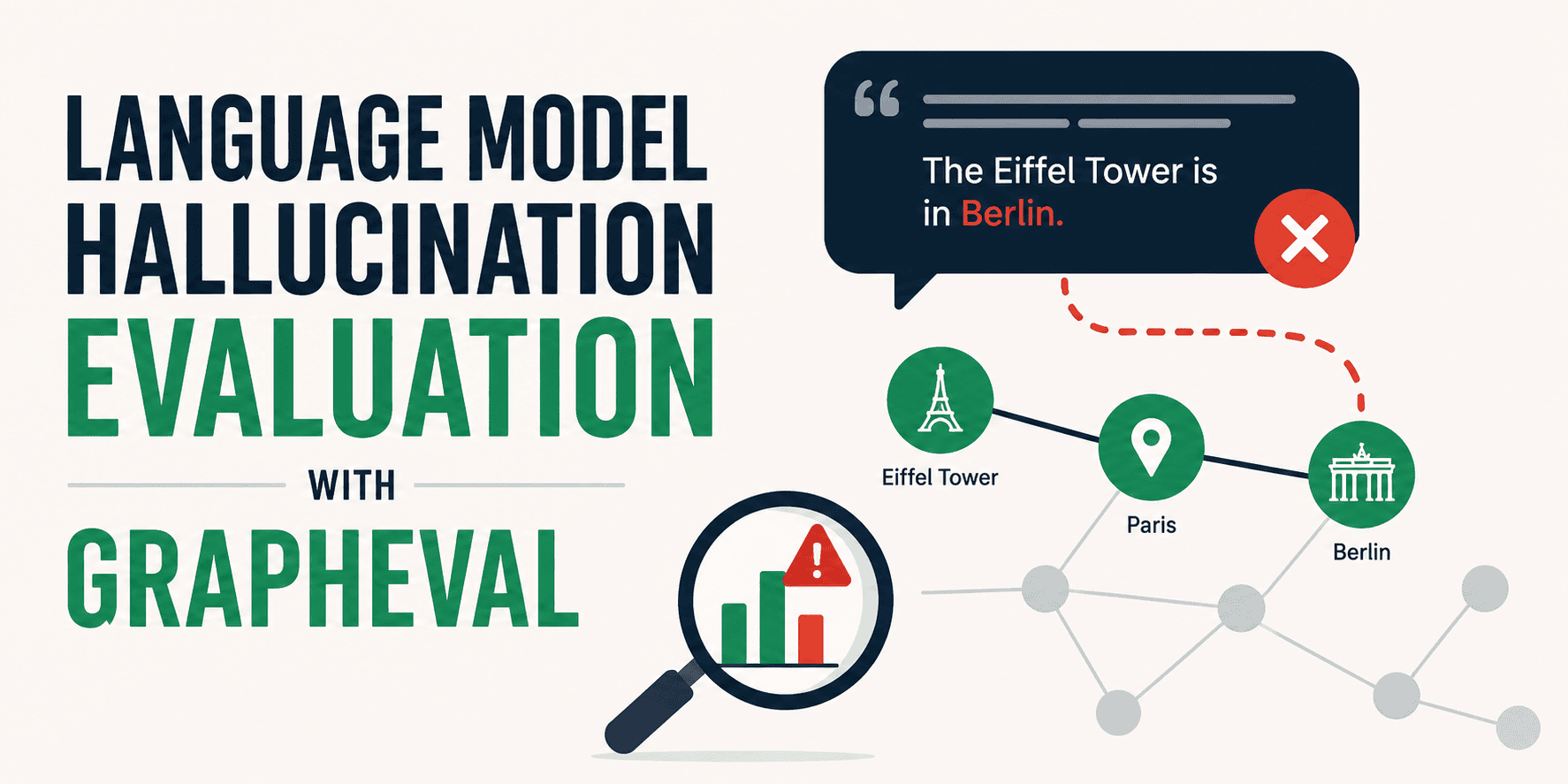
This granular approach offers a level of explainability that single-score metrics cannot match. Instead of simply telling a developer that a response is "60% accurate," GraphEval can visually map out the specific claims and point to the exact segment of the sentence that is untrustworthy.
Supporting Data and Comparative Analysis
The shift toward NLI-based evaluation is supported by a growing body of evidence suggesting that traditional similarity metrics are insufficient for factual verification. In various benchmarks, NLI models have shown a higher correlation with human judgment regarding factuality than ROUGE or BLEU scores.
Furthermore, the use of Knowledge Graphs addresses the "long-form" hallucination problem. In long-form text generation, LLMs often start accurately but lose factual coherence as the response progresses. By mapping the entire response as a graph, researchers can identify "hallucination clusters"—areas where the model has deviated from the provided context and begun generating a chain of false dependencies.
Compared to other modern frameworks like "Self-CheckGPT," which relies on generating multiple samples from the same LLM to check for consistency, GraphEval is more computationally efficient in some regards. While Self-CheckGPT requires multiple inference passes of a large model, GraphEval can leverage smaller, more efficient NLI models (like DeBERTa-small) for the verification stage, making it more viable for real-time monitoring in production pipelines.
Implications for RAG and AI Safety
The implications of GraphEval extend significantly into the realm of Retrieval-Augmented Generation (RAG). RAG is currently the industry standard for reducing hallucinations by providing LLMs with relevant documents before they generate a response. However, even with RAG, models can still misinterpret the provided documents or ignore them in favor of their internal (and potentially outdated) training data.
GraphEval acts as a "sanity check" for RAG systems. By placing GraphEval at the output stage of a RAG pipeline, organizations can implement a gatekeeping mechanism. If the framework detects a high density of non-entailed triples, the system can automatically flag the response for human review or trigger a re-generation with stricter parameters.
From an AI safety perspective, this framework contributes to the development of "interpretable AI." As regulatory bodies in the European Union and the United States begin to move toward requiring transparency in AI decision-making, tools that can provide a clear audit trail of factual verification will become indispensable. GraphEval’s ability to generate a "hallucination map"—a visual representation of grounded versus ungrounded claims—provides exactly the kind of transparency that auditors and end-users require.
Future Outlook: Automated Correction and Self-Healing Systems
The next logical step for research in this area is the move from detection to automated correction. If a system can identify exactly which triple is a hallucination, it could theoretically prompt the LLM to "re-write the response while excluding or correcting the specific claim regarding [hallucinated fact]."
Amazon’s research into GraphEval represents a broader trend in the AI industry: the move away from viewing LLMs as monolithic black boxes and toward treating them as components within a larger, verifiable system. By combining the linguistic fluidity of LLMs with the structured rigor of knowledge graphs and the logical precision of NLI, researchers are building the infrastructure necessary for truly reliable artificial intelligence.
As the technology matures, it is expected that frameworks like GraphEval will be integrated directly into model development lifecycles, providing real-time feedback during both the training and deployment phases. For now, it stands as a powerful tool for developers and researchers seeking to bridge the gap between generative potential and factual reality.