The Quiet Coup: How AI Rewrote the Rules of Content Marketing and What Truly Survives

In 2009, a nascent digital landscape was taking shape, and the author, Jeff Bullas, began his workday at 4:30 AM, driven by a singular passion for writing. This dedication, fueled by an intrinsic desire for progress during a period of personal stagnation, laid the foundation for what would become a monumental online presence. Five years of consistent effort saw jeffbullas.com achieve 100,000 monthly readers, a figure that would eventually swell to over 33 million across 190 countries. This remarkable growth was attributed to a single, potent skill: content marketing. However, seventeen years later, a seismic shift occurred, rendering the established tenets of this discipline obsolete, not due to a decline in writing prowess, but because the underlying mechanics of digital platforms fundamentally changed what they prioritized, a transformation that largely went unnoticed by the very industry it disrupted. This article delves into the genesis of this pivotal moment, its profound consequences, and the enduring elements that have emerged from its wake.
The Algorithmic Revolution: From Followers to Fascination
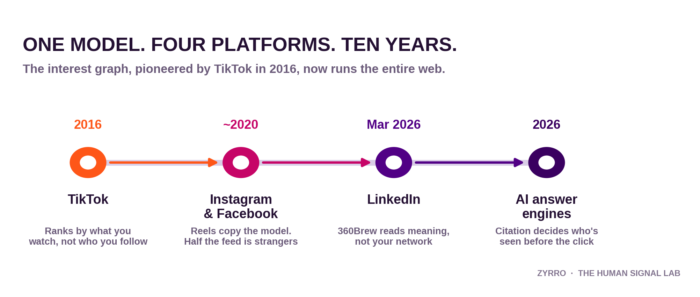
The catalyst for this profound industry upheaval can be traced back to a platform initially perceived by many marketers as a mere playground for viral dances and fleeting trends: TikTok. In 2016, TikTok made a strategic pivot that would irrevocably alter the landscape of content distribution. Instead of prioritizing content based on user followings, the platform began to rank videos based on viewer engagement – specifically, what users watched and for how long. This was a departure from the traditional model where established follower counts were paramount.
TikTok has been explicit in its stance, stating that follower count is not a determinant factor in content ranking. This algorithmic innovation meant that a brand-new account, devoid of any followers, could achieve viral reach, potentially millions of views in a single day, solely based on the merit of its content’s performance among unfamiliar audiences. As the platform matured, this algorithmic focus on engagement solidified, a trend corroborated by Sprout Social’s 2026 analysis of platform algorithms, which indicated a continued emphasis on viewer interaction over established social connections.
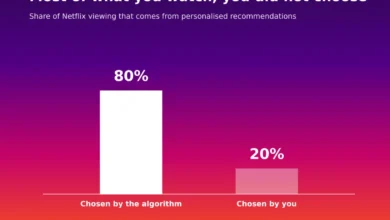
Initially met with skepticism and even derision, this innovative approach was soon emulated by other major social media players. Facebook and Instagram, two titans of the social networking world, gradually adopted similar strategies. By 2026, data from a cross-platform algorithm statistics review revealed that over half of the content displayed in an average Facebook feed originated from accounts users had never followed. Furthermore, artificial intelligence (AI) had become the dominant curator, dictating over 80% of the content presented to users across these platforms.

The ripple effect of this algorithmic paradigm shift reached its apex on March 12, 2026, when LinkedIn, the professional networking giant, integrated a new AI model named 360Brew. With a staggering 150 billion parameters, 360Brew was designed to interpret posts with a nuanced, human-like editorial understanding, moving beyond simple keyword matching that had characterized LinkedIn’s ranking systems for over a decade. This integration marked a definitive move away from a network-centric distribution model towards one driven by inferred relevance and engagement potential.
Even the realm of search engines was not immune to this algorithmic evolution. Google’s introduction of AI Overviews and the widespread adoption of advanced answer engines like ChatGPT have fundamentally reshaped how information is accessed and credited. These AI-driven systems now often pre-empt user clicks by providing direct answers and summaries, influencing which brands and content creators gain visibility before a user even navigates to a website. A 2026 benchmark study by Conductor, analyzing 3.3 billion user sessions, indicated that while AI referral traffic constituted a modest 1.08% of overall web traffic, its influence was disproportionately significant, as it dictated the initial exposure of brands and information.
The convergence of these four major platforms—TikTok, Facebook, Instagram, and LinkedIn—along with search engines, signifies a fundamental underlying shift. For two decades, marketers and content creators had honed their strategies around a specific set of rules governing audience building and content distribution. The advent of AI-driven, engagement-focused algorithms has, however, rendered these established playbooks increasingly obsolete, leaving many still operating under outdated assumptions.
The Data-Driven Demise of the Follower Count
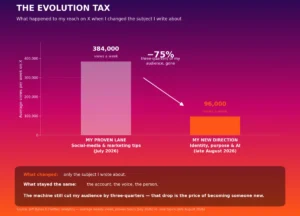
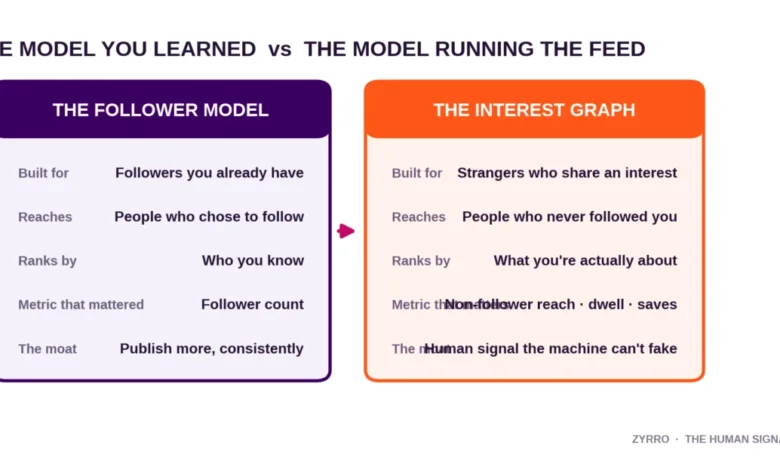
The tangible impact of this algorithmic evolution is evident in the data. According to Richard van der Blom’s Algorithm Insights Report, compiled from an analysis of over a million LinkedIn posts, the past twelve months have witnessed a dramatic recalibration of content visibility. While the instinct for many creators might be to attribute declining reach to a perceived drop in writing quality, a more critical examination reveals a simpler, albeit more challenging, truth: distribution is no longer primarily dictated by the network of followers. Instead, it is increasingly governed by declared and demonstrated topic authority, a concept meticulously inferred by AI models like 360Brew by analyzing a user’s headline, posting history, and the consistency of their published content.
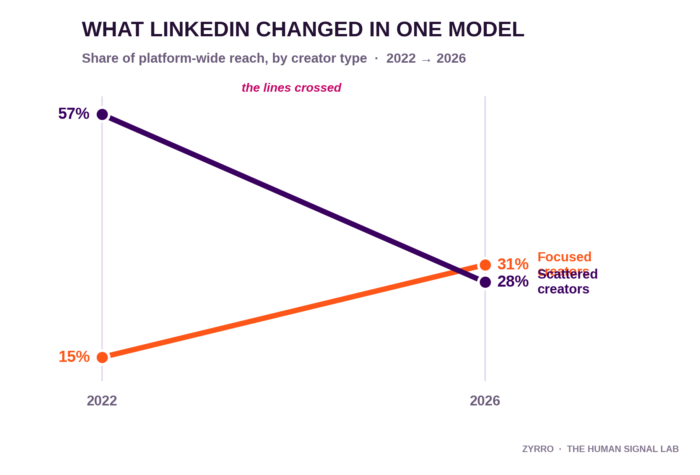
This shift in algorithmic focus has had a profound impact on content creators. One 2026 analysis highlighted that creators who meticulously adhered to a narrow, consistent range of topics experienced a doubling of their share of platform-wide reach between 2022 and the present, climbing from approximately 15% to 31%. Conversely, creators who diversified their content across a wide array of subjects witnessed a significant decline in their reach, plummeting from 57% to a mere 28%. This data starkly illustrates a structural decoupling between follower count and actual reach. An account with 8,000 highly focused followers can now demonstrably outperform an account with 80,000 followers who engage with a more eclectic range of topics. This phenomenon is not confined to LinkedIn; it represents the prevailing influence of the "interest graph"—the algorithmic mapping of user interests—across platforms like TikTok and Instagram, and within the architecture of AI answer engines.
The Unintended Consequence: The Throttling of Polymaths
The data unequivocally points towards a strategic imperative: niche down, select a specialized area of focus, and become the definitive voice within that domain. However, this directive raises a critical question: what becomes of individuals whose intellectual curiosity and creative output span multiple disciplines?
Consider the hypothetical scenario of a modern-day Leonardo da Vinci. A polymath renowned for his masterpieces like the Mona Lisa, his pioneering designs for flying machines, and his meticulous anatomical dissections to understand human expression, da Vinci embodied a mind driven by a dozen interconnected obsessions. In today’s algorithmic environment, posting an image of a flying machine immediately after a portrait of the Mona Lisa could trigger an algorithmic mismatch. This would result in a reduced reach and a lost signal, effectively rendering profound interdisciplinary insights invisible. The algorithms, in their current iteration, demand a singular focus, a "lane" that facilitates the creation of echo chambers and limits broader exploration.
The author’s personal journey, beginning with his engagement on social media in 2008, was driven by a desire to connect with diverse and fascinating individuals worldwide, irrespective of predefined categories. The act of following was predicated on genuine interest and intellectual curiosity. This distinction between "interest" and "interesting" is crucial. While algorithms can efficiently categorize and index predefined interests, they fundamentally struggle to quantify the qualitative essence of being "interesting"—a deeply human attribute rooted in originality, experience, and unique perspective.
While this algorithmic recalibration has laudably curbed the proliferation of engagement bait and empowered lesser-known but genuinely talented creators to eclipse superficial celebrities, the cost extends far beyond these immediate benefits. The fundamental implication is a shift in control: whereas old algorithms dictated what content users saw, the new paradigm dictates who users are allowed to be to maintain visibility. The curious, multifaceted individual is increasingly categorized and confined to a specific niche, a stark contrast to the expansive selfhood championed by poets like Walt Whitman, who famously declared, "I am large, I contain multitudes." The current algorithmic architecture lacks a designation for such inherent complexity.
Content Marketing Reimagined: From Audience to Interest Graph
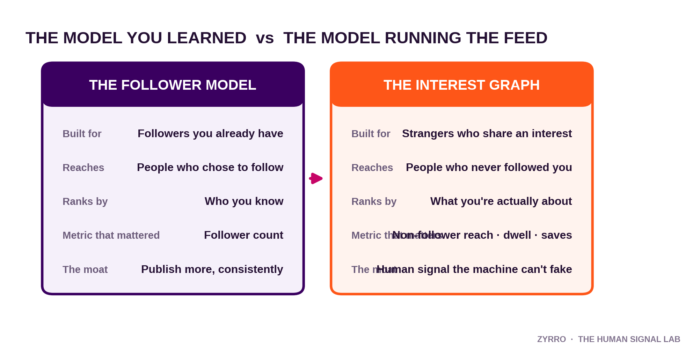
For two decades, the bedrock of content marketing rested on a fundamental assumption: build an audience, publish consistently, and that audience will engage with your content because they actively chose to follow you. This foundational assumption has been irrevocably broken. Content marketing, as it was traditionally conceived, was designed for an existing, opted-in audience. The prevailing "interest graph," however, operates on a different principle: connecting individuals who share an interest, irrespective of prior connection, through AI systems that infer a user’s true thematic focus rather than relying on who is already listening.
The metric that once defined success—follower count—has been superseded by indicators of genuine engagement with new audiences. Non-follower reach, dwell time, and saves have emerged as the critical signals that demonstrate a stranger’s sustained interest. This is not the demise of content marketing, but rather its evolution, shedding an outdated assumption and adapting to a new operational reality.
The Enduring Power of the Human Signal
While the algorithmic shift has successfully matched content to potentially receptive strangers, this initial connection is merely a gateway. The crucial determinant of sustained engagement lies in what happens after a piece of content captures a stranger’s attention. This is where the limitations of AI become apparent. Algorithms can identify thematic relevance, but they cannot replicate the unique human element that compels an audience to remain engaged.
This enduring power resides in what can be termed the "human signal." It is not merely a writing style but a testament to authentic experience, vulnerability, and the courage to express opinions that carry personal cost. It is the nuanced sentence that a language model, programmed for predictability and average outcomes, would never risk. The human signal is irrefutable evidence of presence—of mistakes made, of years of unseen effort, of triumphs earned at a significant price. The interest graph may provide access, but the human signal is the compelling reason why an audience chooses to stay.
Building Territories in the Age of AI Abundance
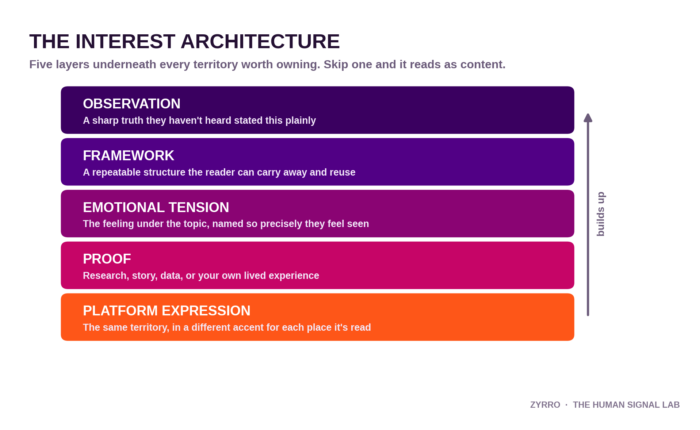
Given that the traditional playbook of increased output and consistent posting is no longer a guaranteed path to visibility, a new strategic framework is required. This framework is not a mere tactic but a comprehensive structure, comprising five interconnected layers designed to establish enduring presence in the digital sphere.
The first layer involves crafting sharp, original observations that offer readers a novel perspective. This is followed by the development of repeatable frameworks that empower audiences with actionable knowledge. Thirdly, identifying and articulating the underlying emotional tension within a topic, precisely enough to make readers feel seen, precedes offering tactical solutions. The fourth layer involves a robust "proof" component, incorporating research, compelling narratives, data, or firsthand lived experiences. Finally, a nuanced "platform expression" ensures that the core message is adapted with appropriate tone and style for each distinct digital environment.
Neglecting any of these layers results in content that, while competent, is ultimately forgettable and easily replaceable by AI-generated alternatives. However, constructing all five layers transforms a topic into a distinct "territory"—a domain that can be independently recognized and claimed by human readers, algorithmic systems, and AI answer engines alike, solidifying a creator’s unique position.
Charting the Territories Worth Owning
In navigating this new landscape, the author has identified five key territories that hold significant market interest and are ripe for cultivation in the AI era. These include "Human Signal in the AI Age," addressing the challenge of maintaining trust amidst identical AI tools; "Reinvention Without an Expiry Date," for professionals and founders contemplating their future evolution; "Meaningful Ambition," catering to a generation seeking purpose beyond conventional career ladders; "Founder as Trust Broker," exploring how authority can endure when AI democratizes information access; and "Content Marketing After AI Abundance," the overarching question that this article seeks to answer.
The objective is not to produce more content, but to cultivate a clearly defined territory within a market that already possesses a discernible need, ensuring that human creators capture attention, algorithms take notice, and AI systems retain recognition.
The Verdict: Content Marketing Endures, Its Foundation Rebuilt
Seventeen years after embarking on a career that the evolving interest graph has fundamentally reshaped, a clear conclusion emerges: content marketing is not defunct. Rather, the underlying assumption upon which it was built has been rendered obsolete. The strategy of simply publishing more content was never the ultimate competitive advantage; it merely served as a sufficiently effective approach for a time, leading to its mistaken identification as a sustainable moat.
The true and enduring moat has always been the human creator behind the content. For the first time since the author’s early morning writing sessions in 2009, the algorithms themselves now acknowledge and prioritize this fundamental truth.
This leads to a compelling paradox. The path forward involves a strategic acknowledgment of what one is already unmistakably known for, providing the algorithms with a clear and discernible pattern to facilitate discovery. This is not an act of capitulation but a strategic opening of the door.
However, the journey does not end there. The true mastery lies in subsequently crossing established lanes, challenging the algorithmic mandate for singular focus. Specialization should be a deliberate choice, not a restrictive decree. Curiosity, far from being an impediment to depth, is its very genesis. Just as Leonardo da Vinci’s anatomical studies informed his artistic endeavors, so too can a breadth of exploration enrich specialized output. The intersection of diverse interests is where true innovation and personal resonance are found—a territory that no algorithm should be permitted to confine.
Therefore, before embarking on the creation of the next piece of content, the crucial question shifts from "What should I publish?" to a more profound inquiry: "Do you follow people for their expressed interests, or because they are genuinely interesting?" Perhaps the most powerful approach lies in embracing both.