AWS Announces General Availability of AWS Glue 6.0 Featuring 30 Percent Price Reduction and Full Apache Iceberg v3 Support

Amazon Web Services (AWS) has officially announced the general availability of AWS Glue 6.0, marking a significant milestone in serverless data integration and processing. The latest iteration of the widely used extract, transform, and load (ETL) service brings a substantial 30 percent reduction in pricing compared to previous versions while introducing comprehensive support for Apache Iceberg v3 features. Built upon a fully modernized runtime framework—featuring Apache Spark 4.1, Python 3.13, and Scala 2.13—AWS Glue 6.0 is engineered to deliver accelerated performance, enhanced query capabilities, and streamlined workflows for data engineers and analytics teams operating at enterprise scale.
Core Architectural Advancements and Modern Runtime
At the heart of AWS Glue 6.0 is a complete modernization of its underlying execution engine. By migrating to Apache Spark 4.1, Python 3.13, and Scala 2.13, AWS has addressed growing industry demands for faster data processing, lower operational latency, and improved resource efficiency. Apache Spark 4.1 introduces major engine-level enhancements that optimize memory management, execution planning, and code generation, resulting in significantly shorter job runtimes for complex ETL pipelines.
In addition to core performance gains, AWS Glue 6.0 delivers the most complete Apache Iceberg v3 implementation available on any fully serverless managed Spark service. Built on Iceberg 1.11.0, the release introduces the groundbreaking VARIANT data type complete with advanced shredding support. Traditionally, querying semi-structured formats such as JSON, application logs, and event streams required cumbersome schema flattening, duplicate data storage, custom parsing logic, and constant pipeline maintenance whenever upstream schemas evolved.
The introduction of the VARIANT data type fundamentally alters this paradigm. By supporting shredding directly within Iceberg v3, AWS Glue 6.0 allows organizations to ingest, store, and query semi-structured data natively. This architecture achieves markedly faster query read performance compared to traditional string-typed columns, eliminates redundant data copies, and shields downstream pipelines from breaking when incoming data structures change. Consequently, data teams can handle high-velocity, variable-schema event streams with unprecedented reliability and speed.
Economic Implications and Cost Optimization
The decision by AWS to roll out a 30 percent price reduction for AWS Glue 6.0 represents a strategic pivot toward aggressive cost optimization for cloud data platforms. As macroeconomic pressures compel enterprises to scrutinize cloud expenditures more rigorously, data infrastructure costs have become a primary target for corporate budget reductions.
By lowering the hourly, second-billed rates for crawlers and ETL jobs, AWS is positioning its serverless data architecture as a more economically attractive alternative to both legacy on-premises data warehouses and competing cloud-native analytics services. Industry analysts note that this price drop lowers the barrier to entry for smaller organizations while providing substantial financial relief to large enterprises processing petabytes of data daily.

The pricing model remains anchored on predictable, consumption-based billing. Users continue to pay an hourly rate billed by the second for executing crawlers and ETL jobs. Meanwhile, the AWS Glue Data Catalog maintains its simplified monthly fee structure for metadata storage and access, which includes generous free tiers—specifically, the first one million objects stored and the first one million accesses remain entirely free of charge. This predictable cost scaling allows organizations to forecast data engineering budgets with higher precision while capitalizing on the native performance upgrades of the 6.0 runtime.
Background Context and Industry Evolution
The release of AWS Glue 6.0 arrives amid a broader industry transformation centered around open table formats, of which Apache Iceberg has emerged as a dominant standard. Over the past several years, data architecture has shifted away from proprietary, tightly coupled storage and compute models toward open data lakes architecture, where formats like Apache Iceberg, Apache Hudi, and Delta Lake provide ACID transactions, time travel, and efficient schema evolution directly on cloud object storage like Amazon Simple Storage Service (Amazon S3).
AWS has steadily aligned its analytics portfolio with this open-format ecosystem. Previous versions of AWS Glue introduced foundational support for Iceberg, but the 6.0 release represents a deep, specification-complete integration of version 3 features. By pairing this robust Iceberg support with a fully serverless deployment model, AWS aims to alleviate the operational overhead traditionally associated with managing distributed compute clusters, compaction processes, and table maintenance.
The evolution of AWS Glue from a basic metadata catalog and simple ETL runner into a sophisticated, high-performance distributed data processing engine mirrors the maturation of cloud data lakes. As organizations increasingly rely on real-time analytics and machine learning pipelines, the demand for single-digit millisecond latency in streaming data ingestion has intensified. AWS Glue 6.0 directly addresses these requirements by combining real-time streaming capabilities with the robust governance and querying performance of Apache Iceberg v3.
Implementation and Migration Pathways
To minimize friction for existing customers, AWS has ensured that transitioning to AWS Glue 6.0 requires no alterations to core application programming interfaces (APIs). Data engineers and platform administrators can adopt the new version by simply specifying the updated --glue-version parameter—configured as 6.0—within create-job or update-job API calls. This parameter can be managed via the AWS Command Line Interface (AWS SDKs), AWS Glue Studio, Amazon SageMaker Unified Studio, or any preferred integrated development environment (IDE).
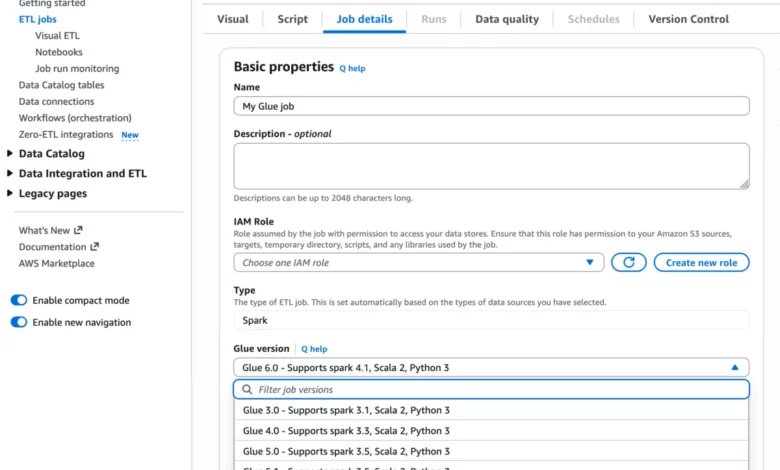
For teams utilizing the visual interface, upgrading or creating jobs via the AWS Glue Studio console involves navigating to the Job Details tab and selecting the designated version labeled Glue 6.0 – Supports Spark 4.1, Scala 2, Python 3. For interactive workflows and notebook-based development, data scientists and engineers can leverage AWS Glue Studio notebooks or interactive sessions by setting the magic command %glue_version 6.0.
To assist organizations with legacy workloads, AWS has integrated the Spark upgrade agent directly into AWS Glue Studio. This tool analyzes existing scripts and configurations, identifying potential compatibility issues or deprecated functions when moving from earlier versions of Glue to the Spark 4.1-based runtime. Additionally, an auto-upgrade feature is available to streamline the transition process for standard production jobs.

Regional Availability and Ecosystem Integration
AWS Glue 6.0 is generally available immediately across all commercial AWS Regions where the AWS Service operates. Organizations seeking specific Regional availability details or reviewing the service roadmap can consult the AWS Capabilities by Region documentation.
Furthermore, AWS has incorporated modern AI-assisted operational tooling into this release. Developers and platform administrators can interact with AWS Glue 6.0 documentation, search API references, verify Regional availability, and troubleshoot deployment errors by utilizing the AWS Model Context Protocol (MCP) Server and associated plugins within their preferred AI-enabled development tools.
Fact-Based Analysis of Broader Market Implications
The launch of AWS Glue 6.0 carries several notable implications for the broader cloud data analytics market.
First, the aggressive 30 percent price reduction intensifies competition among major hyperscalers—namely Microsoft Azure and Google Cloud Platform—forcing rival providers to continually evaluate the cost-to-performance ratio of their own managed serverless Spark and ETL offerings. As profit margins on basic data processing contract, differentiation will increasingly rely on advanced feature sets, such as deep native integration with open table formats like Apache Iceberg.
Second, the maturation of semi-structured data handling via the VARIANT data type addresses a persistent operational bottleneck in modern data pipelines. Semi-structured formats like JSON logs and IoT event streams constitute a massive share of enterprise data intake. By streamlining the ingestion and querying of these formats without forcing rigid upfront schemas or maintaining costly duplicate copies, AWS Glue 6.0 reduces both storage overhead and engineering maintenance hours.
Finally, the seamless upgrade path provided by AWS demonstrates a concerted effort to reduce technical debt for enterprise clients. By embedding automated upgrade agents and maintaining API continuity, AWS encourages rapid adoption of cutting-edge open-source runtimes like Apache Spark 4.1. This strategy not only accelerates time-to-value for end-users but also reinforces the dominance of AWS as a central orchestrator in the modern open-format data lakehouse ecosystem.