RefluXFS Linux Kernel Vulnerability Enables Local Root Access via XFS Reflink Race Condition

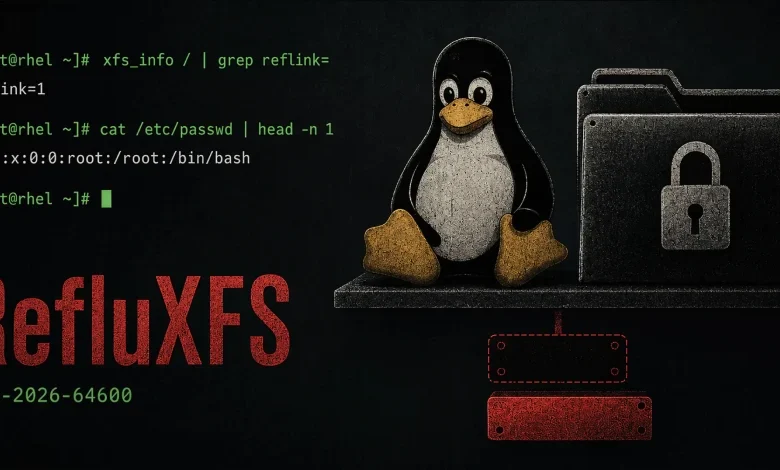
The cybersecurity landscape has been jolted by the discovery of a critical local privilege escalation vulnerability in the Linux kernel, specifically targeting the XFS filesystem. Identified as CVE-2026-64600 and dubbed "RefluXFS" by the researchers at Qualys who discovered it, the flaw allows an unprivileged local user to gain persistent root access by exploiting a race condition. This vulnerability is particularly significant because it affects several major enterprise-grade Linux distributions in their default configurations, including Red Hat Enterprise Linux (RHEL), Fedora Server, and Amazon Linux. The disclosure, made public on July 22, 2026, highlights a fundamental synchronization error within the kernel’s handling of file reflinks, a feature increasingly used in modern cloud and server environments to optimize storage.
Understanding the RefluXFS Mechanism
At its core, RefluXFS is a "stale mapping" vulnerability that occurs during the interaction between XFS reference links (reflinks) and direct I/O operations. The XFS filesystem supports a feature known as "reflink," which allows multiple files to share the same physical data blocks on a disk. When a file is reflinked—typically using the FICLONE ioctl—the system uses a copy-on-write (CoW) mechanism. This means that both the original file and the clone point to the same data until one of them is modified, at which point the kernel is supposed to allocate new blocks for the modified data to prevent the original file from being altered.
The vulnerability arises from a check-then-use error during a lock cycle in the kernel’s block-mapping logic. Specifically, when an attacker attempts a concurrent write using the O_DIRECT flag against a reflinked file, a race condition can be triggered. The kernel initially reads the data-fork mapping while holding the inode lock (ILOCK). However, to reserve transaction space for a potential copy-on-write operation, it must momentarily release and then reacquire this lock.
During this brief window, a second writer can complete a separate CoW operation, causing the file to be remapped to a new block. When the first writer reacquires the lock, the kernel fails to adequately verify if the mapping it previously retrieved is still valid. As the Qualys advisory notes, the mapping becomes "stale" the moment the lock is reacquired. Because the kernel continues to use the old, now-stale address, the write operation intended for the attacker’s cloned file is instead directed to the physical block still owned by the original, protected file—such as /etc/passwd or a setuid-root binary.

The Role of AI in Vulnerability Discovery
One of the most notable aspects of the RefluXFS discovery is the methodology employed by Qualys. The research team utilized a restricted-access frontier AI model, Anthropic’s Claude Mythos Preview, to analyze the Linux kernel source code. The researchers specifically prompted the AI to identify vulnerabilities similar to the infamous "Dirty COW" (CVE-2016-5195) bug, which also involved a race condition in the kernel’s memory management.
The AI model was not only able to locate the specific race condition within the XFS code but also assisted in drafting the technical advisory and developing a working proof-of-concept (PoC) exploit. This successful application of generative AI in high-level vulnerability research marks a significant milestone in the evolution of offensive and defensive security. It demonstrates that advanced models can now navigate complex kernel logic to find deeply nested synchronization errors that have eluded human auditors for years. In this case, the bug traces back to a commit in 2017 (Linux 4.11), meaning it remained latent in the kernel for nearly a decade before being identified by the AI-assisted team.
Affected Distributions and Environmental Conditions
The risk posed by RefluXFS is not universal to all Linux systems but is highly concentrated in environments where XFS is the primary filesystem. Qualys identified three specific conditions required for successful exploitation: the system must be running a vulnerable kernel version, the XFS filesystem must have reflinks enabled (which is the default for many modern versions), and the attacker must have local access to run unprivileged code.
Default installations of the following operating systems are confirmed to be at risk:
- Red Hat Enterprise Linux (RHEL) 8, 9, and 10
- CentOS Stream
- Fedora Server (version 31 and later)
- Amazon Linux 2023
- Amazon Linux 2 (images released from December 2022 onward)
- Oracle Linux, Rocky Linux, AlmaLinux, and CloudLinux (versions 8, 9, and 10)
In contrast, distributions such as Debian, Ubuntu, SLES, and openSUSE are generally not vulnerable in their default states because they typically use ext4 or Btrfs for the root filesystem. However, if a system administrator manually chose XFS with reflink support during the installation process, these systems would be equally exposed. Administrators can verify their status by checking the root filesystem with the command xfs_info / | grep reflink=. A result of reflink=1 indicates that the second necessary condition for exploitation is met.

Chronology of Disclosure and Patching
The timeline of RefluXFS suggests a well-coordinated effort between researchers and vendors to ensure patches were available before the public disclosure.
- July 10, 2026: The flaw was first auto-imported into Red Hat’s bug tracker, initially described as a potential data corruption issue.
- July 14, 2026: Red Hat began issuing "Important" rated kernel advisories (RHSA) and shipping updated kernels to its RHEL 8 and RHEL 9 streams.
- July 16, 2026: The official fix was merged into the upstream Linux kernel. The patch involved adding sequence counters (
ip->i_df.if_seq) to track changes in the data fork, ensuring that the kernel re-reads the mapping if the counter changes during a lock cycle. - July 17, 2026: Patching extended to RHEL 10 and SAP-specific streams.
- July 22, 2026: Qualys publicly disclosed the RefluXFS vulnerability via the oss-security mailing list and a formal technical advisory.
This proactive patching schedule meant that many enterprise customers who follow standard update cycles were protected days before the technical details of the exploit were made public.
Technical Implications and Stealth Potential
The RefluXFS exploit is particularly dangerous due to its "stealth" characteristics. Because the overwrite occurs at the block layer, it bypasses the standard file metadata updates. When the attacker overwrites a root-owned file, the file’s ownership, permissions, timestamps, and setuid bits remain completely unchanged.
For example, if an attacker targets a setuid-root binary like /usr/bin/chfn, they can replace the binary’s code with a malicious payload. Because the metadata is untouched, the system still views the file as a legitimate, root-owned setuid binary. When executed, the malicious code runs with full root privileges. Furthermore, because the write is performed via O_DIRECT, it skips the kernel’s page cache and leaves no obvious logs or warnings. In testing, Qualys researchers found that even stringent security frameworks like SELinux (in Enforcing mode), seccomp, and kernel lockdown were unable to prevent the exploitation, as these systems generally do not monitor for this specific type of block-level synchronization error.
Broader Impact on Enterprise Security
The discovery of RefluXFS serves as a reminder of the inherent complexities in filesystem development and the persistent risks of race conditions in multi-threaded kernel environments. XFS is favored in enterprise settings for its high performance and scalability, but the introduction of advanced features like reflinks increases the attack surface.

The incident also highlights the "dual-use" nature of AI in cybersecurity. While Qualys used AI to find and fix a bug, the same techniques could be used by malicious actors to discover "zero-day" vulnerabilities in other critical infrastructure. The fact that the AI found a nine-year-old bug suggests that there may be many other legacy vulnerabilities hidden in the millions of lines of Linux kernel code, waiting for the right prompt to be uncovered.
Remediation and Recommendations
There is no known configuration-based mitigation for RefluXFS. Standard hardening techniques, such as disabling specific mount options, are ineffective because the reflink capability is baked into the filesystem format at creation. The only reliable solution is to update the Linux kernel to a version that includes the backported fix.
System administrators are urged to:
- Identify Vulnerable Hosts: Use
xfs_infoto find any mounted XFS volumes withreflink=1. - Apply Updates: Install the latest kernel packages provided by the distribution vendor (e.g.,
dnf update kernelon RHEL/Fedora). - Reboot: A system reboot is mandatory to ensure the new kernel is active in memory. Simply installing the package does not mitigate the threat to the currently running system.
- Audit Multi-tenant Systems: Prioritize systems where untrusted users have local shell access or the ability to execute code, such as CI/CD runners and shared web hosting environments.
As of the latest reports, there have been no confirmed instances of RefluXFS being exploited in the wild. However, with the public availability of the technical advisory and the detailed description of the race condition, the window for exploitation remains open for any systems that have not yet been patched and rebooted.
Related posts: