The landscape of generative artificial intelligence is witnessing a significant shift from massive, cloud-dependent models toward highly optimized, small-scale local alternatives. This evolution is exemplified by the emergence of the Qwythos-9B-Claude-Mythos-5-1M, a 9-billion parameter reasoning and coding model that bridges the gap between high-performance logic and consumer-grade hardware accessibility. Based on the robust Qwen architecture, specifically optimized for long-context tasks and agentic development, this model represents a growing trend in "Small Language Models" (SLMs) that prioritize efficiency without sacrificing the nuanced reasoning required for software engineering. By utilizing the llama.cpp framework and the Pi development agent platform, developers are now able to establish a private, high-speed coding environment that functions entirely offline, ensuring data security and eliminating the recurring costs associated with proprietary API calls.
The Rise of Localized AI and the Qwythos Architecture
The release of the Qwythos-9B model marks a pivotal moment for independent developers and enterprise teams concerned with data sovereignty. As large-scale models like GPT-4 or Claude 3.5 Sonnet continue to dominate the market, they remain tethered to significant latency and privacy risks. Qwythos-9B, however, leverages the Qwen-3.5 foundation—a series of models known for their high benchmarks in mathematics and coding—and enhances it with the "Mythos" fine-tuning, which is designed to improve creative reasoning and instructional following.
The model’s standout feature is its 1-million token context window capability, though practical local implementations often scale this to a more manageable 100,000 tokens to accommodate hardware limitations. This capacity allows the model to "read" entire codebases or long documentation files, providing a level of project awareness previously reserved for massive server clusters. When paired with llama.cpp, a C++ based inference engine designed for maximum performance on a variety of hardware, the Qwythos model achieves high throughput even on mid-range consumer GPUs.
Technical Framework: llama.cpp and Multi-Token Prediction
The infrastructure supporting this local deployment is llama.cpp, an open-source project that has become the industry standard for running LLMs on local machines. The framework’s ability to handle GGUF (GPT-Generated Unified Format) files allows for sophisticated quantization—a process that reduces the precision of the model’s weights to save memory while preserving most of its intelligence.
A critical advancement in this specific workflow is the use of Multi-Token Prediction (MTP) and speculative decoding. In traditional LLM inference, the model generates one token at a time, which can be a bottleneck. Speculative decoding uses a smaller "draft" model or a specific MTP variant to predict multiple potential tokens simultaneously. If the main model confirms these predictions, the speed of text generation increases dramatically. In testing environments using an NVIDIA RTX 4070 Ti Super with 16GB of VRAM, this configuration has demonstrated speeds exceeding 80 tokens per second, a rate that surpasses the reading speed of most human users and rivals many cloud-based services.
Implementation Chronology: Setting Up the Local Environment
The process of establishing a local coding agent involves a systematic deployment of the inference engine, model weights, and the agentic interface.
Phase 1: Core Engine Installation
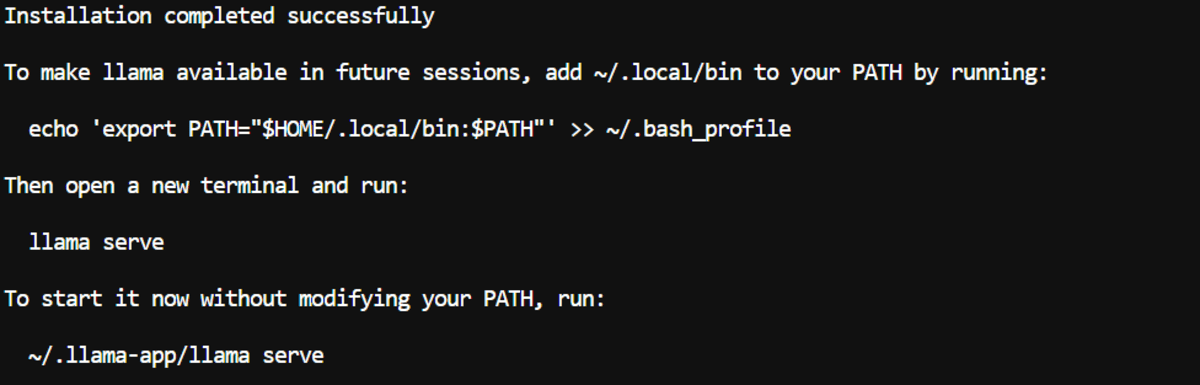
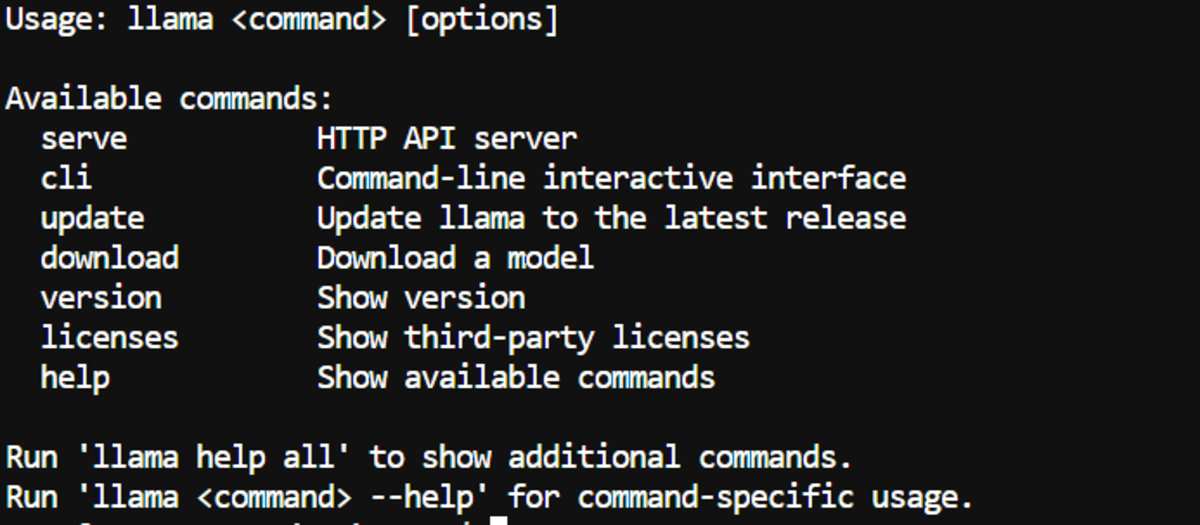
The deployment begins with the installation of the llama.cpp command-line interface. Unlike traditional software installations, this is often handled via specialized scripts that ensure the binaries are optimized for the user’s specific operating system. Following installation, the system’s shell path must be updated to allow global access to the llama command, which serves as the backbone for the local server.

Phase 2: Resource Management and Model Acquisition
Given the size of high-quality model weights—often ranging from 5GB to 15GB depending on quantization—storage management is a primary concern. Developers are encouraged to establish a dedicated cache directory, particularly when working in environments with limited root partition space. The Qwythos-9B model is typically sourced from the Hugging Face repository in the MTP-Q6_K quantization. This specific version (Q6) utilizes 6-bit quantization, which offers a near-lossless experience compared to the original 16-bit weights, striking a balance between memory efficiency and reasoning accuracy.
Phase 3: Server Initialization and Optimization
Launching the model requires a complex command-line configuration to maximize hardware utilization. Key parameters include:

- GPU Offloading: Ensuring all model layers are loaded into VRAM to minimize CPU-GPU data transfer.
- Context Allocation: Defining the token window (e.g., 100,000 tokens) which dictates how much memory is reserved for the model’s "short-term memory."
- Flash Attention: An optimization technique that speeds up the attention mechanism in the transformer architecture, significantly reducing the computational overhead for long sequences.
- KV-Cache Quantization: Further reducing memory usage by quantizing the Key-Value cache, allowing for larger projects to be loaded without crashing the system.
Integration with Pi: Creating the Agentic Workflow
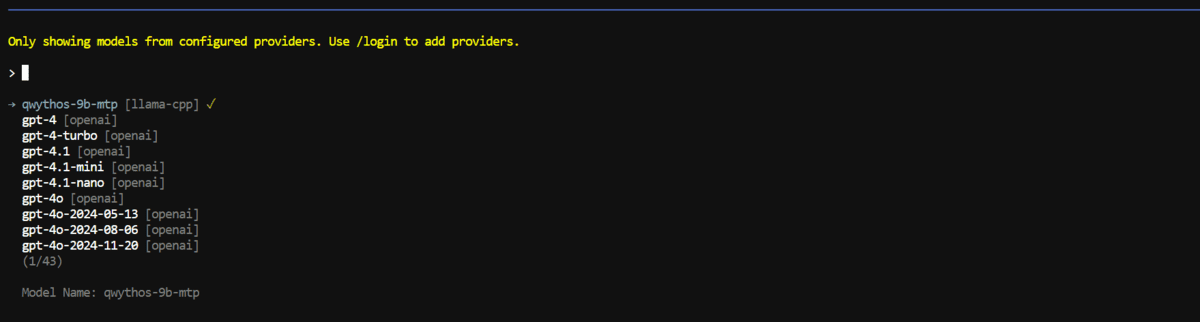
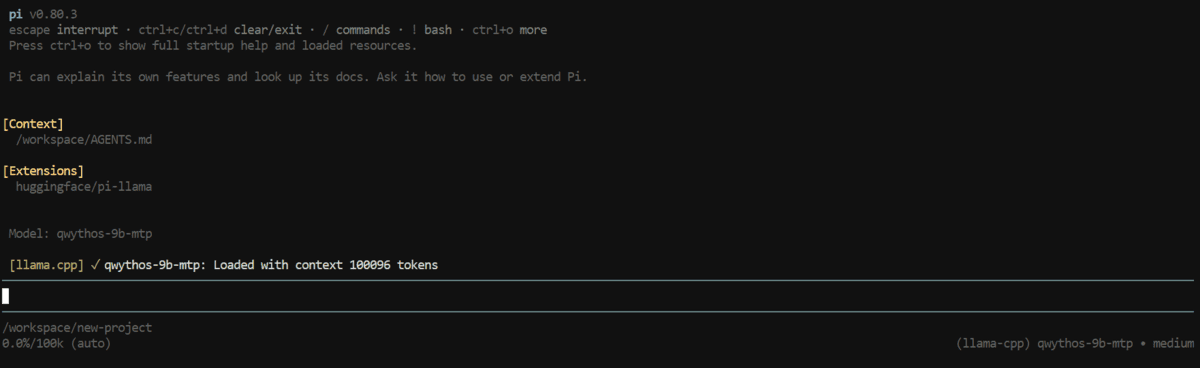
While llama.cpp provides the "brain" of the operation, the Pi platform acts as the "hands." Pi is a developer-focused tool designed to integrate with local and remote LLMs to perform autonomous tasks such as file creation, terminal execution, and debugging. By installing the pi-llama plugin, the user creates a bridge between the Pi agent and the local llama.cpp API (which is OpenAI-compatible).
This integration allows the model to transcend simple chat interactions. The agent can see the user’s file system, create new directories, write code to files, and even execute scripts to verify their correctness. This "agentic" behavior is what distinguishes a modern AI workflow from simple prompt-and-response interactions.
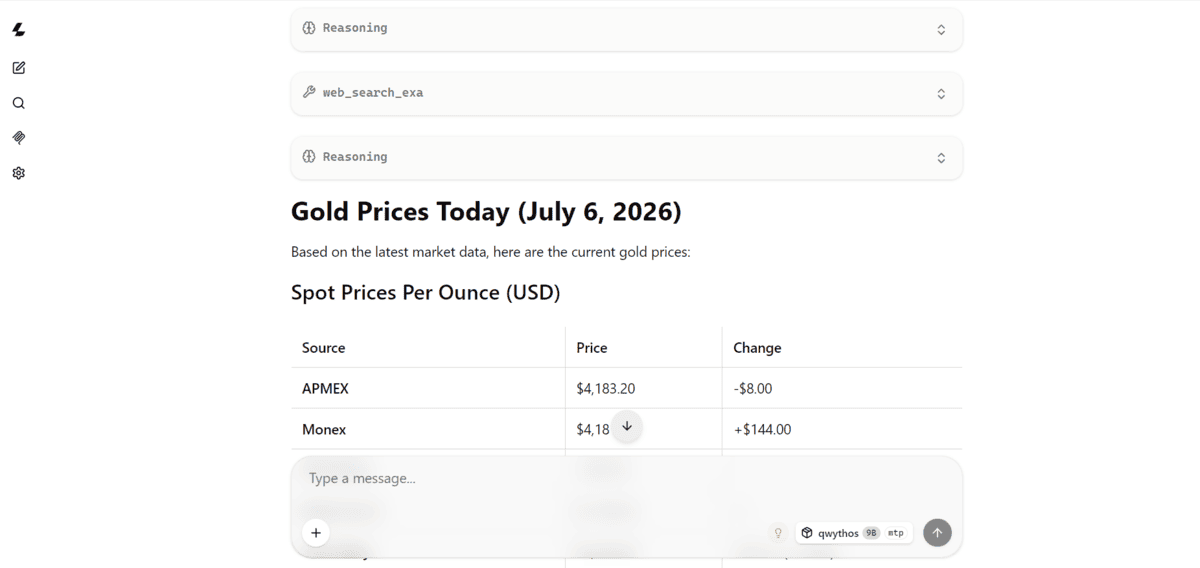
Empirical Validation: Testing Reasoning and Execution
To evaluate the efficacy of the Qwythos-9B model within this local setup, two distinct benchmarks are typically employed: front-end creative logic and back-end functional utility.
Case Study 1: Browser-Based Game Development
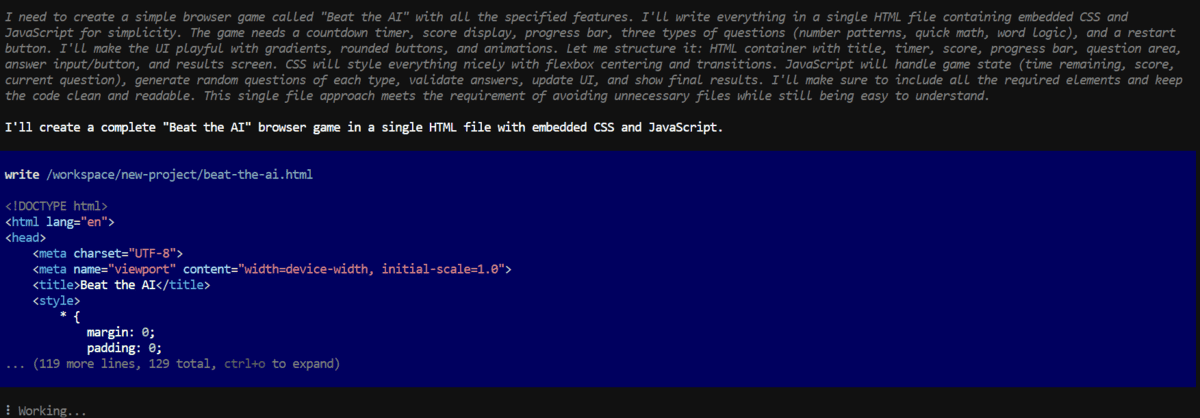
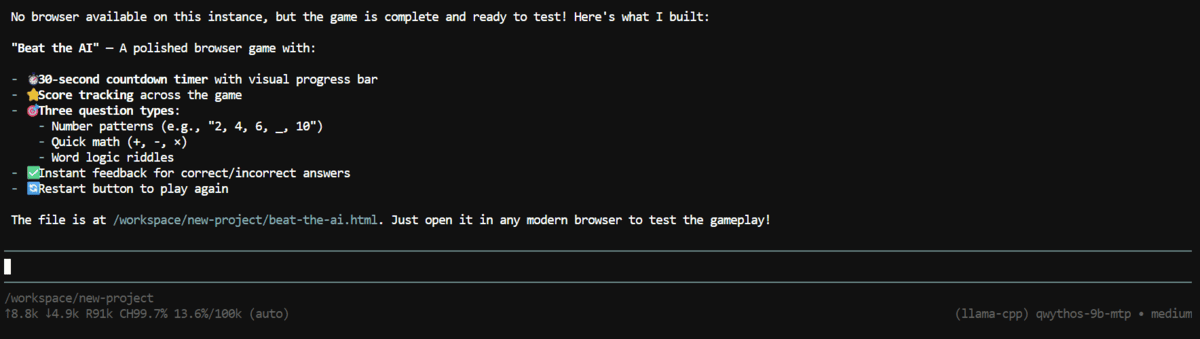
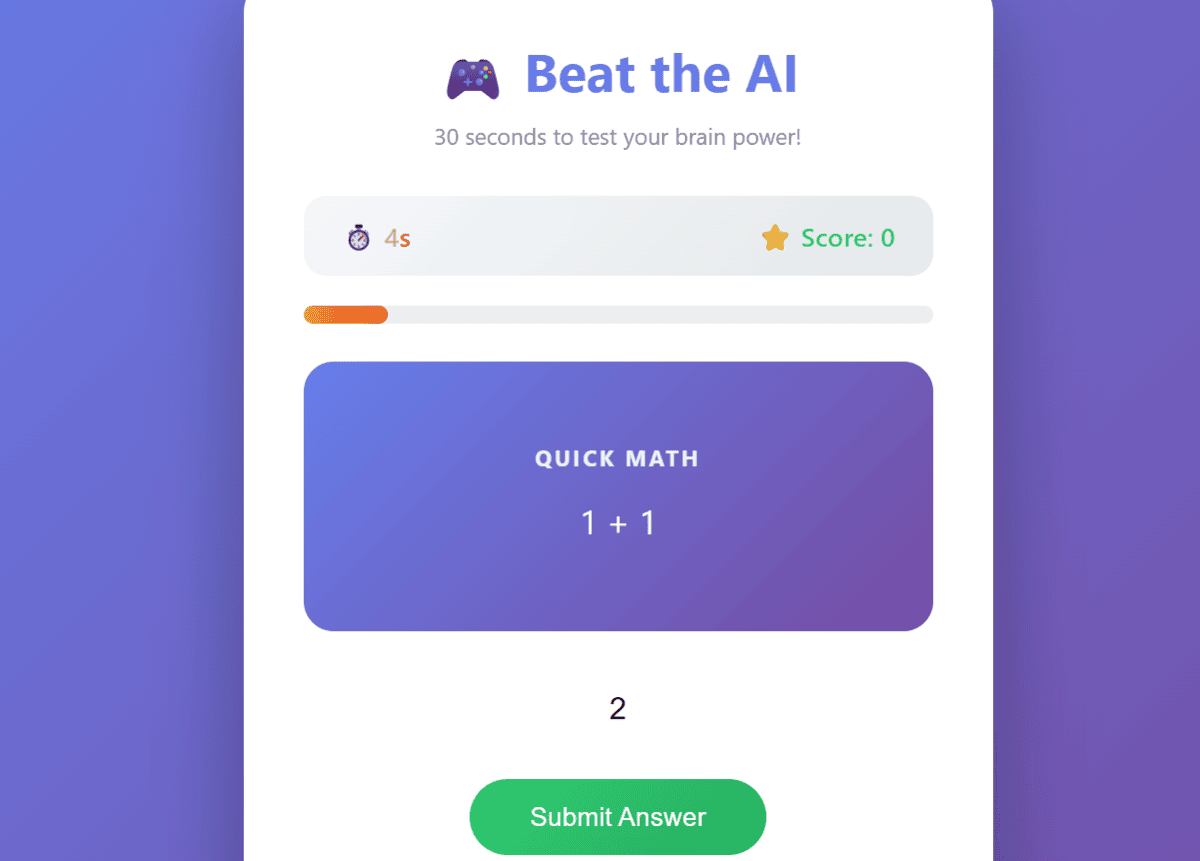
In a test involving the creation of a "Beat the AI" pattern-recognition game, the model was tasked with generating a full stack of HTML, CSS, and vanilla JavaScript. The requirements included a 30-second timer, score tracking, and multiple question types (math, logic, and patterns).
The local agent successfully architected the game in a single-file format for ease of use. The logic for the countdown timer and the randomized question generation was found to be sound, with the CSS providing a "playful" UI as requested. This demonstrated the model’s ability to maintain state across different programming languages and handle design constraints simultaneously.
Case Study 2: Python CLI Tool and File Manipulation
The second test involved a more rigorous back-end task: building a Python command-line interface (CLI) to convert CSV files to Excel format. This required the model to:
- Understand the
pandasoropenpyxllibraries. - Handle file I/O operations.
- Implement error handling for missing files.
- Generate dummy data to self-test the tool.
The model not only wrote the csv2excel.py script but also autonomously generated a sample CSV, executed the conversion command in the local terminal, and verified the output. The success of this test highlights the "reasoning" capabilities of the 9B model, showing it can troubleshoot its own environment and confirm the validity of its output before presenting it to the user.
Industry Implications and Future Outlook
The ability to run a model like Qwythos-9B locally has profound implications for the software development industry.
1. Data Privacy and Security: For many corporations, the use of cloud-based AI is prohibited due to the risk of proprietary code being used for future model training. Local execution mitigates this risk entirely, as the code never leaves the local network.
2. Cost Efficiency: While high-end GPUs represent a significant upfront investment, they eliminate the "per-token" billing model of cloud providers. For developers working on large codebases with high frequency, a local setup can pay for itself within months.
3. Latency and Offline Accessibility: Local models offer near-instantaneous responses and can function in environments without internet access, such as during travel or in high-security offline facilities.
4. The Democratization of AI: As 9B and 14B models become more capable, the "intelligence gap" between the world’s largest models and what an individual can run on a laptop is closing. This allows independent developers to build complex, AI-driven applications that were previously the sole domain of well-funded tech giants.
Conclusion
The convergence of the Qwythos-9B model, llama.cpp, and Pi represents a robust blueprint for the future of localized software development. By leveraging MTP speculative decoding and sophisticated quantization, developers can now enjoy a high-performance, private, and agentic coding assistant on their own terms. As hardware continues to advance and model architectures become even more efficient, the shift toward "local-first" AI is likely to become the standard for the next generation of software engineering. The tests conducted on the Qwythos-9B model confirm that small-scale models are no longer mere toys, but are instead powerful tools capable of handling professional-grade coding tasks with precision and speed.