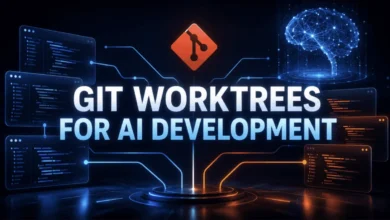
Git Worktrees for AI Development: Scaling Autonomous Coding Workflows and Multi-Agent Parallelism

The rapid integration of autonomous artificial intelligence agents into the software development lifecycle has exposed a critical bottleneck in traditional version control workflows. As tools like Claude Code, Cursor, and OpenAI’s specialized models transition from simple autocomplete suggestions to multi-step agents capable of rewriting entire authentication modules, the standard practice of branch switching and "git stashing" is becoming a primary source of technical friction. Industry data suggests that while 51% of professional developers now utilize AI tools on a daily basis, only 17% report that these tools have significantly improved team collaboration or workflow efficiency. This discrepancy points to an infrastructure problem rather than a failure of the AI models themselves. The solution gaining traction among engineering leads is the utilization of Git worktrees, a feature introduced in Git version 2.5 in 2015 that has found a second life as essential infrastructure for the 2025–2026 AI coding wave.
The Evolution of Workflow Friction in the Agentic Era
In a traditional development environment, a software engineer works within a single directory. When a high-priority production bug arises, the developer must "stash" their current progress, switch to the main branch, apply a hotfix, and then return to their feature branch. While this is a standard inconvenience for humans, it is catastrophic for autonomous AI agents. An AI agent running a complex task builds a specific context based on the current file state, environmental variables, and temporary build logs. Interrupting this process by switching branches mid-task often results in the loss of the agent’s orientation, requiring a costly "re-indexing" phase that wastes both time and API tokens.
Furthermore, the emergence of multi-agent workflows—where different agents work on separate features of the same codebase simultaneously—creates a risk of silent file corruption. If two agents operate within the same working directory, they may inadvertently overwrite each other’s changes to shared files like package.json or requirements.txt without triggering a merge conflict notification until the final build fails. Git worktrees eliminate these collisions by allowing one .git directory to support multiple, isolated working directories. This architecture ensures that each AI agent has its own dedicated physical space on the disk, invisible to other agents, while still sharing the same underlying repository history and object database.
Chronology of Adoption: From 2015 to the Microsoft Global Hackathon
The technical foundation for this workflow was laid a decade ago with the release of Git 2.5. However, for years, the feature remained a niche tool for developers working on massive monorepos where multiple clones were too storage-intensive. The timeline shifted significantly in late 2024 and early 2025 as autonomous agents became commercially viable.
A pivotal moment for this workflow occurred during the Microsoft Global Hackathon in late 2025. Tamir Dresher, a prominent engineering lead, documented a shift in team dynamics where his role transitioned from a primary coder to a "technical lead" overseeing a fleet of AI agents. By utilizing Git worktrees, Dresher’s team was able to assign specific features to individual agents, each running in its own isolated worktree. This allowed for the simultaneous implementation of OAuth2 flows, REST endpoint construction, and production bug fixes without any cross-contamination of code. The success of this model at the hackathon provided a blueprint for what is now referred to as "parallel agentic development."
Technical Architecture: How Worktrees Facilitate Isolation
A standard Git repository consists of the .git folder (the repository) and a single working tree (the files you edit). Git worktrees break this one-to-one relationship. By executing the command git worktree add, a developer creates a new directory that points back to the original .git folder but is checked out to a different branch.
From a resource perspective, this is significantly more efficient than the "naive" alternative of creating multiple clones of a repository. Clones duplicate the entire history and all objects, which can consume gigabytes of space in large projects. Worktrees, conversely, only add the cost of the currently checked-out files. This efficiency is vital for AI development, where a developer might need to spawn five or ten agents simultaneously to handle a suite of microservices or a complex refactor.
To maintain this isolation, industry experts emphasize a four-stage lifecycle for agent-managed worktrees:
- Scripted Creation: Utilizing shell scripts to ensure that every new worktree receives a mirrored set of
.envfiles and installed dependencies. - Context Injection: Providing the agent with an
AGENTS.mdorCLAUDE.mdfile that defines the specific scope and architectural constraints of that worktree. - Parallel Execution: Running the agents in separate terminal multiplexers or IDE windows.
- Linear Synchronization: Using rebasing strategies to ensure the worktree does not drift too far from the main branch over long-running tasks.
Data-Driven Justification for Architectural Context
The push for worktree-based isolation is supported by emerging academic research. Peer-reviewed studies slated for presentation at the International Conference on Software Engineering (ICSE) 2026 indicate that AI agents provided with specific architectural documentation and isolated environments produce code with higher functional correctness. The research suggests that when an agent is "aware" of its boundaries—enforced by the physical isolation of a worktree and the instructional isolation of a context file—the instances of "hallucinated" dependencies or architectural violations decrease by nearly 30%.
This data reinforces the necessity of the AGENTS.md standard. By filling out task-specific criteria within a worktree’s root, developers provide a "ground truth" that limits the agent’s tendency to wander into prohibited zones of the codebase, such as security-sensitive modules or third-party libraries that should remain untouched.
Industry Implications and the Changing Role of the Developer
The shift toward worktree-heavy workflows signals a broader transformation in the software engineering profession. As the "cost of labor" for writing code decreases through AI automation, the "cost of coordination" becomes the primary bottleneck. The developer’s value is increasingly found in their ability to manage these parallel workstreams.

Industry analysts predict that by 2027, the standard "Developer Environment" will no longer be a single window, but a dashboard of active worktrees. In this model, the human engineer acts as a "traffic controller," reviewing the diffs produced in various worktrees, merging them into the main branch, and pruning the worktrees once tasks are completed. This requires a deeper understanding of Git internals than was previously necessary for the average developer.
Furthermore, the adoption of worktrees has implications for Continuous Integration (CI) and Continuous Deployment (CD). Teams are now exploring "pre-CI" checks where AI agents run localized test suites within their own worktrees before a single line of code is ever pushed to a remote repository. This "inner loop" automation significantly reduces the load on shared CI resources and ensures that only high-quality, pre-validated code reaches the pull request stage.
Mitigating the Risks of Branch Drift
Despite the advantages, worktrees introduce the risk of "branch drift." An agent working in an isolated worktree for several days may fall behind the rapid changes occurring on the main branch. If left unmanaged, the eventual merge can become a "merge hell" that requires significant human intervention to resolve.
The emerging best practice to combat this is the "Sync-at-Checkpoint" strategy. Engineering leads recommend that agents be instructed to pause at logical milestones, allowing the human supervisor to run a rebase script. This script pulls the latest changes from the main branch and reapplies the agent’s work on top of them. By maintaining a linear history and resolving conflicts in small, manageable increments, teams can sustain parallel development over weeks-long projects without losing the benefits of isolation.
Conclusion: Infrastructure as the Catalyst for AI Maturity
The transition to AI-driven development is often framed as a battle of LLM capabilities—who has the largest context window or the highest coding benchmark score. However, as the 2025–2026 development cycle has shown, the most productive teams are not necessarily those with the most powerful models, but those with the most robust infrastructure.
Git worktrees represent a mature, battle-tested solution to the modern problem of agentic coordination. By providing physical and logical isolation, worktrees allow developers to scale their output through parallelism without sacrificing code integrity. As AI agents move from experimental toys to the primary engines of software production, the "one repo, one directory" constraint of the past will likely be viewed as an archaic limitation. For the modern engineer, mastering the management of multiple simultaneous worktrees is no longer an optional skill—it is the foundational requirement for operating at the speed of AI.