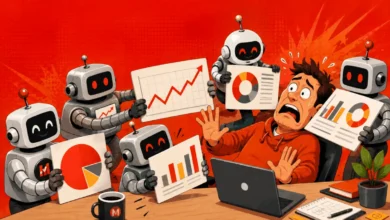
The landscape of consumer engagement has undergone a seismic shift, driven by the pervasive influence of artificial intelligence. As prospective customers increasingly turn to AI tools for product research and category exploration, the very foundations of traditional marketing strategies are being challenged. The information that marketing teams have long considered their most valuable currency, meticulously crafted and disseminated, is now freely and instantly accessible, rendering it a commodity rather than a competitive advantage. This paradigm shift necessitates a fundamental re-evaluation of how brands connect with their audiences, moving beyond the mere dissemination of facts towards the cultivation of deep-seated trust.
For decades, the prevailing marketing dogma centered on delivering "the right message, to the right person, at the right moment." This philosophy, deeply entrenched in rational unique selling propositions (USPs), fueled the growth of disciplines such as Search Engine Optimization (SEO), content marketing, thought leadership initiatives, value-added services, and programmatic targeting. These were all sophisticated mechanisms designed to optimize the efficient delivery of information. However, as AI tools now democratize access to this information, the effectiveness of these strategies is diminishing. The core output of this sophisticated machinery – information – has become abundant and cost-free, effectively neutralizing its power as a differentiator.
The implications are profound. When a potential customer can obtain a competent, factually accurate answer to any query instantly, the value proposition of simply providing information evaporates. This leaves brands in an uncomfortable but unavoidable position: the primary differentiator is no longer what information you provide, but rather who is trusted to deliver it. We are witnessing a transition from an information economy to a trust economy, a development that poses a significant challenge to marketers who have, for the past twenty years, heavily invested in transactional capabilities rather than the cultivation of genuine trust.
Decisions Have Always Been Emotionally Driven, Not Purely Rational
The notion that consumers make purchasing decisions based solely on objective information has long been a flawed premise in marketing. Groundbreaking research, such as Daniel Kahneman’s two-system model of cognitive processing, has consistently demonstrated that human decision-making is predominantly driven by emotion, with rational thought serving as a post-hoc justification. This principle, while acknowledged in academic circles, has often been sidelined in the pragmatic world of marketing.
Empirical evidence supporting this emotional-rational dichotomy in consumer behavior is substantial and long-standing. An extensive analysis of the IPA databank by marketing effectiveness experts Les Binet and Peter Field revealed a striking correlation: emotional advertising campaigns are nearly twice as likely to drive top-tier profit growth compared to those relying solely on rational appeals. This finding underscores that the information consumers engage with most deeply is invariably imbued with human signals – tone of voice, congruence of message and delivery, and the resonance of lived experience. The human brain prioritizes emotional processing, subsequently employing rational faculties to validate those initial feelings.
Artificial intelligence, in its current form, excels at replicating factual information. It can synthesize data, generate reports, and answer complex questions with remarkable speed and accuracy. However, it fundamentally lacks the capacity to replicate the nuanced emotional wrapper that makes information compelling and persuasive. This is precisely why a prospective customer, armed with all the factual answers provided by an AI, may still hesitate to make a purchase. The missing element is not knowledge, but the requisite level of trust in the source to act upon that knowledge.
In the parlance of contemporary branding discourse, information is now considered an expectation, not a differentiator. Brands routinely articulate "why our product is great," "what our product does," and "why our product is different." In the current media environment, this deluge of self-promotional content has devolved into mere noise, easily parsed and dismissed by AI algorithms. The true differentiator lies in the human layer of marketing – the realm of relevance, interest, and surprise. This human element bridges the gap between brands that merely generate noise and those that actively cultivate trust, preventing them from languishing on the "Plateau of Indifference."
The Market is Rapidly Re-evaluating the Value of Trust
The growing importance of trust in consumer decision-making is not merely anecdotal; it is demonstrably reflected in market data. Edelman’s Trust Barometer reports have consistently highlighted this trend. In their 2025 edition, trust emerged as an equal consideration to price and quality in purchase decisions. Notably, a significant 80% of consumers expressed trust in the brands they currently patronize, a stark contrast to the lower figures observed for government (54%) and media (55%).
Concurrently, trust in social media platforms has plummeted to an all-time low of 42%, while search engines maintain a higher level of trust at 63%. Furthermore, the perception that business leaders deliberately disseminate falsehoods has seen a concerning increase, with the percentage of individuals holding this belief jumping by 12 percentage points within a single year. This indicates a heightened consumer sensitivity to perceived insincerity and a growing adeptness at detecting the absence of a genuine human behind marketing messages. Crucially, consumers are becoming less forgiving of this perceived detachment.
The market’s reward system further corroborates this emphasis on authenticity. The BBB National Programs/NAD Influencer Trust Index identified authenticity – a term often debated in marketing circles but undeniably critical – as the cornerstone of consumer trust. Even standard "#ad" disclosures have a limited impact on this trust metric. The underlying reason is that consumers are not reacting to the factual content of the advertisement; they are reacting to the perceived human delivering it.
This does not imply a universal preference for individual creators over established brands. Some studies indicate that influencers are, in certain contexts, trusted less than general advertising. However, the underlying principle remains consistent: as human signals become increasingly replicable at scale, consumers actively seek out genuine connections and develop a backlash against artificial shortcuts. The enduring unit of competitive advantage is not a particular format like video or the label "creator," but rather the inherent qualities of relatability and lived specificity – attributes that are inherently difficult to synthesize durably. These scarce qualities, by definition, command a higher market valuation.
The CFO’s Imperative: Re-allocating Resources for Trust
For Chief Financial Officers (CFOs) and finance departments, this shift presents a critical strategic challenge. AI has effectively commoditized the information layer, which has historically absorbed a significant portion of marketing budgets. However, investment in the human-signal layer – the true driver of consumer decisions – remains comparatively underdeveloped. This imbalance represents a significant missed opportunity.
Despite the evolving consumer landscape, many advertising holding companies continue to double down on media buying and performance-based marketing, even as the fundamental drivers of consumer engagement remain deeply human. The bold truth for CFOs is that their organizations may be investing heavily in a competition that has already been rendered obsolete by AI, while simultaneously underfunding the arena where genuine competitive advantage can still be secured.
This is not an argument for the wholesale abandonment of performance marketing. The widely accepted "60:40 split" between brand building and performance marketing was never intended to be an absolute zero-sum equation. Rather, it signifies a subtle but significant inversion of priorities. The past two decades of marketing expenditure have overwhelmingly favored transactional approaches over the cultivation of trust. Artificial intelligence has simply accelerated the moment of reckoning.
The solution is not to produce more content, as the internet is already saturated with information to a degree that has contributed to declining trust levels. Instead, the imperative is to invest in demonstrating credible evidence that a specific human being stands behind the brand’s message. This is the critical differentiator that AI cannot replicate.
In previous analyses, it was posited that AI surfaces brands possessing the clearest meaning. This represents the technological facet of the current shift. The human dimension, now coming to the fore, reinforces this conclusion. When all brands can provide the same information, the brand that is trusted to deliver it will inevitably prevail. Marketers who recognize and adapt to this reality will systematically build trust, while their competitors will continue to churn out content, ultimately compounding their own irrelevance. Those who fail to grasp this fundamental change risk discovering, through difficult experience, that the fastest route to becoming replaceable is to invest more resources in sounding precisely like a machine that operates for free.