The artificial intelligence landscape has spent the past several years dominated by open-ended, general-purpose large language models (LLMs) such as OpenAI’s GPT series, Anthropic’s Claude, and Google’s Gemini. These models are engineered to generate text, write code, interpret complex multi-step prompts, and simulate natural human conversation. However, as enterprises increasingly integrate AI into production workflows, the industry has encountered a persistent bottleneck: deploying massive, computationally expensive models for routine classification, routing, and decision-making tasks is often inefficient and financially unsustainable. Enter Jev, a newly developed model by TypeSafe AI that has rapidly gained traction across technology blogs, social media channels, and developer forums. While online influencers have hailed Jev as a paradigm-shifting breakthrough that fundamentally reimagines artificial intelligence, a closer examination by machine learning professionals reveals a more nuanced reality—one rooted in long-standing natural language processing (NLP) techniques, refined through specialized architecture and calibration-focused training.
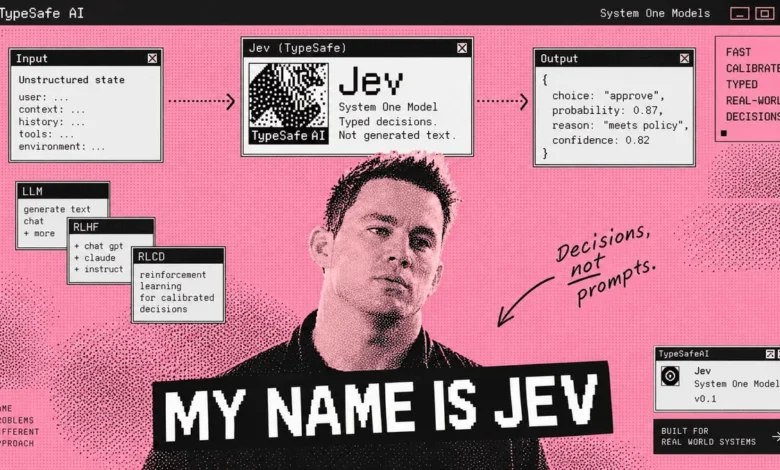
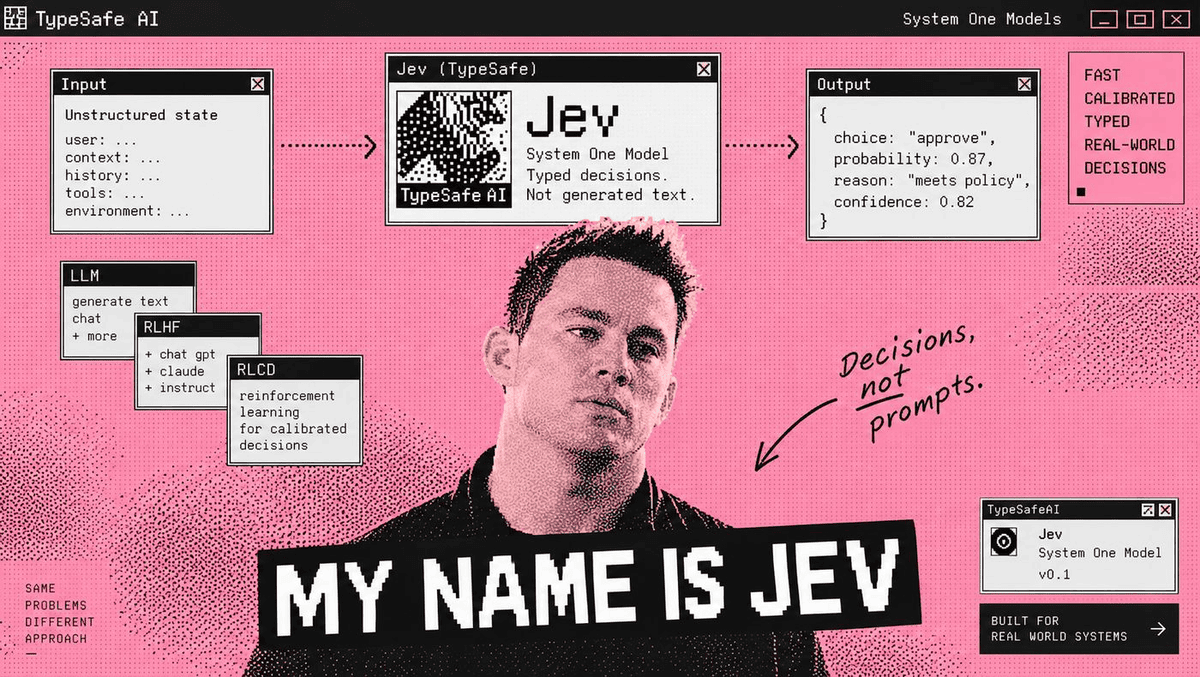
To understand the industry discourse surrounding Jev, it is necessary to examine the core mechanics of what TypeSafe AI defines as a "System One Model." Inspired by behavioral psychology’s conceptualization of System 1 and System 2 thinking—popularized by psychologist Daniel Kahneman—System 1 represents fast, instinctive, and automatic decision-making, whereas System 2 involves slow, deliberate, and analytical reasoning. While frontier LLMs often lean toward System 2 reasoning by generating exhaustive token-by-token chains of thought to solve complex puzzles, Jev is explicitly optimized for the former. When presented with a structured input, such as a customer service message stating, "I upgraded yesterday but now I can’t access the features I paid for," Jev bypasses open-ended text generation entirely. Instead, it evaluates the input against a predefined schema of discrete choices, returning an immediate probability distribution. For this specific query, the model might assign 64% to Technical, 23% to Sales, 13% to Billing, and 0% to Cancellation. This probabilistic output allows downstream software applications to automatically route tickets or escalate ambiguous cases based on transparent confidence metrics, bridging the gap between raw unstructured data and rigid software logic.
The architectural lineage of Jev bears a striking resemblance to established NLP methodologies, specifically zero-shot classification. For years, machine learning engineers have utilized zero-shot text classifiers—powered by architectures like Natural Language Inference (NLI) models such as Facebook’s BART-large-MNLI, which gained widespread prominence between 2019 and 2020—to categorize text against arbitrary, unseen candidate labels without requiring dedicated task-specific training data. Because of these structural similarities, critics and experienced data scientists have debated whether Jev is merely an old concept repackaged with modern marketing. However, dismissing Jev as a standard zero-shot classifier overlooks key engineering divergences. TypeSafe AI has designed Jev around parallel inference, multi-label structured decisions, and a specialized training methodology tailored specifically for calibration. While the underlying problem—text classification and intent detection—is decades old, the productization, inference speed, and developer ergonomics surrounding Jev represent a distinct evolution in how enterprises deploy constrained decision layers.
A central point of discussion among developers is how Jev diverges from traditional frontier LLMs. General-purpose models can technically achieve similar outcomes through advanced prompt engineering, constrained decoding, or function calling, forcing an LLM to output JSON formatted strictly to a schema. Yet, doing so remains computationally heavy, as the underlying architecture still processes billions of parameters and generates unnecessary intermediate tokens. Jev eliminates this overhead by discarding open-ended generation from its core design. By restricting its operational scope to structured decision-making, the model achieves unprecedented processing speeds and cost efficiencies. This architectural specialization explains why Jev can execute classification tasks at a fraction of the computational expense required by large multimodal models, making it an attractive proposition for high-volume enterprise pipelines.
Evaluating the performance and accuracy of Jev remains a complex undertaking due to the current lack of independent, peer-reviewed benchmarks. Initial metrics provided by TypeSafe AI cite a roughly 68% success rate on internal workflow evaluations. However, machine learning researchers emphasize that these reference answers were generated using frontier LLMs rather than independently verified ground-truth datasets. While early small-scale third-party testing has indicated promising results—including high accuracy rates in isolated fact-checking scenarios and strong consensus across limited document sets—industry experts maintain a cautious stance. Comprehensive, large-scale independent benchmarks are required to validate whether Jev’s performance generalizes across diverse, high-stakes enterprise environments. Furthermore, discussions surrounding Jev’s immunity to "hallucinations" require precise semantic clarification. Because Jev operates within a strictly enforced schema—meaning it can only select from pre-approved categories like Billing, Technical, or Sales—it cannot generate out-of-bounds responses such as Legal. In practical terms, this translates to zero out-of-schema outputs. Nevertheless, the model remains susceptible to misclassification; it can incorrectly label a technical issue as a billing inquiry, meaning "zero hallucinations" equates to structural compliance rather than absolute semantic infallibility.

The foundational training innovation behind Jev is described by TypeSafe AI as RLCD, or Reinforcement Learning for Calibrated Decisions. Traditional reinforcement learning from human feedback (RLHF) aligns language models with human preferences regarding tone, helpfulness, and safety. In contrast, RLCD focuses on optimizing the model’s calibration—ensuring that the probabilistic outputs it generates accurately reflect the true likelihood of correctness. In a well-calibrated model, predictions issued with high statistical confidence are empirically correct more frequently than those issued with lower confidence. This calibration transforms raw probabilities into actionable software signals. For instance, if Jev evaluates a transaction with 95% confidence, an automated system can execute an immediate programmatic action; if confidence drops to 52%, the system can dynamically route the case to a human reviewer. By aligning probabilistic uncertainty directly with software logic, RLCD provides developers with a measurable metric of reliability that standard text-generation models struggle to supply.
In terms of real-world utility, Jev is positioned primarily as a foundational decision layer within larger software applications rather than an end-user interface. Early adopters are actively testing the model for automated ticket routing, customer intent detection, content moderation pipelines, intent-based workflow automation, and multi-agent system orchestration. In these architectures, Jev functions as the rapid cognitive router that determines the next step an autonomous agent should take, passing refined parameters to subsequent specialized systems. This modular approach allows organizations to optimize their computational budgets, reserving expensive frontier LLMs strictly for tasks requiring deep synthesis, creative generation, or complex multi-step logical reasoning, while delegating high-frequency classification tasks to lightweight models like Jev.
Ultimately, analyzing TypeSafe AI’s Jev requires balancing technological innovation against marketing hyperbole. The foundational concepts powering Jev—classification, intent detection, zero-shot learning, and probabilistic modeling—are well-established pillars of machine learning research. Characterizing Jev as an entirely unprecedented breakthrough ignores decades of NLP progression. However, dismissing the model as a mere rebranded classifier overlooks the significant engineering achievement of packaging these capabilities into a fast, cost-effective, schema-enforced, and calibration-optimized product architecture. TypeSafe AI has successfully identified and addressed a distinct operational friction point in modern AI deployment: the over-allocation of computing power for binary and categorical decisions. Whether Jev ultimately alters enterprise AI stacks will depend on forthcoming independent validations and real-world scalability. For now, Jev stands out not as a revolutionary leap in artificial intelligence theory, but as a pragmatic, highly optimized engineering solution designed to bridge the gap between probabilistic machine learning and deterministic software engineering.