How To Check If Your Web Page Is In An AI Chatbot Search Index Without Webmaster Tools

The modern search engine optimization landscape has evolved dramatically over the past two decades. For years, digital marketers and search engine optimization professionals relied on rudimentary yet highly effective commands to audit web visibility. Among these, the site: search operator in traditional search engines like Google and Bing served as the ultimate litmus test for verifying whether a specific page had been successfully crawled and indexed. When direct access to platforms like Google Search Console or Bing Webmaster Tools was unavailable, practitioners turned to a secondary method: copying a distinct, meaningful block of text from a web page, enclosing it in quotation marks, and executing a verbatim search. If the exact phrase appeared in the search engine results pages, it confirmed that the content was not only indexed but also potentially syndicated.
However, the rapid acceleration of Answer Engine Optimization and the dominance of generative artificial intelligence platforms have disrupted these traditional verification methods. As search increasingly shifts toward conversational interfaces and AI-driven retrieval systems, traditional webmaster dashboards do not always provide immediate, granular insights into how Large Language Models ingest and retrieve specific web properties. This visibility gap has left many digital marketers scrambling for reliable alternatives to ensure their content is being recognized by AI search tools. Addressing this emerging challenge, SEO expert Chris Green recently published a strategic framework detailing how practitioners can utilize targeted prompting techniques and custom browser extensions to determine if their web pages are actively accessible within AI search indexes.
The Evolution of Search Index Verification and the AI Visibility Crisis
To understand the significance of this new verification approach, one must examine the fundamental mechanics of how modern AI chat interfaces operate. Unlike traditional search engines that rely heavily on static keyword matching and index databases exposed through dedicated webmaster tools, generative AI platforms frequently utilize dynamic retrieval-augmented generation. This architecture allows chatbots to fetch real-time data from the open web to answer user queries. Consequently, determining whether a specific URL or piece of content is eligible for retrieval by an AI assistant has become a complex diagnostic hurdle for technical SEO professionals.
Historically, the absence of centralized reporting for specific AI citation engines meant that site owners operated largely in the dark. While platforms like Bing Webmaster Tools have begun introducing AI citation performance metrics, comprehensive cross-platform visibility data remains sparse. Without access to server log files or proprietary analytics dashboards, verifying whether an AI chatbot can pull a specific page into its active memory presented a significant technical barrier. This operational limitation prompted digital strategists to adapt classic search verification tactics for the era of conversational artificial intelligence.
Adapting Verbatim Snippet Prompting for Generative AI Platforms
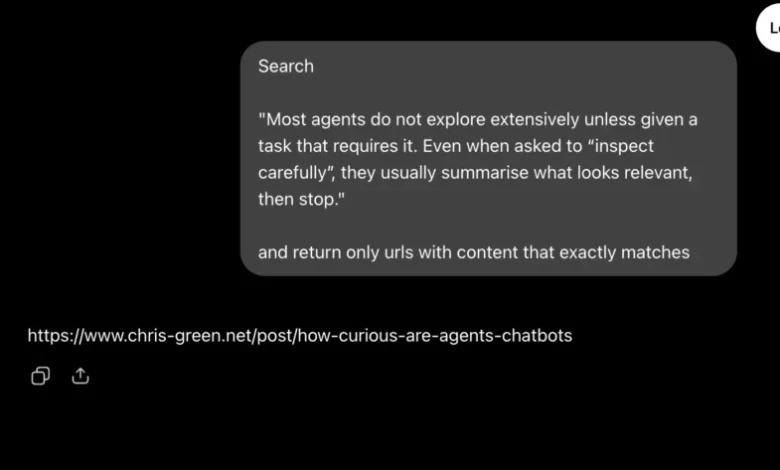
The core methodology proposed for auditing AI retrieval relies on the concept of exact-match verbatim prompting. By extracting a unique snippet of text from a target web page and instructing an AI chatbot with search capabilities to locate and return references containing that exact string, auditors can test whether the underlying URL exists within the AI’s active retrieval index.
A standard diagnostic prompt used in this workflow typically follows a structured command format:
Search for "paste your snippet here" and return any results which contain that exact text only.
When executed on platforms such as a signed-out instance of ChatGPT equipped with web browsing capabilities, the AI queries its underlying index sources. If the system successfully retrieves the page, it generally outputs the corresponding URL and textual context. This output provides immediate, actionable intelligence regarding the page’s status within the AI’s retrieval pipeline.

Industry analysts note that while this method does not replace the deep telemetry offered by comprehensive search console suites, it serves as a reliable proxy metric. By observing whether an AI model can surface a specific string of text alongside its source URL, administrators can confirm that the content has successfully passed through the discovery, crawling, and indexing phases required for AI retrieval.
Chronology of AI Retrieval Diagnostics in Modern SEO
The transition from traditional index verification to AI-focused retrieval auditing has unfolded in distinct phases over the past several years:
- The Pre-AI Era: Practitioners relied exclusively on the
site:operator,cache:commands, and exact-match string searches within traditional search engines to confirm indexation status. - The Rise of Conversational Search: As generative AI models gained widespread adoption, traditional search engine market share began shifting toward conversational interfaces, complicating standard tracking procedures.
- The Visibility Gap: Digital marketers observed discrepancies between traditional search indexing and AI citation performance, creating a demand for new auditing methodologies.
- Emergence of Prompt-Based Auditing: Industry experts began experimenting with exact-match retrieval prompts to test whether AI search tools could surface specific web assets.
- Tooling and Automation: Developers started creating open-source browser extensions and workflow enhancements to streamline the exact-match testing process across multiple AI sessions.
Troubleshooting Indexing Failures and Interpreting AI Search Results
When an exact-match prompt fails to return the expected URL, it signals a breakdown in the retrieval pipeline. Technical SEO specialists recommend a systematic troubleshooting protocol when facing negative results. Because AI platforms frequently pull data from diverse, distributed sources rather than a single unified database, experts advise running the exact-match test four to five times using slightly varied text snippets to account for source rotation and caching delays.
If persistent testing yields no results, webmasters should investigate several potential root causes:
- Discovery and Crawling Blocks: The web page may be restricted by robots.txt directives, noindex meta tags, or server-side firewalls that prevent AI crawlers from accessing the content.
- Indexing Delays: Newly published content often requires an adjustment period before it is fully processed and integrated into dynamic AI search indexes.
- Content Uniqueness: If the text snippet selected is too generic or heavily duplicated across other domains, the AI may prioritize alternative, more authoritative sources.
- JavaScript Rendering Issues: Content that relies heavily on complex client-side rendering without proper server-side prerequisites may fail to be parsed correctly by automated retrieval bots.
Conversely, if a page is successfully returned by the AI chatbot during testing but fails to drive organic traffic or feature prominently in conversational responses, the issue shifts from a technical retrieval problem to an authority and relevance challenge. As search algorithms increasingly prioritize contextual depth and domain authority, simply being present in an index is no longer a guarantee of high visibility or frequent citation.
Streamlining Workflows with Open-Source Extensions
To eliminate the friction of manually copying text snippets and formulating diagnostic prompts, developers have begun creating specialized utility tools. For instance, open-source browser extensions such as "Exactly Matchy," hosted on public code repositories like GitHub, have been introduced to automate the exact-match testing workflow directly within the browser environment.
These extensions typically allow users to highlight text on any given webpage and instantly format a retrieval prompt designed to test AI search visibility. However, cybersecurity and technical SEO experts emphasize the importance of exercising caution when deploying third-party browser extensions. Because these tools operate within active browsing sessions, practitioners are advised to review the underlying source code and install them in developer mode to ensure data security and maintain compliance with internal organizational policies.
Broader Implications for the Future of Search Marketing
The reliance on prompt-based retrieval testing highlights a broader structural shift in digital marketing and search engine optimization. As search engines transition from deterministic keyword-matching engines to probabilistic generative models, the metrics governing online visibility are undergoing a fundamental transformation.
Traditional key performance indicators, such as raw keyword rankings and standard indexation counts, are increasingly being supplemented by retrieval metrics, citation frequency analyses, and exact-match visibility audits. While major search providers will likely continue expanding their official webmaster tooling to accommodate AI-driven search features, interim diagnostic workflows remain an indispensable asset for proactive digital strategists. By mastering prompt-based retrieval testing, SEO professionals can better navigate the opaque mechanics of generative search engines, ensuring their digital properties remain discoverable in an increasingly automated ecosystem.