The Evolution of Authorship in the Age of Artificial Intelligence: Redefining Creative Mastery

Ten years ago, a visitor to the Musée Rodin in Paris encountered a profound realization regarding the nature of artistic creation. The conventional understanding—that the sculptor Auguste Rodin was the singular, physical architect of every work bearing his name—was revealed to be a misconception. While Rodin was the conceptual mastermind, the physical realization of his iconic sculptures relied on an intricate network of assistants, specialist craftspeople, and foundries. From enlargers and reducers to marble carvers and fellow artists like Camille Claudel, the physical production was a collaborative, industrial-scale endeavor. Yet, the art world continues to categorize these works as simply "a Rodin." This historical reality provides a vital framework for navigating the modern dilemma surrounding artificial intelligence in writing and creative production.
The emergence of generative AI has sparked a debate that mirrors the historical tension between individual craft and institutional production. As seen in the recent New York Times profile of artist Jeff Koons, whose studio operates with a system of digital models, standardized processes, and teams of fabricators, the definition of authorship has shifted from the "maker" to the "director." In the context of writing, where AI tools can now assist in research, outlining, editing, and drafting, the professional community is grappling with the distinction between assisted creation and the total abdication of creative responsibility.
The Chronology of Technological Disruption in Creative Work
The integration of technology into creative processes is not a new phenomenon, but the pace of recent developments has been unprecedented. Historically, the evolution of creative tools follows a distinct trajectory: from human-powered labor to mechanized assistance, and finally, to systemic orchestration.
In the late 20th century, word processing software transformed the physical act of typing, effectively automating the mechanical friction of document revision. By the early 2010s, digital research tools and collaborative cloud-based platforms allowed for a more efficient aggregation of data. However, the 2023 release of advanced large language models (LLMs) marked a transition from tool-based assistance to generative output.

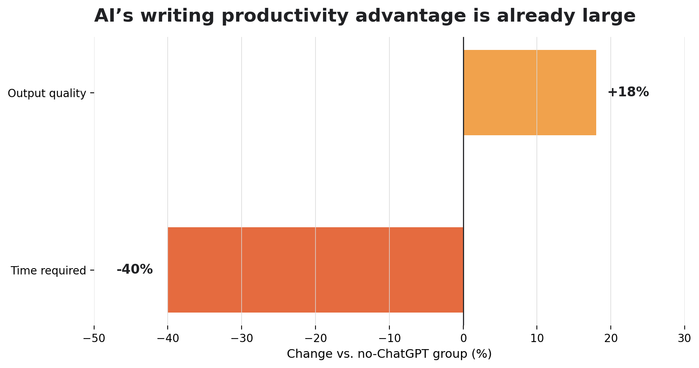
A seminal study published in the journal Science in 2023 by Shakked Noy and Whitney Zhang quantified this shift. Examining 453 college-educated professionals across various writing tasks, the researchers found that access to generative AI tools reduced task completion time by 40 percent while simultaneously improving the assessed quality of the output by 18 percent. This data point serves as the modern baseline for understanding the productivity gains—and the resulting existential anxiety—now facing the creative workforce.
The Purity Versus Abdication Dichotomy
Current discourse regarding AI-assisted writing has largely bifurcated into two extreme positions: the doctrine of "purity" and the practice of "abdication."
Proponents of the purity camp argue that authorship is defined strictly by the manual labor of generating text. In this view, any intervention by an algorithm renders the work intellectually dishonest. Conversely, the practice of abdication involves the full delegation of the creative process to the machine, with the human user acting merely as a passive publisher.
Neither extreme captures the nuance of professional creation. The former conflates the mechanical act of keystrokes with the cognitive act of authorship, while the latter mistakes the role of a project manager for that of an author. True authorship resides in the synthesis of intent, direction, and rigorous judgment. Just as Rodin did not need to chisel every block of marble to remain the author of his work, a modern writer does not necessarily need to type every word to claim ownership of the underlying ideas, provided they retain control over the creative vision.
Cognitive Offloading and the Mastery Ladder
A critical concern identified by researchers is the risk of "cognitive offloading." A 2026 review in Trends in Cognitive Sciences suggests that while outsourcing repetitive tasks can enhance productivity, it may inadvertently impede the acquisition of fundamental skills. The development of expert judgment—the ability to discern quality from mediocrity—is rooted in the process of "formative friction." When a writer wrestles with an argument or refines a sentence to achieve perfect clarity, they are not merely producing a document; they are building the internal mental models required to evaluate future work.
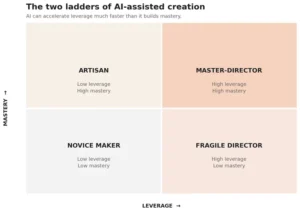
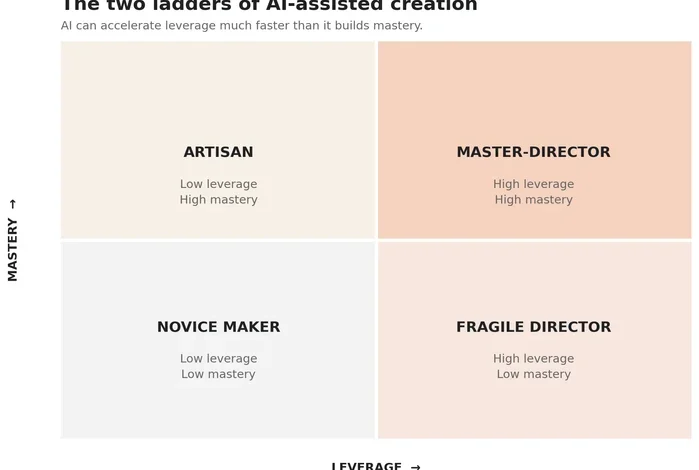
The danger of AI is not that it exists, but that it allows for the emergence of the "fragile director." This individual can produce high-volume content at high speeds without the foundational mastery required to assess its validity or stylistic merit. If the foundational work is offloaded entirely to a machine, the human director loses the ability to recognize when the machine is failing, leading to a degradation of the final output.
The Paradox of Homogenization in Generative AI
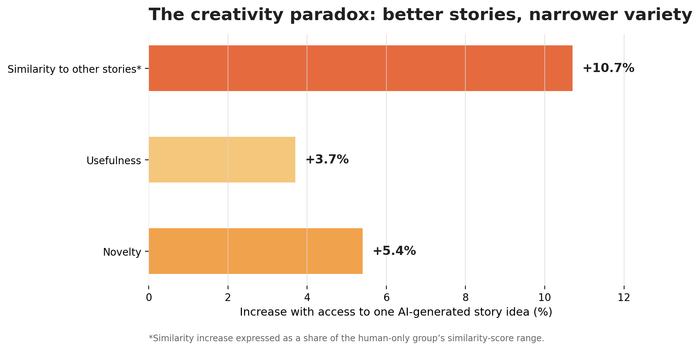
While AI tools offer significant productivity benefits, they also present a paradox regarding creative novelty. A 2024 experiment conducted by Anil Doshi and Oliver Hauser, published in Science Advances, demonstrated that while AI assistance increased the judged novelty and utility of story ideas, it also significantly increased the similarity between the stories produced by different participants.
This effect has been further corroborated by subsequent research. A 2025 study analyzing 2,200 college admissions essays found that human-authored content introduced new semantic diversity at a rate two to eight times faster than models utilizing GPT-4. Furthermore, a 2026 meta-analysis of 19 distinct studies confirmed a statistically significant trend toward "homogenization" in human-AI co-creation. The implication is clear: while AI can elevate the floor of a creator’s output, it often pulls the ceiling toward a statistical average.
Establishing a Modern Standard for Authorship
To maintain the integrity of authorship in the era of artificial intelligence, a new set of criteria must be established. Legal and industry standards are beginning to converge on the idea that the human contribution must be the dominant force in the work. The U.S. Copyright Office’s 2025 report on AI and copyrightability highlights that while the use of AI tools does not disqualify a work from protection, the human must demonstrate active "selection, arrangement, or modification."
A more practical, philosophical test for modern authorship involves five core pillars:
- Origin: Does the work stem from a genuine human inquiry or lived experience?
- Intent: Is there a defined objective that exists independent of the AI’s suggestions?
- Direction: Does the creator actively curate the research, structure, and argumentative flow?
- Judgment: Is the creator capable of evaluating the output for truth, utility, and aesthetic quality?
- Responsibility: Is the creator prepared to defend the content publicly?
If these five conditions are met, the presence of AI-generated text or structure becomes a secondary concern. The focus shifts from the percentage of text generated by a machine to the degree of human oversight and creative intentionality.
Toward the Master-Director Model
The most effective creators in the future will likely adopt the "master-director" model. This approach requires maintaining two simultaneous trajectories: increasing leverage through technology and increasing mastery through traditional practice. By automating the "frictional" labor—such as transcription, citation formatting, and preliminary data aggregation—creators can reclaim time for the cognitive labor that cannot be outsourced: deep thinking, nuanced observation, and the development of a unique voice.
The goal is not to become a mere requester of automated services, nor to cling to manual labor that adds no intellectual value. Instead, the objective is to leverage technology to expand the scope of one’s creative output while deepening the expertise required to guide it. As AI becomes ubiquitous, the value of the human input—the ability to decide what is worth saying and why it matters—will increase in value.
In this landscape, delegation is a tool for expansion, while abdication is a surrender of agency. The future of authorship belongs to those who view technology as a means to amplify their capabilities rather than a replacement for their judgment. The fundamental question for any creator remains: what is worth my time, energy, and commitment? The machine can generate the answer, but only the human can provide the reason.