The AI Era Demands More Than Just Tools; It Requires Permission to Transform Lives


The advent of Artificial Intelligence has undeniably reshaped the landscape of human endeavor, dismantling traditional barriers to entry and offering unprecedented capabilities. Yet, as this technological wave crests, the most significant challenge lies not in mastering the tools themselves, but in granting oneself the permission to embark on a transformative journey. This profound shift is illuminated by the author’s personal narrative, tracing a lifelong pattern of stepping out of comfortable, yet constricting, environments into the vast, often intimidating, unknown. This journey, amplified by AI’s sudden and universal accessibility, presents humanity with a critical juncture: a catalyzed opportunity for growth, or a passive surrender to the status quo.
From the author’s early departure from home at 17 to embark on higher education, to significant life choices made at 27 and 52, a recurring theme emerges: the inherent fear and excitement associated with leaving behind the known for the potential of a larger world. AI, in its current iteration, has acted as a global catalyst, simultaneously opening a multitude of doors for everyone. The critical question is whether individuals and society are prepared to step through them, and what lies beyond.
The Four Gifts of AI: Expertise, Efficiency, Simplicity, and Freedom
Artificial Intelligence is not a deceptive illusion; its gifts are tangible and quantifiable, yet they lead to an uncharted territory. These benefits can be broadly categorized into four key areas:

1. Unearned Expertise: Bridging the Skill Gap
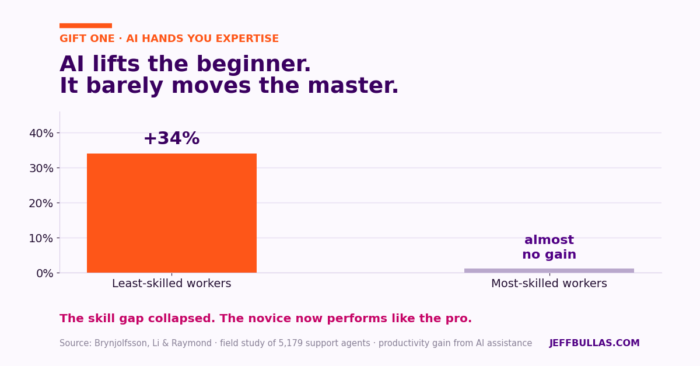
One of AI’s most striking contributions is the democratization of expertise. Research conducted by Stanford and MIT on customer support workers utilizing AI assistants demonstrated a remarkable average productivity increase of 14%. Crucially, the least skilled workers saw a productivity surge of 34%, while the performance of the most experienced individuals saw minimal improvement. This data suggests that AI acts as a powerful leveling agent, effectively imparting the foundational knowledge and patterns of seasoned professionals to novices. The implication is a dramatic reduction in the time and effort historically required to attain a certain level of proficiency, effectively collapsing the skill gap for many entry-level tasks.
2. The Demise of Friction: Accelerating Innovation
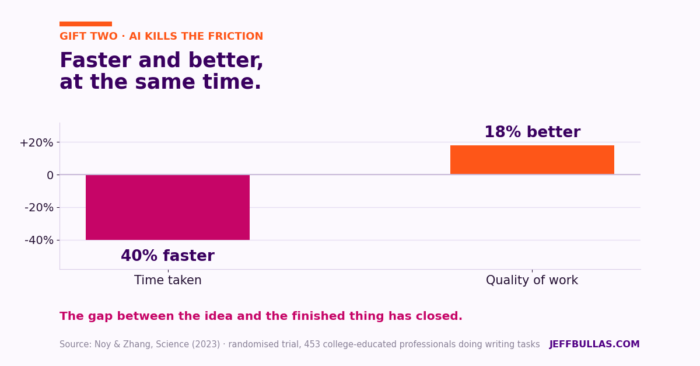
The distance between conceptualization and execution has been drastically shortened by AI. A study published in Science involving 453 professionals undertaking writing tasks revealed that those using ChatGPT experienced a 40% reduction in time spent and an 18% increase in work quality. This dual benefit of speed and enhancement signifies a fundamental alteration in how creative and knowledge-based work can be accomplished. Complex projects that once demanded extensive planning and execution time can now be initiated and brought to a near-complete state with unprecedented rapidity.
3. The Collapse of Complexity: Simplifying the Intricate
Tasks that previously required specialized teams, substantial budgets, and years of dedicated practice can now be approached with a well-posed question and an afternoon’s effort. AI has the capacity to demystify complex processes, making them accessible to a broader audience. This simplification of intricacy is not merely about making tasks easier; it is about unlocking potential by removing formidable obstacles that historically prevented individuals from engaging with challenging endeavors.
4. Unlocking Personal Adventure: The Gift of Permission
Perhaps the most profound, yet often overlooked, gift of AI is the liberation it offers for individuals to pursue their own ambitions. Traditional impediments such as lack of capital, inadequate skills, absence of a team, time constraints, or simply not knowing where to begin, have been significantly diminished by AI. The author posits that the remaining barrier is no longer a matter of capability, but of internal permission. The psychological hurdle of self-authorization to pursue new paths is now the primary gatekeeper.
The Internal Gate: Permission and Action in the Age of AI
The assertion that "everything standing in your way is behind your own eyes" serves as a potent reminder that true transformation hinges on an internal shift. The author suggests a two-step process: first, granting oneself permission to pursue a new direction, and second, taking decisive action. The adage that "action is better than inaction" underscores the peril of allowing good ideas to languish, ultimately leading to their demise. AI can provide the tools, but it cannot open this internal gate; that responsibility rests solely with the individual.
The Unmentioned Catch: The Crowded Room and the Drained Moat
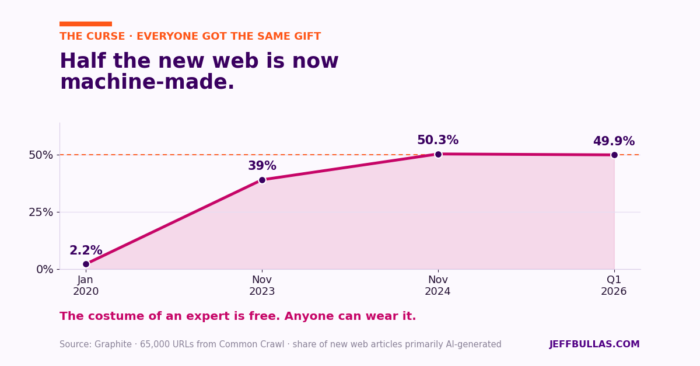
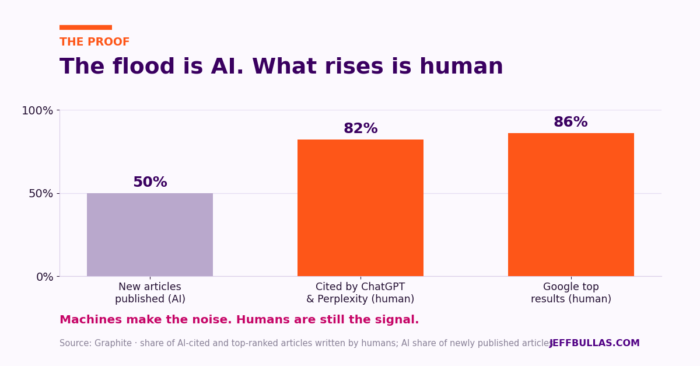
The widespread availability of AI tools, all distributed simultaneously and at a comparable cost, has led to an unprecedented influx of participants into formerly exclusive domains. The rapid adoption of AI in content creation serves as a stark illustration. In January 2020, machine-generated web articles constituted approximately 2% of the total. By late 2024, this figure had surpassed 50%. This "arithmetic" of increased accessibility naturally leads to a more crowded environment.
The underlying implication is that AI has effectively drained the "moat" of difficulty that once protected specialized fields. Historically, the inherent complexity of tasks served as a natural barrier, limiting competition. Now, with AI lowering these barriers, a significant increase in competition is inevitable. This means that while the tools are more accessible, the landscape for standing out has become more challenging due to the sheer volume of individuals now capable of producing at a higher baseline.
The True Villain: Not the Machine, But the Loss of Difficulty’s Protection
The author identifies the true "villain" not as AI itself, but as the erosion of the protective buffer that difficulty once provided. For many, the challenge inherent in a task was not just an obstacle but a form of security. The difficulty of starting a blog, for instance, deterred many, leaving the field relatively open for those who persevered. AI has rendered this protective difficulty obsolete for a vast array of tasks, simultaneously opening the door for both the ambitious and the opportunistic. This presents a dual reality: access to powerful tools coupled with a significantly more competitive environment.
The Price of Walking Through the Door: Personal Transformation and Earned Authority
The author’s personal journey, marked by three significant departures from established norms—leaving home at 17, departing from religious upbringing at 27, and transitioning to entrepreneurship at 52—illustrates the tangible costs associated with embracing the unknown. These transitions involved fear, anxiety, and years of uncertain investment. However, the price paid was commensurate with the rewards: the freedom to grow, the resilience forged through failure, and an intrinsic motivation that transcended mere discipline.
AI can replicate skills, accelerate processes, and generate outputs, but it cannot bestow the deeply ingrained motivation and the earned wisdom that stem from personal struggle and perseverance. This intrinsic drive, the "reason you got up this morning," is a uniquely human attribute cultivated through the very act of navigating challenges.
What AI Can Collapse, and What It Cannot: Doing vs. Deciding
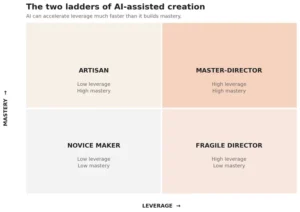
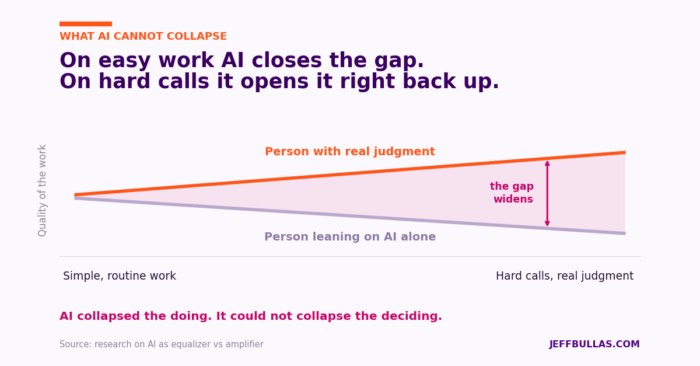
AI’s transformative power is most evident in its ability to equalize performance in routine and predictable tasks. It bridges the gap between beginners and experts, making sophisticated capabilities accessible to a wider audience. However, in areas requiring nuanced judgment, taste, context, and complex decision-making, AI functions as an amplifier rather than an equalizer. It magnifies the capabilities of individuals who already possess these critical human faculties.
Therefore, AI has revolutionized the doing of many tasks but has not, and cannot, collapse the deciding. The market’s response reinforces this distinction. While machine-generated content floods the web, human-authored articles continue to dominate search engine rankings and are more frequently cited by AI models. This suggests that while AI can generate voluminous content, the discerning voice of human judgment remains the signal in the noise.
Building for the Future: The Emergence of Owned Authority
In an era where production is commoditized, the true prize lies in building something that cannot be replicated: a public record of trusted judgment. The author outlines three types of authority, distinguished by who holds the leash:
- Borrowed Authority: Dependent on external validation or platform algorithms.
- Rented Authority: Subject to the whims and changes of underlying systems.
- Owned Authority: Earned through consistent, verifiable action and judgment.
Data from the Edelman Trust Barometer 2025 indicates a global decline in trust towards institutions and figures, with a significant percentage of people feeling that leaders deliberately mislead them. This erosion of institutional trust necessitates a shift towards person-to-person earned authority.
The Pillars of Owned Authority and the Continuous Loop of Trust Building
Building owned authority is not a shortcut but a deliberate process built on five foundational pillars:
- Consistency: Regularly delivering value and insights.
- Transparency: Openly sharing processes and reasoning.
- Authenticity: Expressing genuine perspectives and experiences.
- Vulnerability: Acknowledging limitations and learning from mistakes.
- Impact: Demonstrating tangible positive outcomes for others.
This framework is sustained by an "Authority Loop," a continuous cycle of creating, engaging, learning, refining, and sharing. The critical, and often neglected, step in this loop is the consistent refinement and truthful communication of insights gained from experience. This iterative process, performed publicly, builds a reservoir of trust that is impervious to algorithmic shifts or market fluctuations.
The Unseen Advantage: The Unclaimed Territory of Earned Judgment
The author’s personal writing approach, characterized by a focus on understanding rather than performance, resonated with readers because it revealed the process of thinking. Machines can provide answers, but they cannot replicate a lifetime of earned judgment, a quality forged through experience, risk, and unwavering honesty.
As the tools become universally accessible, the barrier to entry dissolves, and the "room" becomes increasingly crowded. The unique differentiator, the element that cannot be copied, faked, or revoked, is the indelible trail of a person who consistently learned, took risks, and spoke truth publicly, thereby earning irrefutable trust. AI has undeniably opened the door, but the act of stepping through it, navigating the challenges, and forging a path of authentic authority remains a deeply personal undertaking. The question for each individual is not about the tools they possess, but about which room they are prepared to leave behind.