The AI Divide: Why Users Aren’t Craving More Artificial Intelligence, and What They Actually Need

Many businesses operate under the assumption that an insatiable public appetite exists for new artificial intelligence features, products, and workflows. This perception, deeply embedded within corporate strategy, suggests that AI will seamlessly replace outdated practices and resolve existing inefficiencies. However, emerging evidence and user sentiment analysis indicate a significant disconnect between this corporate vision and the reality experienced by individuals. Instead of widespread eagerness, many users express a notable lack of desire for more AI, particularly in the form currently championed by industry leaders. This phenomenon is underscored by consistently low adoption and retention rates for many AI-powered features, often incurred at substantial development costs and carrying significant reputational risks for the implementing organizations.
The current AI landscape, as envisioned by many developers and executives, frequently presents AI as a standalone solution – a bolt-on feature or an entirely separate tool. This approach often disrupts established workflows, forcing users to navigate an additional layer of complexity rather than integrating AI enhancements seamlessly into their existing routines. The inherent nature of AI, while powerful in its ability to process vast amounts of data, can also amplify existing organizational shortcomings. This includes issues with data quality, decision-making processes, and the lingering effects of accumulated technical debt, cultural fragmentation, and internal politics. When AI is introduced into such environments, these underlying weaknesses can become more pronounced, manifesting as inconsistencies, conflicting priorities, and ultimately, a greater burden on end-users to reconcile the disparate outputs and underlying issues.
The fragmented nature of modern work, characterized by constant context-switching between numerous disconnected systems, is exacerbated by the introduction of yet another specialized AI tool. This often leads to increased workload and a diminished sense of accomplishment, as the effort required to manage and integrate these new AI systems outweighs the perceived benefits. Furthermore, users are increasingly aware of the significant effort and potential cost associated with identifying and rectifying AI-generated inaccuracies, commonly referred to as "hallucinations." While the initial act of prompting an AI for a response might appear simpler than manual creation, the subsequent task of verification and correction introduces a hidden but substantial cost.
A critical aspect of this user resistance stems from the unsolicited and often impositional nature of AI integration. For many, AI features are not proactively chosen or explored; they arrive as dictated by corporate roadmaps and at an organizational pace. This top-down introduction, coupled with pervasive narratives about AI potentially displacing jobs, fosters an environment of apprehension rather than excitement. The prevailing sentiment often leans towards resistance to change and deep-seated anxiety about one’s place in a rapidly evolving technological landscape.
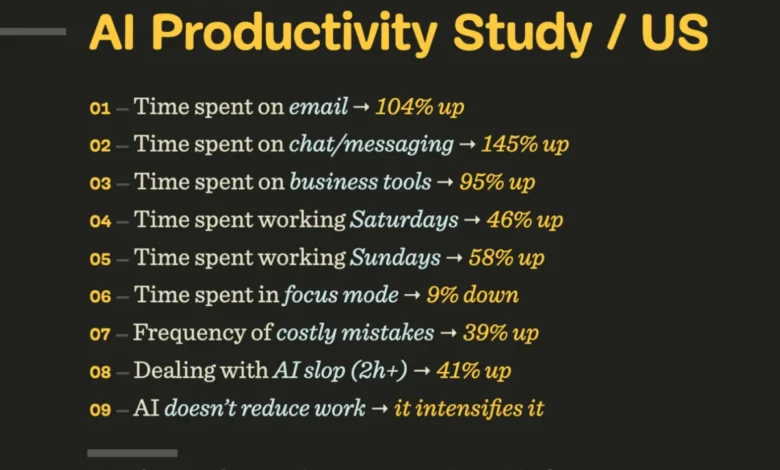
Recent studies have shed light on the actual impact of AI on productivity. For instance, a study reported by NBC News, citing insights from HBR, WSJ, and ActivTrak, revealed a trend where AI implementation did not necessarily reduce work but rather intensified it. The findings indicated significant increases in time spent on tasks like email (up 104%), chat/messaging (up 145%), and business tools (up 95%). This intensification also manifested in extended work hours, with a notable rise in working Saturdays (up 46%) and Sundays (up 58%). Paradoxically, while AI was intended to streamline processes, the study found a decrease in focus mode (down 9%), an increase in costly mistakes (up 39%), and a substantial rise in time spent dealing with AI-generated "slop" (up 41%). This data suggests a counterintuitive outcome where AI, rather than freeing up human capacity, can lead to greater demands on user attention and effort.
At best, new AI features might be met with passive acceptance or quiet resignation. At worst, they can trigger legitimate concerns, doubts, and a healthy dose of skepticism. The inherent unpredictability and unreliability of AI, unlike more established software functionalities, can position it as a liability rather than an asset. This sentiment is further solidified by the absence of widespread public yearning for AI-driven art museums, AI-equipped refrigerators, AI hotel receptionists, or AI-narrated children’s books. The prospect of AI companions, the management of autonomous AI agents operating within personal finances, or the constant need to interact with a disembodied AI interface for every task, do not resonate with the fundamental human desire for genuine connection and intuitive functionality.
The AI People Actually Need

A recurring, albeit flawed, argument in favor of AI centers on comparing its unreliability to human fallibility. However, users do not typically benchmark software against human performance. Instead, they compare features directly. If one product’s feature is consistently unreliable while a similar feature in another product functions flawlessly, users will invariably opt for the latter. The critical distinction lies not in whether a feature is AI-powered, but in its consistent and dependable performance.
Much of the discourse surrounding AI is dominated by discussions about the speed of delivery. While efficiency is important, many individuals find greater value in performing tasks well, with sufficient time for thoughtful consideration and sound decision-making. The emphasis should shift from merely shipping faster to enhancing the quality of the work and fostering an enjoyable experience. The sense of reward and achievement, which is integral to job satisfaction, risks erosion with continuous, rapid, and often superficial technological changes.
Human nature remains remarkably consistent. After decades of technological evolution, individuals continue to seek features that are fast, accessible, reliable, predictable, and unequivocally useful, every single time. The ideal AI integration is not one that replaces entire workflows but rather augments existing processes, taking over the most mundane, tedious, and unenjoyable tasks. This allows individuals to focus their energy on aspects of their work that are more engaging, creative, and personally fulfilling.
The landscape of jobs most vulnerable to AI automation, as highlighted by research from GovAI and Brookings Institution and reported by The Washington Post, reveals that while many roles face significant exposure, the rewarding aspects often lie in the unique, creative, and intuitive elements that require human judgment and perspective. When AI can effectively automate the more tedious and mentally taxing components of these jobs, it presents a clear advantage, enhancing productivity and contributing to greater job satisfaction. This is particularly true when AI is not an add-on but is deeply embedded within existing workflows, aligning with users’ established mental models and decision-making processes. The AI should adapt to human cognition, not the other way around.

Ultimately, the branding of features as "AI," "smart," or "automation" is secondary to their efficacy. For these tools to be successful, users must be acutely aware of their practical applications and be inspired to discover further use cases organically. The most effective tools are not necessarily "AI-first" but rather "AI-second"—subtle, integrated, and supportive, operating in the background to alleviate the burden of dull and unnecessary tasks.
Bo Young Lee articulated a poignant perspective on this dichotomy: "I don’t want to read books written by AI. I don’t want to gaze upon paintings by AI. I don’t want AI to teach my children. I don’t want to have an AI therapist. I don’t want AI making my medical decisions. I want AI to do all the physical and mental labor that taxes me so I can read books written by humans and go to art galleries to engage with art made by humans. I want AI that makes my life easier rather than forces me to change myself." This sentiment encapsulates the desire for AI to serve as a tool for human enhancement, enabling individuals to engage more deeply with human-created content and experiences, rather than replacing them.
Wrapping Up
While acknowledging the possibility of a broader perspective or a generational shift, the inherent value of human interaction remains paramount. The richness of human stories, the nuances of thought, the spectrum of emotions, the infectious nature of enthusiasm, and the simple joy of laughter are irreplaceable. AI can indeed be a powerful aid in numerous contexts, but so can human connection. In any given situation, the preference for spending time with a human, imperfections notwithstanding, is a consistent and understandable choice.

The core need is not for more AI in our lives, but for AI to effectively automate the tedious and repetitive aspects of daily work. This automation should liberate individuals, providing them with the time and mental space to pursue activities they genuinely enjoy and find fulfilling. This does not equate to increased interaction with AI, but rather to more quality time spent with other humans, fostering deeper connections and richer life experiences.
A significant development in this area is the emergence of resources dedicated to improving AI interface design. "Design Patterns For AI Interfaces," a video course by Vitaly, offers practical examples and insights into creating user-centric AI experiences. This initiative, alongside upcoming live UX training sessions, aims to bridge the gap between AI’s potential and its practical, human-centered application. Such educational efforts are crucial for fostering a more thoughtful and effective approach to AI integration in products and services.
The implications of this AI divide are far-reaching. Companies that fail to recognize and address user sentiment risk alienating their customer base, incurring significant financial losses due to low adoption rates, and damaging their brand reputation. A strategic pivot towards user-centric AI design, focusing on augmentation rather than replacement, and prioritizing reliability and seamless integration, will be essential for future success in the evolving technological landscape. The future of AI lies not in its proliferation, but in its intelligent and beneficial application, enhancing human capabilities and enriching human lives.