Microsoft expands the frontiers of digital sovereignty through an integrated continuum of cloud and AI control

In an era where geopolitical volatility and rigorous regulatory demands intersect with the rapid adoption of artificial intelligence, the imperative for digital sovereignty has become a cornerstone of modern infrastructure strategy. Leaders across government sectors, critical infrastructure, and highly regulated industries are increasingly tasked with a dual mandate: harnessing the transformative power of advanced cloud and AI capabilities while maintaining absolute oversight of their most sensitive digital assets. To address these evolving requirements, Microsoft has unveiled the next phase of its Microsoft Sovereign Cloud strategy, providing organizations with a flexible, workload-centric continuum of control that bridges public, private, and partner-operated environments.
This strategic pivot marks a significant evolution in how global enterprises and public institutions manage their technology dependencies. As data residency gives way to more complex questions regarding operator access, system transparency, and operational continuity, the need for a granular approach to governance has intensified. By transitioning from a one-size-fits-all deployment model to a tiered architecture, Microsoft aims to provide organizations with the ability to tailor their security posture to the specific risk profile of each individual application.
The Evolution of Sovereign Cloud: A Chronological Overview
The development of the Microsoft Sovereign Cloud framework has been a multi-year initiative, reflecting the company’s response to heightened data protection standards such as the European Union’s General Data Protection Regulation (GDPR) and the subsequent demand for local control over infrastructure.
In 2023, Microsoft formally introduced the Sovereign Cloud initiative to provide customers with greater choice in meeting stringent regulatory requirements. This initial launch focused on addressing data residency, particularly in European markets, where demand for localized control over digital services was peaking. Throughout 2024, the focus shifted from foundational infrastructure to operational transparency, integrating tools like Customer Lockbox and enhanced audit logging to ensure that customers—not service providers—maintained ultimate authority over their environments.
As of late 2025 and heading into the Microsoft Ignite conference cycle, the strategy has moved into the realm of "sovereign AI." This latest phase acknowledges that as AI models and agentic workflows integrate into core business processes, the traditional perimeters of cloud security are no longer sufficient. The current rollout includes advanced confidential computing, local deployment options for AI inferencing, and expanded partner ecosystems, marking the most significant expansion of the platform since its inception.

A Continuum of Control: The Workload-Centric Architecture
The core of Microsoft’s updated approach is the recognition that not all workloads are created equal. A public-facing government portal may prioritize rapid innovation and scalability, while a national power grid management system requires high-availability, disconnected operations, and total data isolation.
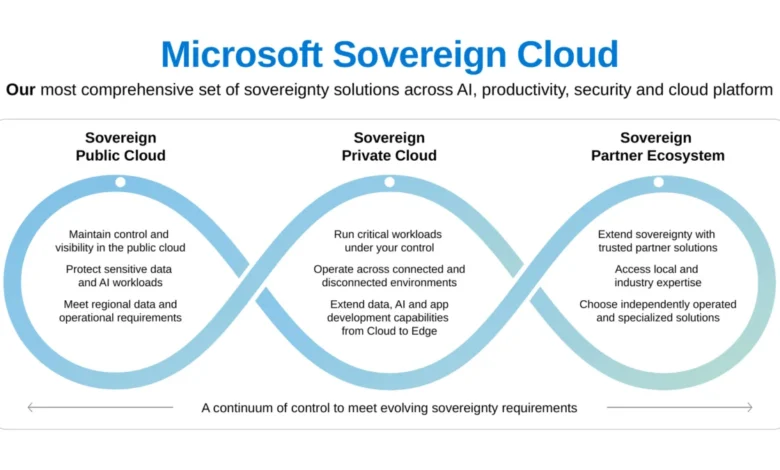
The "continuum of control" framework is categorized into three primary pillars:
- Sovereign Public Cloud: Designed for organizations that require the scale of Azure but need added layers of transparency, resident oversight, and advanced policy management. New features, such as the Sovereign Control Panel, allow administrators to visualize their sovereignty posture across the entire digital estate, identifying potential compliance gaps before they escalate.
- Sovereign Private Cloud: Built on the foundation of Azure Local, this segment allows for "connected and disconnected" operations. By extending cloud-native capabilities into customer-operated hardware, organizations can maintain critical services even in the event of major network disruptions or geopolitical isolation.
- Sovereign Partner Ecosystem: This pillar leverages specialized, locally operated environments—such as Bleu Cloud in France or Delos Cloud in Germany—to address specific national requirements that go beyond standard enterprise offerings.
Technical Safeguards and Transparency Initiatives
Transparency has become the primary currency of digital trust. Microsoft’s latest updates include several technical mechanisms designed to provide verifiable proof of data protection. For customers in the EU and EFTA, the introduction of "Data Guardian" services and "Production Touch Ledgers" represents a significant shift. These features ensure that any access by Microsoft engineers to production systems is not only limited by Just-in-Time (JIT) protocols but is also subject to oversight by third-party, EU-based partners, with all actions recorded in a tamper-evident ledger.
Furthermore, the expansion of Azure confidential computing—specifically through the general availability of confidential virtual machines and the limited preview of Confidential Clean Rooms—addresses the "AI paradox." Organizations want to utilize the massive datasets required for training and fine-tuning AI models, but they are often constrained by the risks of data exposure. Confidential Clean Rooms allow multiple parties to derive insights from shared, sensitive data without ever exposing the underlying raw information to the other participants or to the cloud infrastructure provider itself.
Operational Independence and the Edge
A critical component of this strategy is the shift toward "local" application lifecycles. With the general availability of GitHub Enterprise Local and the introduction of Foundry Local, developers can now build, test, and deploy applications—including those utilizing AI models—entirely within their own infrastructure.
This move toward operational independence is largely driven by the needs of critical infrastructure providers. Recent industry analysis suggests that the risk of connectivity loss—whether due to fiber cuts, cyberattacks, or regional instability—has become a top-three risk factor for CTOs in the public sector. By allowing SQL Server, DocumentDB, and Blob Storage to run natively on Azure Local in a disconnected state, Microsoft is providing a "continuity-first" architecture that ensures basic services remain operational regardless of the external network environment.

Industry Implications and Expert Analysis
The broader implications of this strategy are significant for the global tech landscape. Analysts observe that Microsoft is effectively "localizing" the cloud to combat the perception that centralized, hyperscale computing is inherently at odds with national security interests.
"The goal is to remove the friction between innovation and compliance," notes a senior technology analyst specializing in cloud governance. "By bringing the tools that developers love—like GitHub Copilot and SQL Server—into a sovereign-ready, local environment, Microsoft is preventing the ‘innovation drain’ that often occurs when organizations are forced to choose between legacy, air-gapped systems and modern cloud capabilities."
However, this shift also introduces complexity. Maintaining a hybrid, multi-tenant environment requires a higher level of operational maturity from the customer. The responsibility for managing keys, overseeing partner access, and maintaining local hardware falls squarely on the organization. To mitigate this, Microsoft is emphasizing its ecosystem of specialized partners—companies like Dell, HPE, NVIDIA, and Intel—who are tasked with delivering the "turnkey" hardware and expertise necessary to manage these environments at scale.
The Future of Sovereign AI
As the industry looks toward the next decade of digital transformation, the definition of sovereignty will continue to shift. The integration of AI agents that can act on behalf of a user or system adds a new layer of complexity to access control. If an AI agent has the power to query a database, the organization must ensure that the agent itself resides within a sovereign boundary and adheres to the same residency and confidentiality rules as the data it accesses.
Microsoft’s roadmap suggests a future where the distinction between "public cloud" and "local server" becomes increasingly blurred from a management perspective, even as the physical boundaries remain distinct. By providing a unified interface—the Sovereign Control Panel—Microsoft is betting that simplicity in management will be the ultimate differentiator in a market currently fragmented by diverse international regulations.
The commitment to this "continuum of control" is not merely a technological roadmap; it is a business strategy designed to ensure that the global cloud remains the default choice for the world’s most regulated and sensitive entities. As geopolitical boundaries and digital environments continue to evolve, the capacity for organizations to assert control over their data, their models, and their operations will define the next generation of global competitiveness. The expansion of these capabilities signifies that the cloud is no longer just a destination for data; it is becoming a flexible, adaptable framework that can exist wherever the customer needs it most.
Related posts: