Microsoft Azure Databricks Delivers 331 Percent ROI and Sub-Six-Month Payback According to New Forrester Economic Impact Study

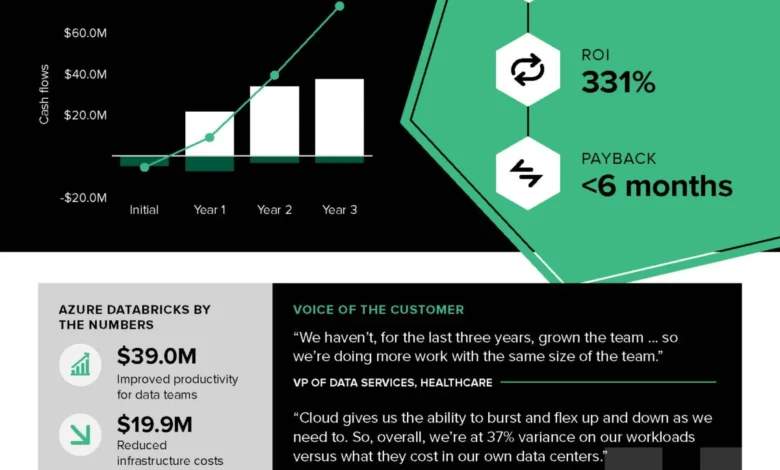
The strategic alliance between Microsoft and Databricks has reached a new milestone in quantifiable business value, according to a newly released Forrester Total Economic Impact (TEI) study. The report, commissioned by Microsoft, reveals that organizations leveraging Azure Databricks as their primary data and AI platform can expect a staggering 331 percent return on investment (ROI) over a three-year period. Perhaps more significantly for capital-conscious Chief Financial Officers, the study found that the initial investment in the platform is typically recovered in less than six months. These findings come at a critical juncture in the enterprise technology landscape, as companies move beyond generative AI experimentation toward full-scale industrialization of data workloads.
The study centers on a "composite organization" designed to reflect the typical high-scale Azure Databricks user: a global enterprise with $6 billion in annual revenue, operating within a regulated industry, and managing a data estate of approximately 10 petabytes. Before migrating to the integrated Azure service, this composite entity struggled with a fragmented data environment characterized by high operational costs, scalability bottlenecks, and complex governance requirements. The transition to Azure Databricks resulted in a net present value (NPV) of $58.1 million, stemming from $75.6 million in total benefits against $17.5 million in costs over three years.
The Strategic Evolution of a First-Party Partnership
To understand the magnitude of these financial results, one must look at the unique architectural relationship between the two technology giants. Unlike many cloud partnerships where software is simply "hosted" on a provider’s infrastructure, Azure Databricks is a first-party service. This means it is co-engineered by Microsoft and Databricks, appearing natively within the Azure Portal. It shares a unified integration roadmap with the broader Microsoft data and AI stack, including Power BI, Azure Machine Learning, and Microsoft Fabric.
This "built-in, not bolted-on" philosophy is the primary driver of the cost efficiencies identified by Forrester. Because the service is native, technical teams avoid the "integration tax" typically associated with third-party software. There is a single billing motion, a unified support path, and seamless integration with Microsoft Entra ID (formerly Azure Active Directory) for identity management. For the enterprise, this reduces the risk of security gaps and eliminates the need for redundant data copies, which are a major source of "dark costs" in modern cloud environments.
Quantifying the Four Pillars of Value
The Forrester study attributes the $75.6 million in total benefits to four primary areas of operational improvement. While the specific financial breakdown varies by organization, the report highlights the following drivers as the most impactful:
- Increased Data Engineering Productivity: By utilizing the Lakehouse architecture, which combines the performance of a data warehouse with the flexibility of a data lake, engineering teams spend significantly less time on ETL (Extract, Transform, Load) processes. The study noted that the unified environment allows engineers to manage more pipelines with fewer manual interventions.
- Accelerated Data Science and AI Delivery: The platform’s ability to provide a collaborative workspace for data scientists reduces the time required to move models from development to production. This "Time to Value" is a critical metric for businesses looking to capitalize on market trends ahead of competitors.
- Infrastructure and Legacy Cost Savings: The transition to a managed, autoscaling cloud environment allowed the composite organization to retire expensive on-premises hardware and reduce the licensing fees associated with legacy data warehousing solutions.
- Enhanced Governance and Risk Mitigation: Through the implementation of Unity Catalog, a unified governance layer, organizations can manage access to data and AI assets across their entire estate from a single interface. In regulated industries, the ability to audit data lineage and enforce fine-grained access control is not just a convenience but a prerequisite for operation.
Performance Benchmarks: The Speed Advantage
Financial returns are inextricably linked to technical performance. To validate the speed claims associated with Azure Databricks, independent firm Principled Technologies conducted a series of industry-standard, TPC-DS-like decision-support benchmarks. The testing compared Azure Databricks against Databricks on Amazon Web Services (AWS) using a 10-terabyte dataset.
The results showed that Azure Databricks completed a single query stream up to 21.1 percent faster than the AWS equivalent when autoscale was disabled. Furthermore, in scenarios involving four concurrent query streams—simulating a busy corporate environment where multiple departments are accessing data simultaneously—Azure Databricks finished the tasks more than nine minutes faster than its competitor. In the world of cloud computing, where "time is money" literally translates to "compute seconds equal billing units," these performance gains contribute directly to the lower total cost of ownership (TCO) cited in the Forrester report.
The Generative AI Frontier: Genie and Copilot Integration
A significant portion of the current interest in Azure Databricks revolves around its capabilities in the generative AI space. The report highlights the integration of Azure Databricks Genie with Microsoft Copilot Cowork as a transformative development for non-technical business users. Genie allows employees to query the "lakehouse" using plain English rather than complex SQL code.
This integration extends into the tools where employees already spend their time, such as Microsoft Teams and Microsoft 365 Copilot. By grounding these AI interactions in trusted, governed data through the Genie Ontology, Microsoft ensures that the answers provided by AI are accurate and business-specific. Crucially, because this is governed by the Unity Catalog, the AI only provides information that the specific user is authorized to see, maintaining the organization’s security posture even as data access is democratized.
Industry Context and Market Implications
The findings of the Forrester study reflect a broader shift in the "Data + AI" market. For several years, the industry was divided between "Data Lakes" (good for unstructured data and machine learning) and "Data Warehouses" (good for structured data and business intelligence). Databricks pioneered the "Lakehouse" category to bridge this gap, and Microsoft’s decision to make it a first-party service on Azure has forced other cloud providers to rethink their strategies.
Market analysts suggest that the 331 percent ROI figure will serve as a powerful sales tool for Microsoft as it competes with Snowflake and Google Cloud Platform for dominance in the data estate. The ability to demonstrate a payback period of less than six months is particularly compelling in the current economic climate, where IT budgets are under intense scrutiny and "AI fatigue" has begun to set in among executives who have yet to see tangible returns on their initial AI investments.
Chronology of the Partnership
The relationship between Microsoft and Databricks has evolved through several key phases:
- 2017: The initial announcement of Azure Databricks as a co-engineered service, marking the first time Microsoft partnered so deeply with a third-party software vendor.
- 2021: The introduction of the Lakehouse architecture as the standard for Azure Databricks, moving away from traditional siloed approaches.
- 2023: The launch of Unity Catalog, providing the governance framework necessary for large-scale enterprise adoption.
- 2024-2025: The deep integration of Generative AI tools, including Mosaic AI and Genie, into the Azure ecosystem.
- 2026: The release of the current Forrester TEI study, confirming the long-term economic viability of the platform.
Conclusion: A Foundation for the Autonomous Enterprise
As organizations look toward the future, the choice of a data platform is increasingly viewed as a foundational strategic decision. The Forrester study suggests that the value of Azure Databricks lies not just in its individual features, but in the "flywheel effect" created by the Microsoft-Databricks integration. Improved performance leads to lower costs; lower costs allow for more experimentation; more experimentation leads to better AI models; and better AI models drive higher business revenue.
For decision-makers, the report provides a data-backed roadmap for modernization. While actual results will vary based on the specific maturity of an organization’s data estate, the composite model offers a clear signal: the integration of first-party cloud services is no longer just a technical preference, but a significant financial advantage. As the petabytes of data held by global corporations continue to grow, the efficiency of the platform used to manage that data will likely become the primary differentiator between market leaders and laggards in the AI era.