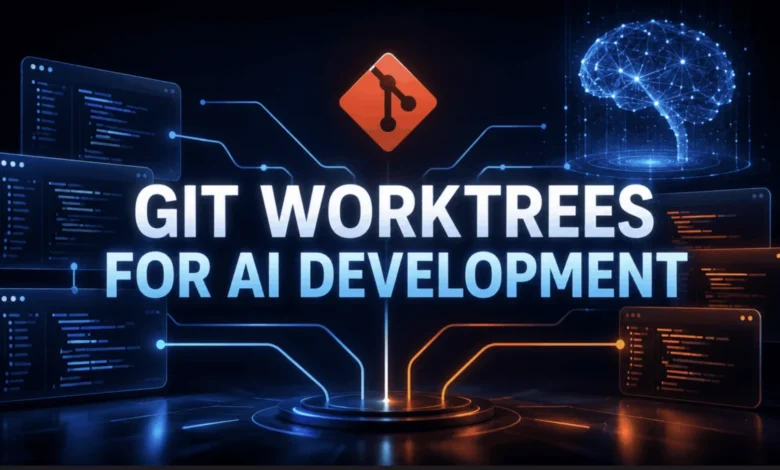
The software engineering landscape is currently undergoing a structural transformation as artificial intelligence agents shift from passive assistants to autonomous contributors capable of managing complex, multi-step tasks. However, as developers increasingly deploy tools like Claude Code, Cursor, and OpenAI Codex to handle concurrent feature requests, a critical infrastructure bottleneck has emerged: the limitations of the traditional single-working-directory model. To address this, the industry is seeing a resurgence of a decade-old Git feature—Git worktrees—which has transitioned from a niche power-user tool to a fundamental requirement for modern AI-driven development.
The Context Fragmentation Crisis in AI Engineering
The primary challenge facing developers in 2025 is the "context fragmentation" that occurs when an AI agent is interrupted. In a standard workflow, a developer might initiate an AI agent on a feature branch to perform an authentication rewrite. If an urgent production bug requires a hotfix on the main branch, the developer is traditionally forced to stash changes and switch branches. For a human, this is a minor annoyance; for an AI agent, it is catastrophic.
When an AI agent’s environment is altered mid-task, it loses the specific file-system state and context it spent minutes or hours building. Furthermore, if a developer attempts to run two agents simultaneously within the same directory, the risks escalate. Both agents may attempt to modify shared files like package.json or requirements.txt, leading to silent overwrites, corrupted lockfiles, and non-deterministic test failures.
Recent industry data highlights this friction. While approximately 51% of professional developers now report using AI tools on a daily basis, a significantly smaller fraction—only 17%—claim these tools have improved team collaboration. Analysts suggest this "collaboration gap" is not a failure of the AI models themselves but a failure of the underlying workflow infrastructure. Git worktrees have emerged as the primary solution to this discrepancy.
Understanding Git Worktrees: History and Mechanism
Git worktrees are not a recent innovation. The feature was introduced in Git version 2.5 in July 2015, designed to allow a single repository to have multiple working trees attached to it. Unlike the "multiple clone" approach—where a developer clones a repository several times into different folders—worktrees share a single .git directory.
In a worktree setup, the repository’s history, objects, and configuration are stored once, but the files can be checked out into multiple independent directories simultaneously. This means a developer can have one directory for a feature branch, another for a hotfix, and a third for a code review, all while sharing the same underlying Git database. For AI agents, this provides physical isolation. An agent operating in project-feat-auth/ is entirely invisible to an agent operating in project-hotfix/, preventing any possibility of file collision or context bleeding.
Chronology of the AI Workflow Evolution
The adoption of worktrees has followed a distinct timeline as the industry moved through different phases of AI integration:
- Phase 1: The Copilot Era (2021–2023): AI was largely used for autocomplete within a single IDE window. Standard branch switching remained the norm because the "agent" was the human developer.
- Phase 2: The Agentic Shift (2024): Tools began performing multi-file edits. Developers noticed that switching branches broke the agent’s "chain of thought," leading to increased errors upon returning to a task.
- Phase 3: Parallel Execution (2025–Present): Engineering teams began treating AI agents as "virtual interns" or "junior developers." The need to run three or four agents at once made the single-directory model obsolete, leading to the current standardization of worktree-based workflows.
Case Study: The Microsoft Global Hackathon 2025
A pivotal moment in the validation of this workflow occurred during the Microsoft Global Hackathon in late 2025. Tamir Dresher, an engineering lead, documented a successful transition from traditional branching to a "virtual AI development team" model using worktrees.
Facing a backlog of features and limited time, Dresher’s team assigned individual worktrees to different AI agents. One agent handled OAuth2 implementation, another built REST endpoints, and a third addressed production bug fixes. By assigning each agent its own VS Code window and its own worktree, Dresher was able to shift his role from a line-by-line coder to a technical lead. He spent his time scoping the tasks in a central AGENTS.md file and reviewing the pull requests generated by the agents.
The hackathon results demonstrated three major advantages:
- Zero Context Loss: Agents could run for hours without being interrupted by high-priority interrupts.
- Resource Efficiency: Unlike multiple clones, which duplicate the entire history and can consume gigabytes of disk space for large repositories, worktrees only added the weight of the checked-out files.
- Linear History: Because all worktrees shared the same Git backend, commits made in one were immediately visible to the others, simplifying the eventual merge process.
Technical Implementation and Best Practices
For organizations looking to implement this model, the workflow revolves around a specific set of Git commands and environmental configurations.
The Core Command Suite
Managing a multi-agent environment requires mastery of seven primary commands:
git worktree add: To create a new workspace on a specific branch.git worktree list: To monitor active agent workspaces.git worktree lock: To prevent a workspace from being accidentally deleted while an agent is mid-process.git worktree prune: To clean up metadata after a task is completed.
Environmental Synchronization
A common pitfall in worktree adoption is the failure to sync non-tracked files. Because .env files and node_modules are typically gitignored, they do not automatically appear in a new worktree. Industry experts recommend using setup scripts to automate the copying of environment variables and the installation of dependencies whenever a new agent workspace is initialized.

The Role of Architectural Documentation
A significant finding presented at the ICSE 2026 conference suggested that AI agent performance improves by up to 30% when provided with explicit architectural context. This has led to the rise of the AGENTS.md or CLAUDE.md file—a committed document in the repository root that defines build commands, architectural boundaries, and prohibited zones. In a worktree workflow, this file acts as the "briefing document" for the agent assigned to that specific directory.
Managing Drift: Rebase vs. Merge
One of the primary risks of parallel development is "branch drift," where a worktree remains active for several days while the main branch continues to evolve. To mitigate this, senior engineers advocate for a rebase-centric strategy.
By rebasing the worktree branch onto the latest main branch at the end of every agent session, developers ensure that the history remains linear and that the final pull request is easy to review. This prevents the "merge hell" that often occurs when an autonomous agent makes hundreds of changes to a codebase that has moved on significantly since the agent started its task.
Analysis of Implications: The Changing Role of the Developer
The shift toward worktree-based parallel AI development signals a broader change in the software engineering profession. As the friction of running multiple agents decreases, the value of a developer is increasingly measured by their ability to:
- Decompose Tasks: Breaking a large feature into smaller, isolated components that can be handled by separate agents in separate worktrees.
- System Design: Ensuring that the architectural boundaries defined in
AGENTS.mdare robust enough to prevent agents from creating conflicting logic. - Review and Orchestration: Acting as the final arbiter of quality for code produced across multiple concurrent streams.
Future Outlook
As we look toward 2026, the integration of Git worktrees into AI development environments is expected to become even more seamless. IDEs are already beginning to offer "one-click worktree" buttons that automatically handle directory creation, environment variable syncing, and agent initialization.
The agentic coding community has reached a consensus: the model writes the code, but the human manages the environment. By utilizing Git worktrees, developers provide the "clean room" necessary for AI to operate at peak efficiency. This infrastructure allows for a level of parallelism that was previously impossible, effectively turning a single developer into a multi-agent orchestration lead. The transition is not merely a change in Git commands; it is a fundamental redesign of the developer’s workspace for the age of autonomy.