The deployment of small language models (SLMs) in production environments often encounters significant efficiency bottlenecks that stem not from model capability, but from operational execution. As organizations increasingly adopt compact architectures—such as the Qwen2.5-0.5B-Instruct model—for narrow automation tasks like customer support ticket classification, hardware utilization frequently remains suboptimal. A primary driver of this inefficiency is the traditional execution of processing requests sequentially, or item-by-item. Recent engineering benchmarks highlight that shifting from item-by-item processing to length-bucketed batching yields substantial performance enhancements without altering the underlying model outputs or introducing predictive regressions.
This analysis concludes a three-part technical series examining narrow automation optimization for small language models. Previous installations explored constraining the output space to restrict model responses to valid categorical options and reusing prompt prefixes through key-value caches. By addressing the mechanics of data ingestion and memory management, engineering teams can drastically accelerate inference throughput on constrained hardware, including standard consumer-grade processing units like an M2 MacBook Air equipped with 24GB of RAM and a 16-core Neural Engine.
Understanding the Memory-Bandwidth Bottleneck
When operating a small language model at a batch size of one, the system is typically memory-bandwidth bound rather than compute-bound. During a single forward pass, the hardware must stream the entirety of the model’s weights out of memory to process just one sequence of text. Once that sequence is evaluated, the hardware repeats the exact same memory-fetching process for the subsequent item. Consequently, the arithmetic logic units—the components responsible for actual computational calculations—sit largely idle between consecutive inputs.
This hardware constraint manifests uniformly across architectures, affecting both dedicated graphics processing units and the central processing units where compact 0.5-billion-parameter models are frequently deployed in edge and enterprise environments. Processing a dataset of hundreds or thousands of support tickets individually results in compounding latency delays. For instance, processing 600 variable-length support tickets one by one can require upwards of 144 seconds, translating to an average throughput of approximately 4.2 items per second.
The Pitfalls of Naive Batching
Batching multiple sequences together is the standard industry countermeasure to memory-bandwidth limitations, as it amortizes the heavy weight-read cost across numerous items simultaneously. However, naive batching introduces a secondary inefficiency: padding.
Because standard tensor operations require uniform dimensions within a batch, sequences of varying lengths must be padded with placeholder tokens to match the length of the longest item in that specific batch. Real-world text distributions—such as customer support inquiries—typically exhibit long-tail characteristics. While the median length of a ticket might be under 100 tokens, an outlier in the dataset may stretch to several hundred tokens. If batches are formed arbitrarily without regard for sequence length, every item in that batch is padded to match that single outlier. Consequently, the hardware spends a considerable proportion of its compute cycles processing meaningless padding tokens rather than actual semantic data. Benchmarks demonstrate that naive global padding can force a system to process nearly four times the volume of tokens strictly necessary for the task.
The Solution: Length-Bucketed Batching
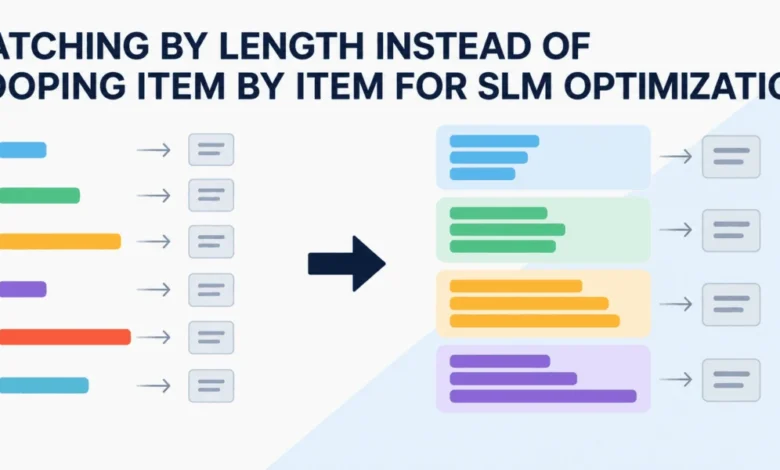
To eliminate excessive padding overhead while retaining the hardware benefits of batching, engineers utilize length-bucketed batching. This methodology requires sorting the dataset by token length prior to batch formation. By grouping similarly sized inputs together, each batch establishes its own local maximum length rather than conforming to a global maximum.
In practical implementations using the Qwen2.5-0.5B-Instruct framework, sorting and batching tickets in size-optimized groups drastically reduces padding waste. In experimental evaluations involving 600 variable-length support tickets processed with a batch size of 32, length-bucketed batching reduced total execution time from approximately 144 seconds down to 79.6 seconds. This nearly doubles the processing throughput from 4.2 items per second to 7.5 items per second on identical hardware. Furthermore, performance tracking reveals that padding overhead drops to just 7.6% of the total processed token budget, compared to the inflated ratios seen in unorganized workflows.
Technical Implementation and Verification Protocols
Deploying optimized batching workflows requires rigorous verification to ensure that structural modifications do not inadvertently corrupt model outputs. Because padding strategies alter tensor shapes and attention masks, engineers must validate that batched inference yields identical classifications to unpadded, single-item execution paths.
Below is an implementation of length-bucketed batching utilizing PyTorch and Hugging Face Transformers, incorporating constrained output scoring to ensure classification outputs remain strictly within predefined business logic parameters:
import os
import time
import inspect
import torch
import numpy as np
from transformers import AutoTokenizer, AutoModelForCausalLM

MODEL_ID = "Qwen/Qwen2.5-0.5B-Instruct"
BATCH_SIZE = 32

torch.set_num_threads(os.cpu_count() or 1)

tokenizer = AutoTokenizer.from_pretrained(MODEL_ID)
if tokenizer.pad_token is None:
    tokenizer.pad_token = tokenizer.eos_token

tokenizer.padding_side = "left"

model = AutoModelForCausalLM.from_pretrained(MODEL_ID, dtype=torch.float32)
model.eval()

LABELS = ["billing", "technical", "account"]
label_first_ids = [tokenizer.encode(label, add_special_tokens=False)[0] for label in LABELS]
assert len(set(label_first_ids)) == len(LABELS), (
    "Labels share a first token; score full label sequences instead."
)
label_first_ids = torch.tensor(label_first_ids, device=model.device)

_forward_params = inspect.signature(model.forward).parameters
if "logits_to_keep" in _forward_params:
    LAST_LOGIT_ONLY = "logits_to_keep": 1
elif "num_logits_to_keep" in _forward_params:
    LAST_LOGIT_ONLY = "num_logits_to_keep": 1
else:
    LAST_LOGIT_ONLY =

def build_prompt(ticket):
    messages = [

            "role": "system",
            "content": "You classify support tickets. Answer with exactly one of: billing, technical, account.",
        ,
        "role": "user", "content": f"Ticket: ticketnCategory:",
    ]
    return tokenizer.apply_chat_template(messages, tokenize=False, add_generation_prompt=True)

BASE_TICKETS = [
    "My card was charged twice for the same invoice.",
    "The mobile app crashes whenever I open the settings page.",
    "I need to change the email address on my profile.",
]
FILLER = (
    "I have been waiting for a response for several days now and would really "
    "appreciate an update on this whenever someone gets a chance to look at it."
).split()

rng = np.random.default_rng(0)
target_words = np.clip(rng.lognormal(np.log(60), 0.9, size=600), 12, 400).astype(int)

def make_ticket(base, n_words):
    words = base.split()
    while len(words) < n_words:
        words += FILLER
    return " ".join(words[:n_words])

tickets_var = [make_ticket(BASE_TICKETS[i % 3], int(n)) for i, n in enumerate(target_words)]
prompts = [build_prompt(t) for t in tickets_var]
token_lengths = [len(tokenizer(p, add_special_tokens=False)["input_ids"]) for p in prompts]

def run_batched(order, batch_size):
    predictions = [None] * len(prompts)
    processed_tokens = real_tokens = 0
    start = time.time()
    for i in range(0, len(order), batch_size):
        idx = order[i:i + batch_size]
        batch = tokenizer(
            [prompts[j] for j in idx],
            add_special_tokens=False,
            padding=True,
            return_tensors="pt",
        ).to(model.device)
        processed_tokens += batch["input_ids"].numel()
        real_tokens += int(batch["attention_mask"].sum())
        with torch.no_grad():
            logits = model(**batch, **LAST_LOGIT_ONLY).logits[:, -1, :]
        best = logits[:, label_first_ids].argmax(dim=-1)
        for slot, choice in zip(idx, best.tolist(), strict=True):
            predictions[slot] = LABELS[choice]
    return predictions, time.time() - start, processed_tokens, real_tokens

def classify_one(prompt):
    inputs = tokenizer(prompt, add_special_tokens=False, return_tensors="pt").to(model.device)
    with torch.no_grad():
        logits = model(**inputs, **LAST_LOGIT_ONLY).logits[0, -1, :]
    return LABELS[int(logits[label_first_ids].argmax())]

order = sorted(range(len(prompts)), key=lambda i: token_lengths[i])
predictions, duration_batched, processed, real = run_batched(order, BATCH_SIZE)

print(f"Length-bucketed batching: duration_batched:.2f seconds (len(prompts) / duration_batched:.1f items/sec)")
print(f"Padding overhead: 100 * (1 - real / processed):.1f% of processed tokens were padding")

probe = order[::60]
mismatches = [i for i in probe if classify_one(prompts[i]) != predictions[i]]
print(f"Batched vs unbatched agreement on len(probe) probes: len(probe) - len(mismatches)/len(probe)")
assert not mismatches, f"Batched path disagrees at indices mismatches"
Implications for Enterprise AI Deployment
The implementation of systems-level optimizations underscores a fundamental principle in modern artificial intelligence engineering: algorithmic efficiency is frequently gated by data orchestration rather than model parameter scale. Small language models offer immense promise for narrow automation tasks due to their low resource footprint and rapid deployment capabilities. However, realizing their economic and operational viability requires treating infrastructure execution with the same rigor applied to model training.
Combining multiple optimization strategies—such as constraining output token spaces to eliminate unnecessary generation loops, caching prefix keys and values to avoid redundant prompt processing, and organizing data via length-bucketed batching—transforms unoptimized pipelines into high-throughput production services. Crucially, industry practitioners emphasize that none of these techniques alter the fundamental intelligence of the underlying model. Every performance enhancement must be validated against unpadded, baseline execution paths. In professional software engineering, an optimization that alters predictive outputs is not an efficiency gain, but a regression masked by a stopwatch.