AMD Unleashes Helios: A Rack-Scale System to Challenge Nvidia’s Dominance in AI Computing

Advanced Micro Devices (AMD) has escalated its direct challenge to industry titan Nvidia with the official unveiling and impending shipment of its latest hardware innovation: Helios. This formidable rack-scale system is engineered to satisfy the insatiable computing demands of the world’s most ambitious artificial intelligence laboratories, marking a significant stride in AMD’s strategy to capture a substantial share of the rapidly expanding AI accelerator market. The announcement, a centerpiece of the company’s sold-out Advancing AI conference in San Francisco, underscored AMD’s commitment to providing a robust alternative in a domain historically dominated by its primary competitor.
Helios: A New Era in AI Infrastructure
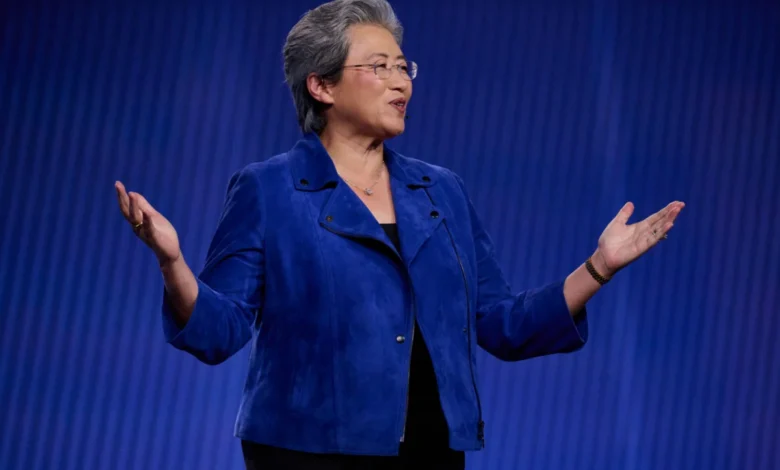
During her keynote address at the Advancing AI conference on Thursday, Dr. Lisa Su, AMD Chair and CEO, spotlighted the Helios AI rack system, positioning it as a pivotal development in high-performance computing. Dr. Su lauded Helios as the tech industry’s "highest-performance AI rack," asserting its design specifically to "train and run the most demanding frontier models in the world at massive scale." This claim directly challenges Nvidia’s long-standing leadership in delivering integrated, high-power solutions for large-scale AI training and inference.
Rack systems, at their core, represent a consolidation of numerous processors—typically Graphics Processing Units (GPUs) or specialized AI accelerators—into a single, highly potent unit. These systems are the backbone of modern data centers, where they are instrumental in the computationally intensive tasks of training and deploying complex AI models, alongside other demanding workloads. Helios, with its promise of gigawatt-scale deployment by leading AI companies, signifies AMD’s ambition to cater to the extreme power and performance requirements of next-generation artificial intelligence.
First revealed in 2025 and subsequently showcased on stage at CES 2026 in January, Helios has rapidly garnered significant industry interest. The system is slated for shipment later this year, with an impressive roster of high-profile customers already committing to its deployment. This list includes industry giants such as Microsoft, OpenAI, Meta, Oracle, and Anthropic, signaling a strong vote of confidence in AMD’s capabilities to deliver a competitive, high-performance solution.
Strategic Partnerships and Market Adoption
The widespread customer adoption of Helios is a testament to AMD’s strategic inroads into the AI ecosystem. Microsoft CEO Satya Nadella publicly confirmed on Monday the company’s plans to expand its Azure infrastructure with Helios, integrating AMD’s cutting-edge technology into one of the world’s leading cloud computing platforms. This partnership is crucial, as it provides a robust platform for developers and enterprises to leverage Helios’s power for their AI initiatives, potentially driving broader adoption across the cloud services sector.
Further solidifying its market position, AMD announced a strategic partnership with Anthropic on Wednesday. This collaboration will see Anthropic, a prominent AI research and deployment company, deploy up to two gigawatts of AMD Instinct MI450 series GPUs via the new Helios rack system. Such a massive deployment underscores the system’s scalability and the trust placed in AMD’s hardware to power the development of advanced AI models, including Anthropic’s Claude series. These partnerships are not merely transactional; they represent a concerted effort to build an alternative, robust ecosystem around AMD’s hardware, challenging the incumbent’s established software and hardware stack.
Challenging Nvidia’s Hegemony
Nvidia has historically enjoyed a near-monopoly in the market for AI accelerator hardware, primarily with its powerful Vera Rubin and Grace Blackwell rack-scale systems. The company’s dominance is multifaceted, stemming from its early investment in GPU computing, the development of its proprietary CUDA software platform, and a comprehensive ecosystem of libraries and developer tools that have fostered immense loyalty within the AI community. Nvidia’s GPUs have become the de facto standard for AI training and inference, with its market share often estimated to be upwards of 80-90%.
AMD’s entry with Helios is a direct and formidable challenge to this entrenched position. Reports from publications like The Register indicate that Helios’s performance metrics appear to give it a genuine competitive edge, reportedly surpassing Vera Rubin in several key areas. While specific benchmark figures are often proprietary and complex, general performance advantages in AI often translate to higher Floating Point Operations Per Second (FLOPS), superior memory bandwidth and capacity, and faster interconnect speeds within the rack system. These improvements are critical for accelerating the training times of increasingly massive AI models and enhancing the efficiency of inference workloads. The emergence of a credible alternative like Helios offers major AI labs and cloud providers a much-needed diversification of their hardware supply chain, potentially mitigating vendor lock-in and fostering a more competitive pricing environment.
Expanding AMD’s Portfolio: The Venice-X CPU
Beyond the Helios system, AMD further reinforced its commitment to high-performance computing by introducing the Venice-X CPU on Thursday. Scheduled for launch in 2027, the Venice-X is specifically engineered for data centers and designed to handle the most demanding high-computing workloads. This CPU boasts impressive specifications, including 1152 MB of 3D V-cache, 96 cores, and a boost clock speed of 5.15 GHz, built on the Zen 6 architecture.
The Venice-X CPU will play a complementary role to the GPU-centric Helios system. While GPUs excel at parallel processing tasks essential for AI, high-performance CPUs remain critical for general-purpose computing, data pre-processing, post-processing, and orchestrating complex workloads within data centers. The integration of 3D V-cache technology is particularly significant, as it dramatically increases the amount of available cache directly on the CPU die, leading to reduced latency and increased bandwidth for core-intensive applications, which is vital for many high-performance computing (HPC) and enterprise applications. This dual-pronged approach, offering both leading-edge AI accelerators and powerful CPUs, positions AMD as a comprehensive solution provider for the evolving demands of modern data centers.
Dr. Lisa Su’s Vision: The Trillion-Dollar AI Accelerator Market
Dr. Lisa Su’s address transcended mere product announcements, offering a profound commentary on the trajectory of the chip industry and the transformative impact of artificial intelligence. She projected that by the year 2030, chips dedicated to powering AI applications will constitute a massive portion of the overall computing market, driven by what she termed a "step change in compute demand."
This exponential demand, Dr. Su explained, is largely fueled by the advent of "agentic AI." Unlike simpler AI models that perform single, defined tasks, agentic AI systems are designed to reason, plan, and execute complex, multi-step tasks autonomously. "When you ask the agent to do something, it actually has dozens of steps, and it has to reason, and it has to call tools, and it has to access data, and it has to keep doing it over and over until it solves the problem," Dr. Su elaborated. This iterative and highly complex problem-solving process necessitates "lots of GPUs" to handle the continuous computational burden.
The financial implications of this shift are staggering. Dr. Su forecasted that the AI accelerator market is poised to reach approximately $1.4 trillion by 2030. To put this figure into perspective, she highlighted that this projected size would "approach the size of the entire semiconductor market today." This comparison underscores the unprecedented growth expected in the AI segment, signaling a monumental reallocation of resources and investment within the technology sector. The total semiconductor market was valued at roughly $527 billion in 2023, making Su’s projection a bold statement about AI’s future economic footprint.
Furthermore, Dr. Su emphasized the continued dominance of GPUs within this burgeoning market. "We do expect that GPUs are going to make up the vast majority of that market because the algorithms are still very much in their infancy, and we’re still continuing to see the workloads change, and that favors programmability in the overall silicon ecosystem," she stated. This highlights the adaptability and general-purpose nature of GPUs, which can be reprogrammed and optimized for new AI algorithms as the field rapidly evolves, a critical advantage over more specialized, fixed-function accelerators in a nascent industry.
Broader Implications and Future Outlook
AMD’s aggressive push into the AI hardware market with Helios and Venice-X carries significant implications for the technology landscape. For major AI development labs and cloud providers, increased competition means more choices, potentially leading to better performance-per-dollar, diversified supply chains, and reduced reliance on a single vendor. This fosters a healthier market dynamic and can accelerate innovation across the board.
The sheer scale of the projected $1.4 trillion AI accelerator market by 2030 suggests a profound shift in global computing priorities. This growth is driven by the widespread adoption of AI across industries, from healthcare and finance to manufacturing and entertainment, and the continuous development of more sophisticated and resource-intensive AI models. The ability of hardware providers like AMD to meet this demand will be critical in shaping the future capabilities and accessibility of artificial intelligence.
However, AMD’s journey is not without challenges. Overcoming Nvidia’s deeply entrenched CUDA ecosystem and convincing developers to either switch or embrace AMD’s ROCm software platform remains a significant hurdle. The "full-stack compute" strategy AMD touts implies not just powerful hardware but also a robust, developer-friendly software environment. The success of Helios will ultimately depend on its performance, scalability, and the strength of the accompanying software stack that enables developers to efficiently harness its immense power. As the "AI arms race" intensifies, AMD’s bold moves with Helios signify a new chapter in the competition to power the artificial intelligence revolution.
Related posts: