Transforming AI Coding Agents: 10 Essential Design Skills and Directories to Elevate Generated UI

The rapid evolution of artificial intelligence coding assistants has fundamentally transformed software development, enabling developers and non-technical stakeholders alike to generate functional codebases in mere minutes. Yet, a persistent aesthetic barrier remains. Default outputs generated by leading large language models (LLMs) frequently gravitate toward predictable tropes: ubiquitous purple gradients, overly rounded corners, the omnipresent Inter font, and structural layouts that meet functional requirements without artistic conviction. Industry experts note that this deficiency is not an inherent flaw in the reasoning capabilities of the models, but rather a lack of curated design literacy.
To bridge the gap between functional programming and genuine visual craftsmanship, developers are increasingly turning to AI skills—specialized modular markdown files and configuration directories integrated directly into modern development environments like Claude Code, Cursor, Codex, and Windsurf. By injecting structured frameworks of taste, these skills teach autonomous agents to reason through the lens of established design systems, color theory, and typographic hierarchy.
The Aesthetic Bottleneck of Autonomous Code Generation
Since the mainstream adoption of AI-driven integrated development environments (IDEs) and terminal tools, productivity metrics for software engineers have soared. However, the democratization of software creation has flooded the digital ecosystem with visually homogenous web applications. Without explicit guidance, coding agents rely on generalized training data that prioritizes generic, safe UI patterns over intentional artistic direction.
The introduction of agentic skills marks a paradigm shift in how design knowledge is operationalized. Rather than relying on human designers to manually correct generated components—or forcing developers to painstakingly rewrite CSS classes—design principles are codified into machine-readable instructions. When an agent encounters a styling or structural task, it dynamically consults these embedded skills, translating high-level aesthetic rules into precise, production-ready code.
1. OKLCH Color Skill
Color consistency remains one of the most difficult challenges for automated coding agents. Traditional color spaces, such as HSL or standard RGB hex values, often suffer from perceptual non-uniformity, where colors with identical lightness values appear drastically different to the human eye. This frequently results in botched dark mode implementations and muddy color scales.
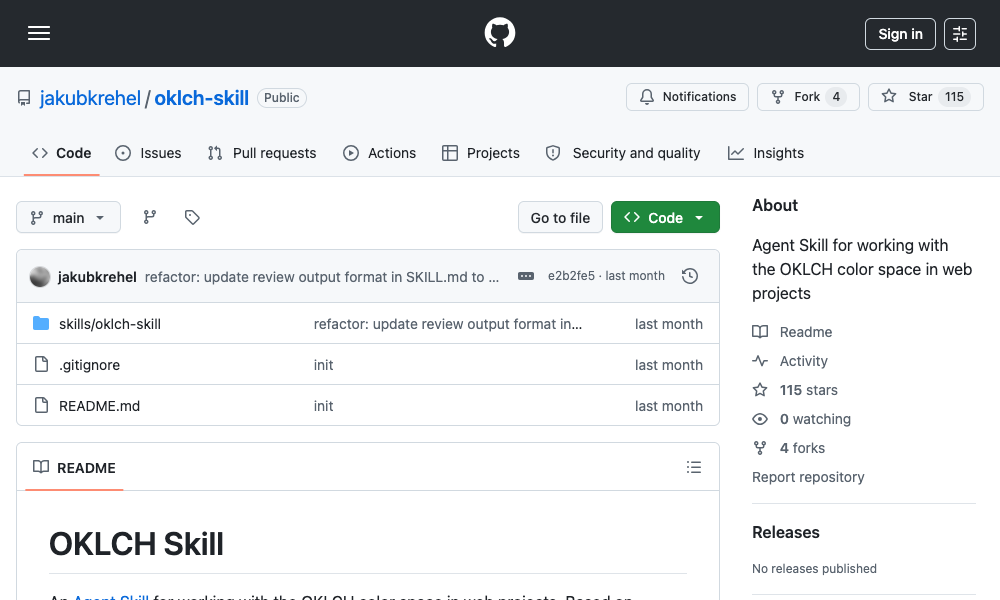
The OKLCH Color Skill equips coding agents with the capability to operate within the OKLCH color space—a perceptually uniform alternative that eliminates hue drift and enables mathematically predictable palette generation. Developed for seamless integration via a simple Node package manager command (npx skills add jakubkrehel/oklch-skill), this tool enables agents to convert color formats, automatically generate uniform scales ranging from 50 to 950, derive accessible dark mode palettes through systematic lightness manipulation, and rigorously check contrast ratios against both WCAG 2.2 and Advanced Perceptual Contrast Algorithm (APCA) standards. Furthermore, it natively outputs Tailwind CSS v4 themes utilizing proper OKLCH tokens, ensuring long-term maintainability for design systems.
2. Swiss Design System Skill
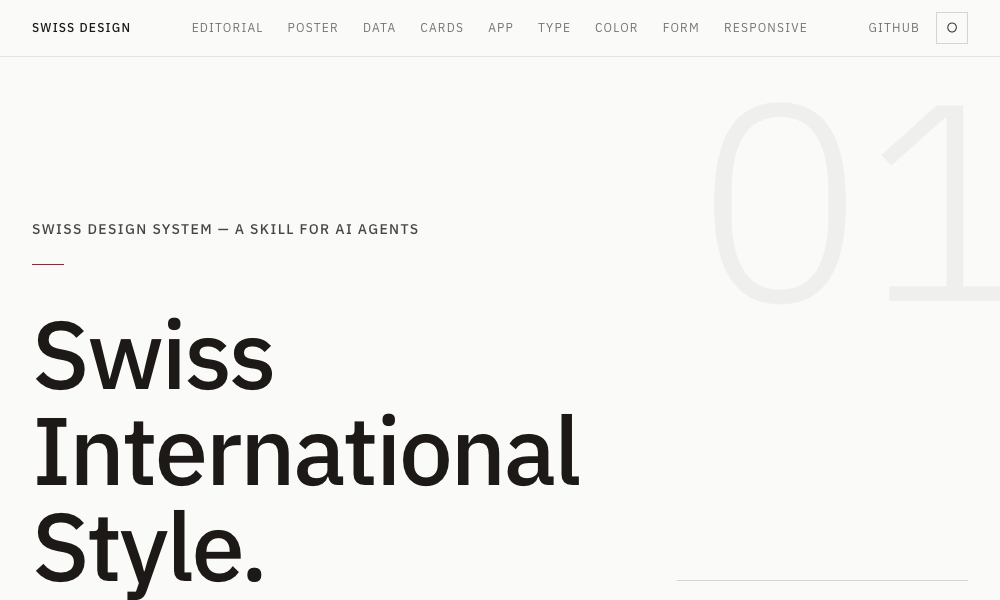
For applications requiring austere clarity, robust grid alignment, and uncompromising readability, the Swiss International Style remains the gold standard of graphic design. Bringing this rigorous architectural tradition to the digital realm, the Swiss Design System skill instructs AI agents in the principles pioneered by mid-century masters such as Josef Müller-Brockmann.
Once integrated via npx skills add zeke/swiss-design-skill, the agent gains access to a curated hierarchy of grotesque sans-serif typography—including Helvetica, Univers, and Neue Haas Grotesk—alongside strict mathematical grid frameworks, generous whitespace allocation, and restrained color usage. The skill translates these historical principles into modern Tailwind utility classes, making it ideal for high-end editorial layouts, corporate landing pages, and complex data-dense interfaces where visual hierarchy supersedes decorative flourish.
3. Transitions.dev
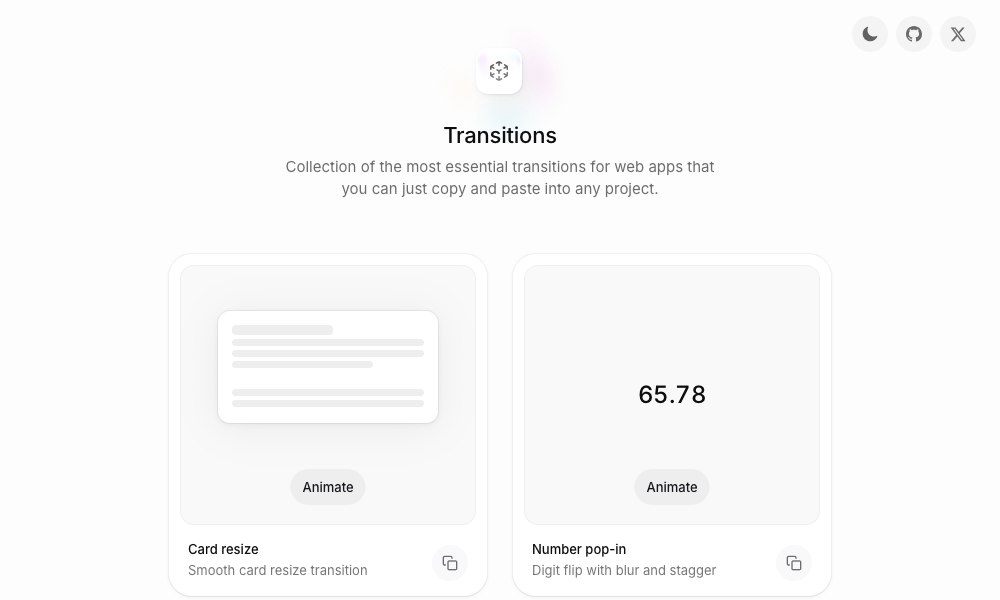
Motion design is frequently neglected by automated coding agents, resulting in jarring user interfaces where modals appear abruptly and elements resize without warning. Transitions.dev addresses this by packaging nine essential UI motion patterns—ranging from fluid card resizing and animated digit-flip number pop-ins to diagonal notification badge slides—into an installable agent skill.
Derived directly from a standardized web showcase, the underlying CSS is pre-optimized and verified for performance. Developers can reference the repository via GitHub (github.com/Jakubantalik/transitions.dev) and prompt their agents to apply specific micro-interactions. The result is software that feels tactile and responsive, elevating basic web applications to polished, consumer-grade experiences.
4. DESIGN.md Directory
For teams seeking immediate aesthetic enhancement without the overhead of command-line interfaces or package managers, the DESIGN.md directory offers a frictionless alternative. Comprising a crowdsourced collection of standardized markdown files, each entry encapsulates a complete design system—detailing exhaustive color palettes, typography scales, spacing tokens, component specifications, and layout principles.
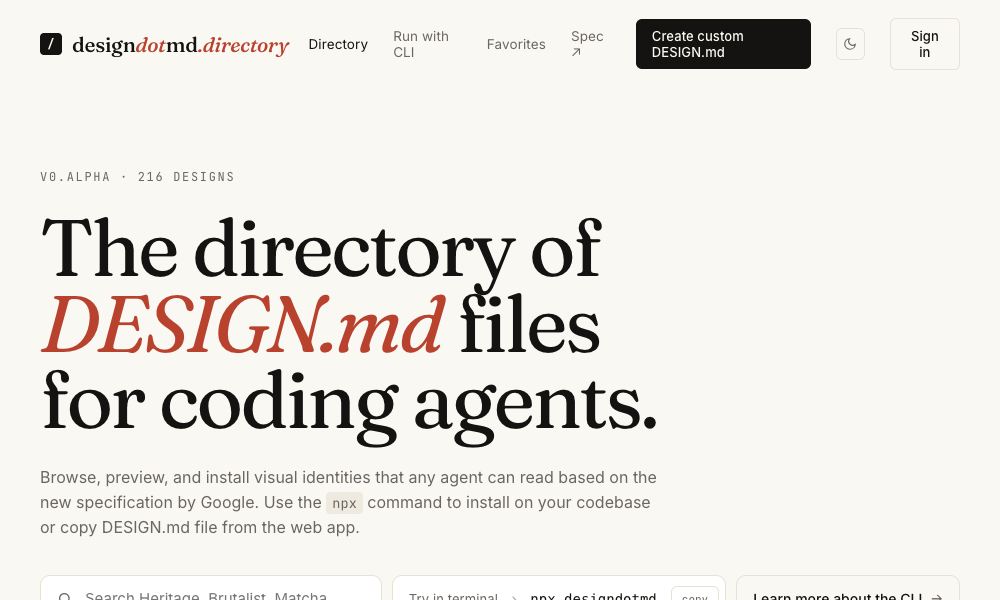
Implementing a design language requires nothing more than copying a chosen style’s markdown file, renaming it to DESIGN.md, and placing it in the root directory of a project. Autonomous coding agents natively scan the project workspace, ingest the markdown file, and automatically apply the specified design language to every subsequent button, form, and page layout they generate.
5. Agents with Taste
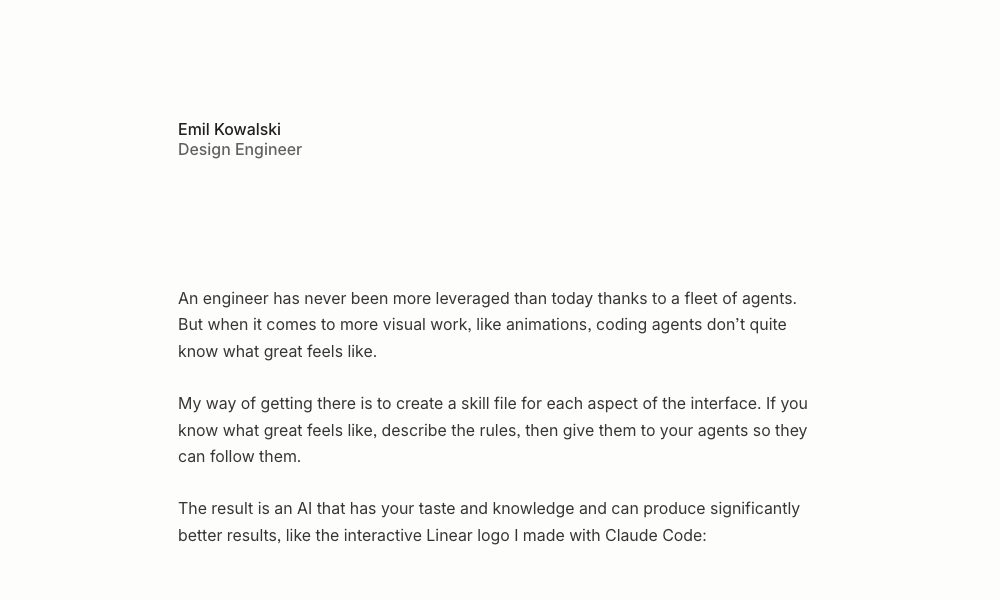
Developed by prominent design engineer Emil Kowalski, Agents with Taste codifies personal production philosophies into an executable agent skill (npx skills add emilkowalski/skill). The framework provides granular guidance on animation physics, component construction, and typographic discipline.
Notably, the skill features an algorithmic easing curve decision flowchart that dictates precisely which transition curve to use based on context, alongside strict duration guidelines ranging from 100 to 150 milliseconds for micro-interactions up to 300 milliseconds for complex modals. It also enforces rigid typographic constraints, such as capping body text containers at 65 characters to optimize reading comprehension.
6. Hue
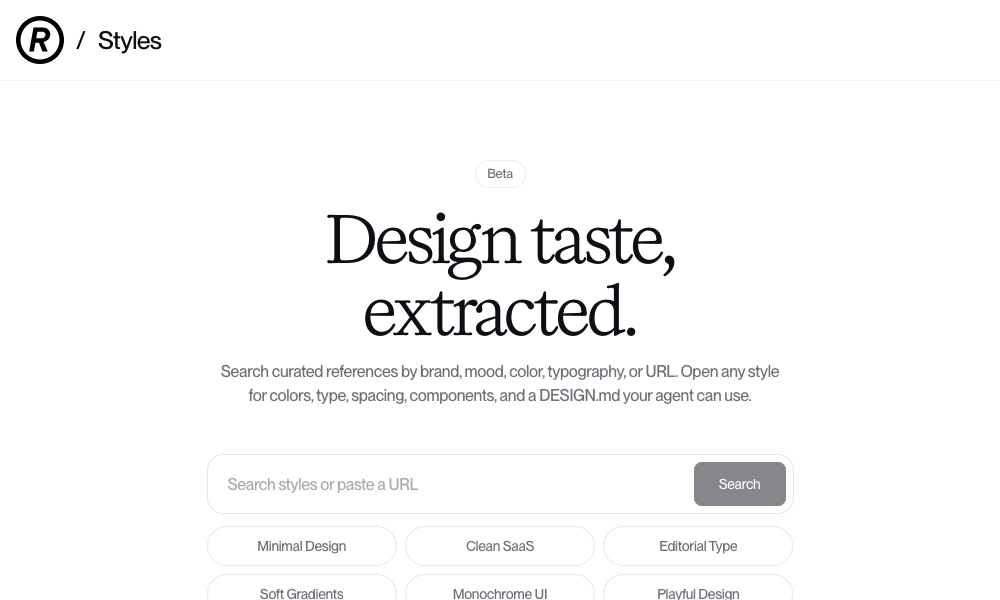
Replicating an existing brand identity manually within an AI-generated prototype can be a painstaking endeavor. Created by Dominik Martin, the Hue open-source skill allows developers to clone or point an agent at any target URL, brand name, or UI screenshot to instantly reverse-engineer its aesthetic DNA.
By executing git clone https://github.com/dominikmartn/hue ~/.claude/skills/hue, developers empower their agents to analyze reference products—ranging from classical maritime aesthetics to noir editorial fragrance houses—and generate comprehensive design models complete with color tokens, typography, spacing, component specifications, dark mode variations, and curated icon recommendations.
7. Refero Styles
Leveraging a visual search engine containing over 150,000 real application screens and 6,000 user flows from industry leaders such as Stripe, Linear, Notion, and Figma, Refero Styles bridges the gap between competitive analysis and code generation.
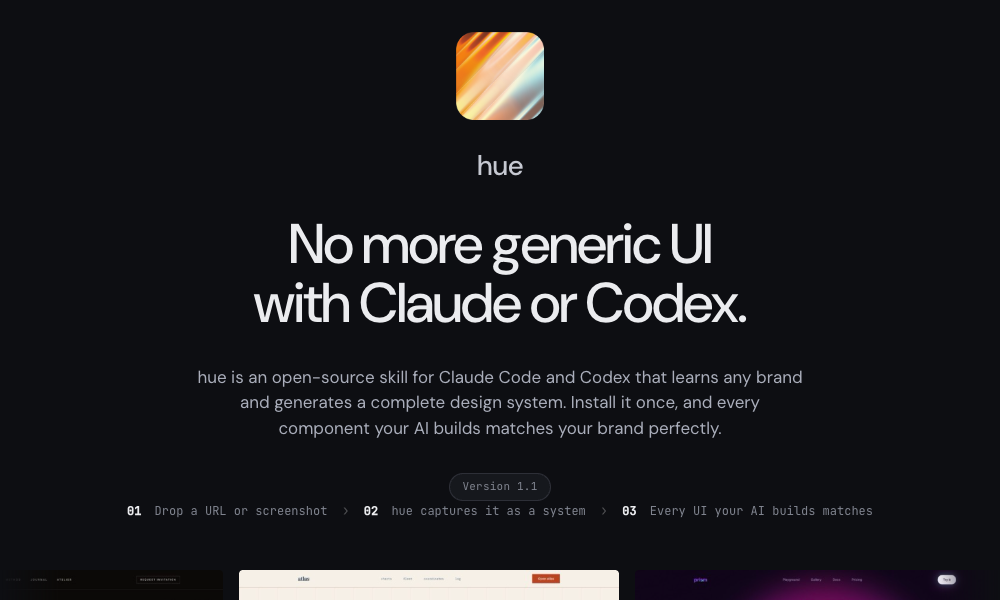
The associated agent skill provides access to exhaustive style breakdowns. By utilizing Refero’s Model Context Protocol (MCP) server or importing pre-packaged DESIGN.md files from its library, developers can direct their coding assistants to emulate the exact UI patterns and design languages of top-tier software products on demand.
8. TypeUI Design Skills
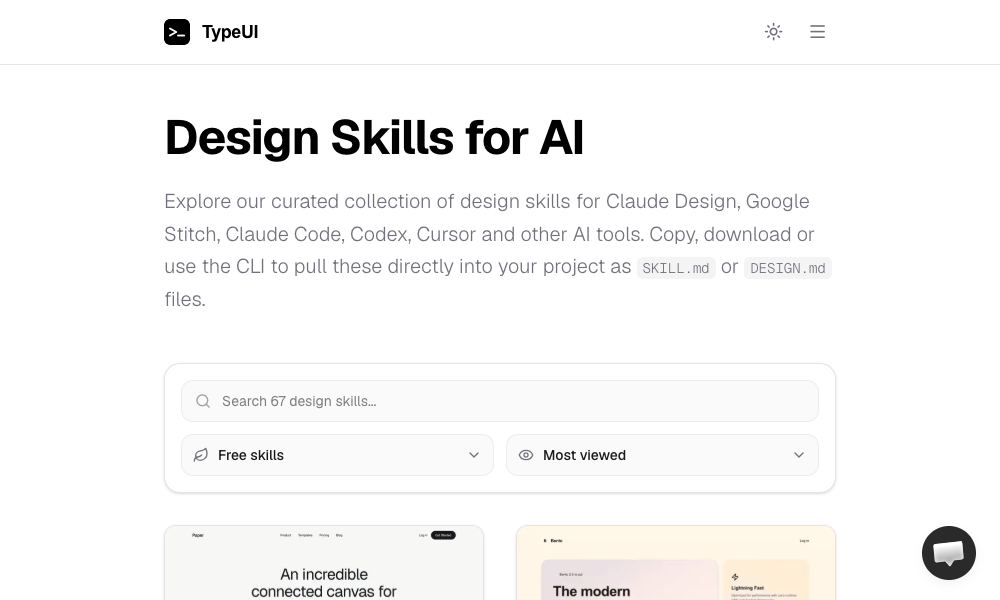
Designed to support multi-agent ecosystems—including Claude Design, Google Stitch, Cursor, and local OpenClaw deployments—TypeUI Design Skills offers a streamlined CLI (npx typeui.sh pull [name]) and repository of optimized SKILL.md and DESIGN.md files. The collection allows engineering teams to rapidly swap between diverse aesthetic profiles, ensuring that proof-of-concept builds reflect targeted artistic directions from their inception.
9. UI/UX Pro Max Skill
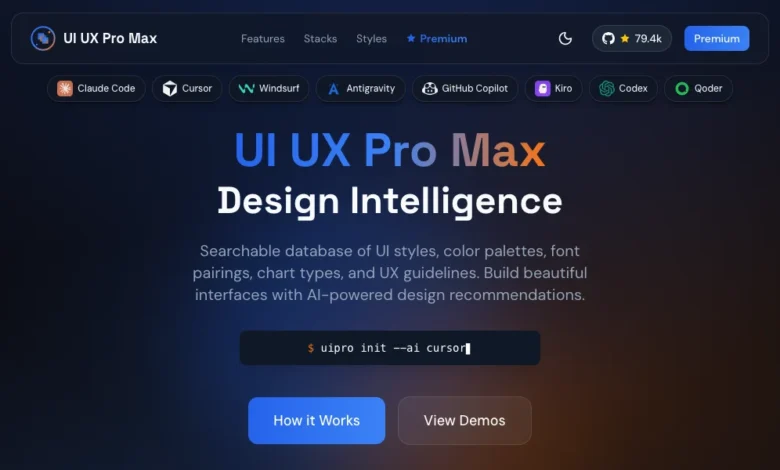
Representing one of the most comprehensive frameworks available, the UI/UX Pro Max skill incorporates 161 logical reasoning rules and 67 distinct UI styles. Activated via npx ui-pro init, the framework features a built-in Design System Generator.
When provided with a natural language project description—such as "a premium tour booking application"—the skill formulates a holistic design system encompassing layout structures, color theory, component states, and explicit rules on anti-patterns to avoid. It supports HTML, Tailwind CSS, React, and Next.js stacks across major IDEs, serving as an end-to-end architecture for automated design management.
10. AI UX Playground
As artificial intelligence products introduce entirely new interaction paradigms, traditional user experience heuristics often fall short. AI UX Playground is a dedicated repository of UX patterns specifically engineered for conversational interfaces, LLM wrappers, and agentic workflows found in platforms like ChatGPT, Claude, and Perplexity. By documenting real-world examples and platform-specific implementation tips, the playground equips developers with the foundational patterns necessary to build intuitive interfaces for intelligent systems.
Implications and the Future of Design Engineering
The proliferation of executable design skills signals a fundamental transition in how design knowledge is disseminated and applied. Historically, design systems existed as static documentation—style guides, Figma libraries, and PDF brand books—intended for human interpretation. Today, these guidelines are rapidly evolving into machine-executable rulesets that govern autonomous systems.
Industry analysts suggest this shift elevates the strategic value of human designers. Rather than executing repetitive layout tasks, designers are increasingly acting as curators of taste, authoring the foundational markdown files and behavioral constraints that guide AI output. As these directories mature and expand, the historical dichotomy between raw computational efficiency and aesthetic excellence in software engineering is steadily dissolving, paving the way for a new era of automated, beautifully crafted digital products.