Amazon ECS Gateway Launches to Streamline Ingress Networking and Eliminate Operational Bottlenecks for Containerized Applications

Managing containerized applications at scale has long presented platform engineering teams with significant structural friction, particularly when configuring ingress networking. In complex cloud environments running on Amazon Elastic Container Service (Amazon ECS), every new microservice or containerized workload historically required the manual provisioning and intricate stitching together of Application Load Balancers (ALBs), AWS Certificate Manager (ACM) SSL/TLS certificates, AWS WAF web access control lists, and custom security groups. Furthermore, platform teams were forced to manually maintain synchronization among these disparate components as services scaled up or down, underwent rolling updates, or faced shifting security compliance requirements.
This per-service operational overhead has consistently introduced deployment bottlenecks, slowed developer velocity, and increased the latent risk of configuration drift across enterprise cloud estates. To address these systemic challenges, Amazon Web Services has officially announced the launch of Amazon ECS Gateway, a powerful new account-level resource designed to automate ingress networking completely. By dynamically provisioning and managing necessary infrastructure directly within an organization’s AWS account, the new capability aims to redefine how platform teams deliver secure, scalable, and isolated routing endpoints to application developers.
The Architecture of Simplification: Core Mechanics and Infrastructure Sharing
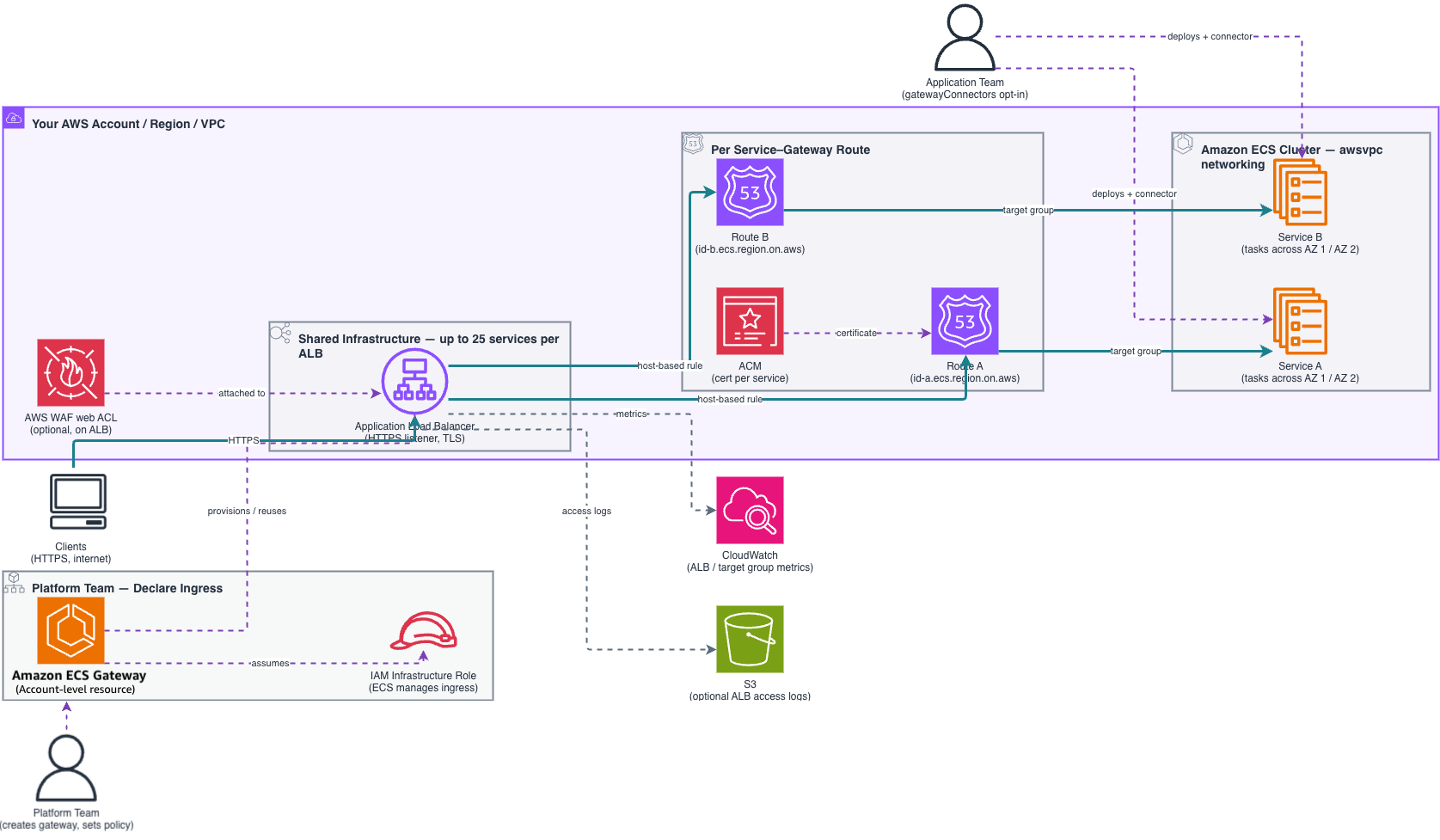
At its operational core, Amazon ECS Gateway introduces a clean structural separation of responsibilities between centralized platform teams and distributed application development teams. Platform administrators establish the baseline gateway configurations, define security boundaries, and provision overarching routing policies, while application teams simply attach their workloads to the pre-existing fabric.

One of the most economically significant features of the new service is its support for host-based routing using Application Load Balancers, allowing up to 25 distinct containerized services to share a single ALB. This high-density consolidation significantly optimizes cloud infrastructure costs by reducing the proliferation of idle load balancers that traditionally plagued large-scale microservice architectures.
Amazon ECS manages the complete lifecycle of the underlying networking infrastructure automatically. The system provisions the initial ALB the moment a service connects, dynamically scales out additional load balancers as capacity thresholds are reached, and safely decommissions them when workloads are scaled down or terminated. Upon successful provisioning, each connected service receives a dedicated, unique DNS hostname, granting developers an immediate, ready-to-use production endpoint.
The flexibility of ECS Gateway is further emphasized by its robust many-to-many relationship model. A single gateway can be associated with up to 10,000 distinct ECS clusters, while an individual cluster can support up to five separate gateway associations. This architectural fluidity empowers platform engineers to share a centralized gateway across multiple development or staging environments, or conversely, assign specialized gateways—such as dedicated public-facing and VPC-internal variants—to a single high-traffic cluster.
Deployment Workflows and Programmatic Integration
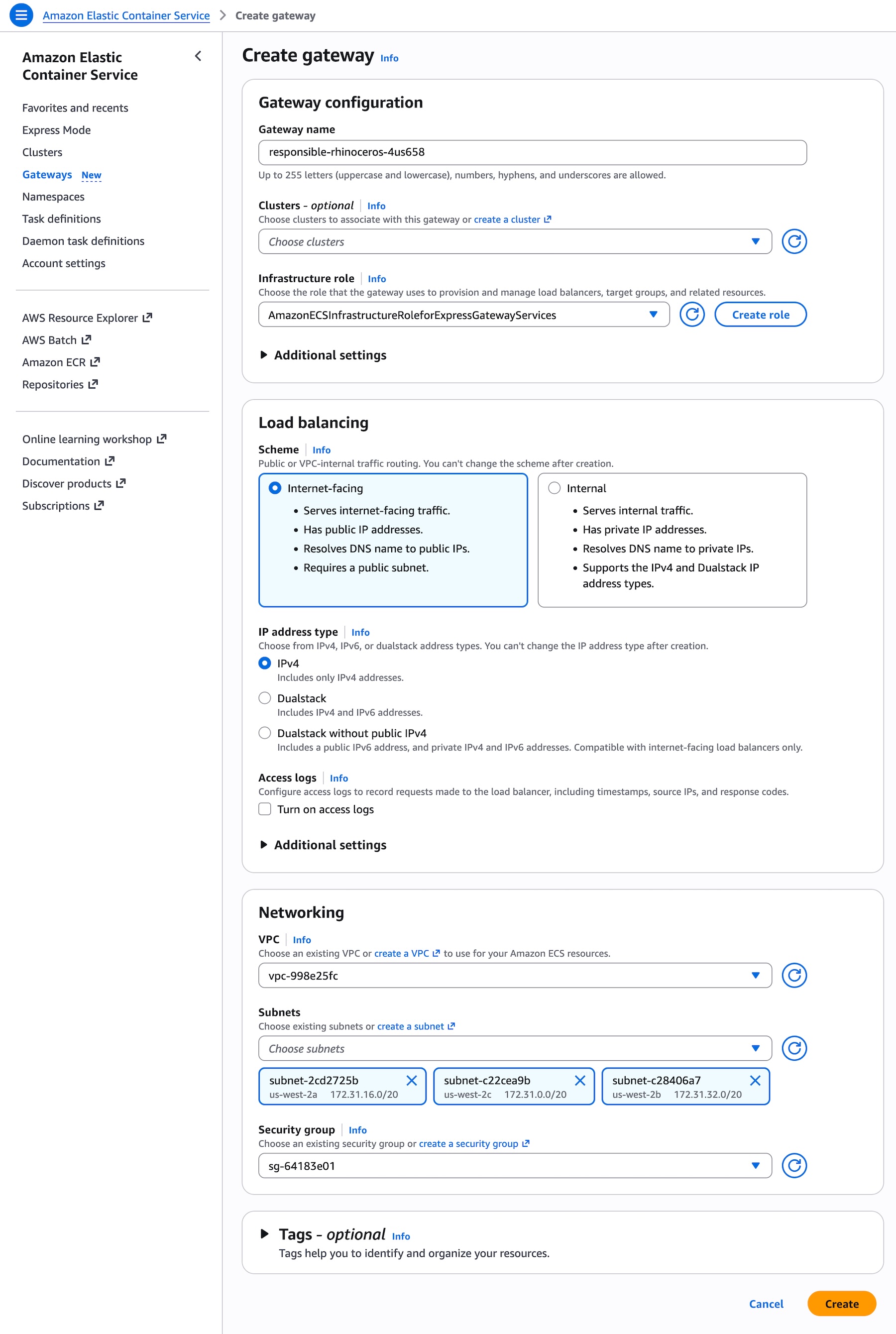
Configuring an Amazon ECS Gateway can be executed seamlessly through either the AWS Management Console or the AWS Command Line Interface (AWS CLI). Within the console, platform administrators navigate to the ECS dashboard, initiate the gateway creation wizard, and designate a specific IAM infrastructure role. This designated role grants Amazon ECS the necessary permissions to autonomously provision and manage networking assets such as ALBs, target groups, security groups, and certificates within the account.

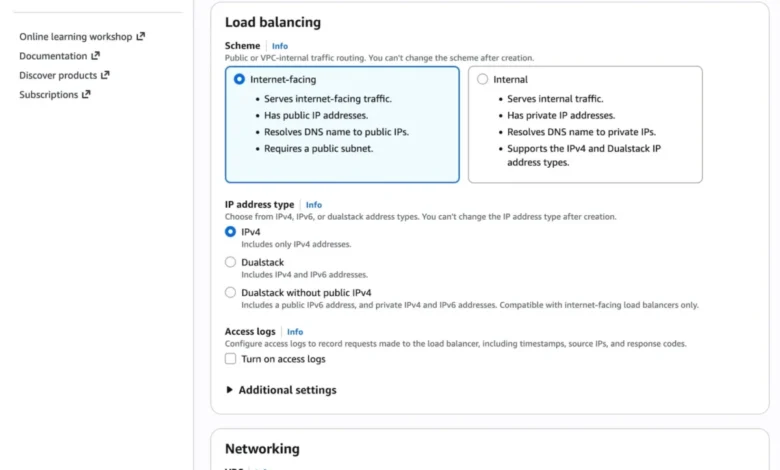
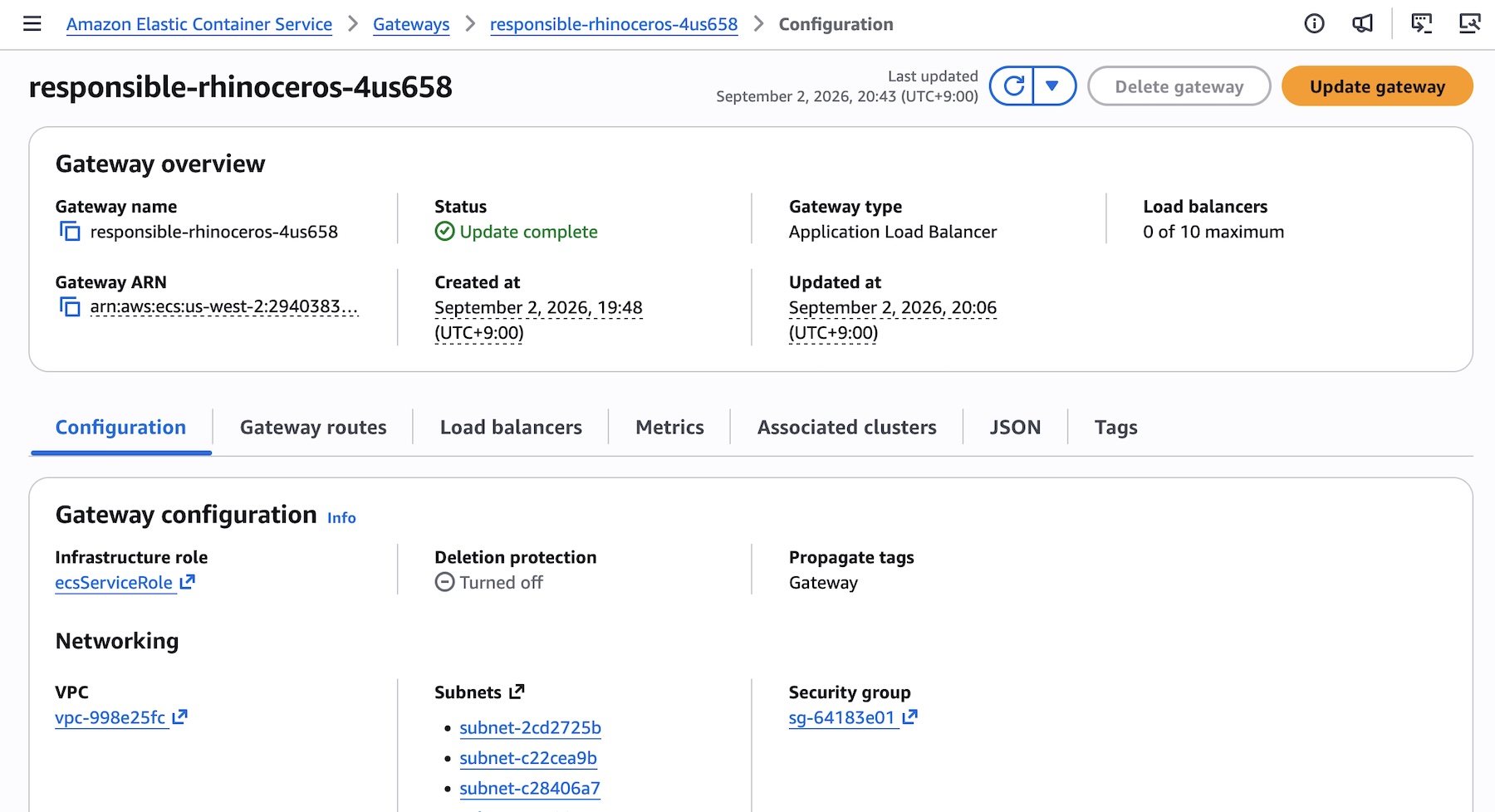
When establishing a gateway, operators select whether the traffic routing scheme should be public (internet-facing) or entirely VPC-internal. Additional configurations allow teams to specify listeners, ports, maximum load balancer scaling limits, and AWS WAF web ACLs to shield applications from common web vulnerabilities. It is worth noting that certain foundational parameters—such as the gateway name, routing scheme, underlying VPC, subnet selections, IP address types, and listener protocols—are immutable once the resource has been instantiated.
Programmatic deployment via the AWS CLI follows a similarly straightforward syntax. Administrators issue the CreateGateway command, supplying a unique account-level name, the infrastructure role ARN, and a comprehensive configuration object detailing the subnets and routing schemes. For instance, the initialization command takes the following structural form:
aws ecs create-gateway
  --name my-team-gateway
  --infrastructure-role-arn arn:aws:iam::123456789012:role/ECSGatewayRole
  --configuration '
    "HostSharedAlb":
      "networkConfiguration":
        "subnets": [
          "subnet-080779f9bd887757a",
          "subnet-03d5b2fead6bc6258",
          "subnet-0861210a397d31252",
          "subnet-06539e194023cb77a"
        ],
        "ipAddressType": "ipv4"
      ,
      "scheme": "internet-facing"

  '
Once the gateway resource exists, platform operators link it to specific container clusters by invoking the AssociateGatewayWithCluster API. Application teams can then onboard their services incrementally. For existing workloads already operating with legacy load balancer configurations, Amazon ECS Gateway supports gradual adoption. By calling the UpdateService API to incorporate a gateway connector, teams can run both ingress paths concurrently, validating the new routing behavior before deprecating and removing the older load balancer infrastructure.
Furthermore, AWS has ensured that modern developer workflows are fully supported from day one. Engineering teams can leverage the AWS Model Context Protocol (MCP) Server and associated plugins to create and manage ECS Gateway resources programmatically, query documentation, and execute API calls directly within their preferred AI-assisted coding environments.
Automated Lifecycle Management and Security Enforcement
Behind the scenes, Amazon ECS continually evaluates cluster-to-gateway compatibility whenever a service deployment is initiated. A gateway is deemed compatible if its access type aligns with the service connector’s filter parameters, it resides within the same Virtual Private Cloud as the workload, and it encompasses all Availability Zones utilized by the service’s configured subnets.
When a match is confirmed, Amazon ECS automates the orchestration of per-service resources. This includes generating an ACM certificate, establishing a unique DNS entry, configuring listener routing rules to direct traffic from the hostname to the proper target group, and adjusting security groups to restrict inbound traffic strictly to the ALB security group. If existing shared ALBs have exhausted their capacity limits, ECS automatically provisions a new load balancer, capped only by the user-defined maxAlbCount quota.
Security and access control remain paramount throughout this lifecycle. Platform teams retain granular control over which gateways are exposed to specific clusters. For advanced multi-tenant environments, organizations can layer AWS Identity and Access Management (IAM) policies over cluster deployments, restricting unauthorized users from binding services to sensitive or restricted production gateways.
Background Context and Industry Evolution
The release of Amazon ECS Gateway arrives at a critical juncture in the evolution of cloud-native architecture. Over the past decade, container orchestration platforms like Amazon ECS and Kubernetes have successfully democratized application deployment, allowing organizations to scale microservices from handfuls to thousands with unprecedented ease. However, this proliferation of microservices exposed a significant operational gap in edge networking.
Traditionally, networking components failed to keep pace with the hyper-agile pace of container deployments. While compute resources could be spun up in seconds via container definitions, networking configurations—such as DNS record propagation, target group registration, and certificate provisioning—often required out-of-band automation scripts, custom CI/CD pipeline steps, or heavy GitOps toolchains. These makeshift solutions frequently resulted in brittle infrastructure pipelines and increased vulnerability to security misconfigurations.
Industry analysts note that platform engineering has emerged as the dominant organizational response to this complexity. By treating internal developer platforms as discrete products, modern enterprises strive to hide underlying infrastructure plumbing behind clean, self-service abstractions. Amazon ECS Gateway directly aligns with this paradigm shift, shifting the burden of load balancer lifecycle management from individual application developers back to automated, platform-controlled primitives.
Economic Implications and Availability
From a financial perspective, Amazon ECS Gateway is being made available at no additional base service charge. Organizations do not pay a fixed software licensing fee or hourly management rate to utilize the gateway controller. Instead, customers incur costs solely for the underlying AWS resources provisioned within their accounts as services connect to a gateway. These standard usage fees encompass Application Load Balancer hourly rates, CloudWatch logs and metrics, AWS Certificate Manager validation, and standard data transfer charges.
The service is generally available immediately across all commercial AWS Regions where Amazon ECS is supported. Enterprise architects and platform administrators can begin provisioning gateways through the AWS Management Console or infrastructure-as-code tooling immediately.
As organizations increasingly migrate mission-critical workloads to containerized architectures, innovations like Amazon ECS Gateway represent a vital step forward in reducing cognitive load for developers while empowering platform teams to enforce rigorous security, compliance, and cost-optimization standards across the enterprise cloud ecosystem.