The global landscape of artificial intelligence education has undergone a radical transformation over the last several years, moving from an era of exclusive academic specialization to a democratized model where the most advanced training is available at zero cost. As of 2026, the proliferation of "AI bootcamps" and high-priced certifications has created a paradox of choice for aspiring engineers. While the barrier to entry is lower than ever, the "signal-to-noise ratio" has significantly worsened, leaving many learners overwhelmed by expensive programs that often provide less value than the open-source materials developed by the organizations actually building the frontier models.
Industry data indicates that hiring managers in the technology sector are increasingly prioritizing practical, project-based competency over traditional degrees. This shift has elevated a specific sequence of free, high-quality curricula—maintained by institutions such as Harvard University, Google, and leaders in the open-source community—as the gold standard for self-taught practitioners. For professionals with a foundational grasp of Python, a transition into AI engineering no longer requires a return to university; instead, it requires a strategic, sequential mastery of logic, mathematics, framework application, and first-principles architecture.
The Strategic Framework of AI Literacy
The path to becoming a proficient AI practitioner is typically divided into three distinct layers: the logical foundation, the practical application layer, and the architectural mastery phase. Education experts suggest that the most common failure point for self-taught learners is skipping the foundational layer to work directly with large language models (LLMs). This creates "API-reliant" developers who lack the depth to troubleshoot model behavior or optimize performance.
The first layer establishes a mental model for how machines reason. This involves moving from classical AI logic—such as search algorithms and optimization—to the core mathematics of machine learning, including gradient descent and backpropagation. The second layer focuses on "shipping" models, transitioning from theory to training, evaluating, and deploying systems on real-world datasets. The final layer removes the abstractions provided by modern libraries like PyTorch or TensorFlow, requiring the student to build architectures from scratch to understand the underlying mechanics.
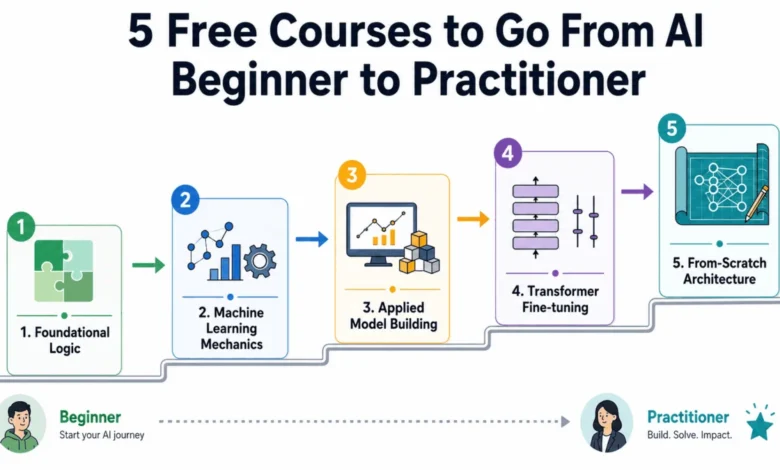
1. Establishing Logical Foundations: Harvard’s CS50 AI
The journey begins with Harvard University’s CS50: Introduction to Artificial Intelligence with Python. While many beginners attempt to jump straight into neural networks, Harvard’s curriculum emphasizes the "classical" AI logic that remains the backbone of modern systems. This course acts as a bridge between standard software engineering and the probabilistic world of machine learning.
The curriculum covers essential concepts such as graph search algorithms, classification, and optimization. By focusing on how AI systems make decisions in structured environments—like game-playing or pathfinding—students develop a rigorous understanding of state spaces and heuristics. This foundational knowledge is critical for technical interviews at top-tier firms, where candidates are often tested on their ability to solve problems without relying on pre-built libraries. Harvard provides this material through its OpenCourseWare platform and edX, allowing students to audit the full suite of lectures and assignments for free.
2. Mathematical Mechanics: Google’s Machine Learning Crash Course
Following the logical foundation, practitioners must confront the mechanics of how machines learn from data. Google’s Machine Learning Crash Course (MLCC) serves as the industry’s primary fast-track for this purpose. Originally developed to upskill Google’s internal engineering teams, the course has been refined over several years to provide a high-velocity introduction to the mathematics of the field.
The MLCC is unique for its integration of interactive visualizations and Google Colab notebooks. It guides students through the nuances of loss functions, regularization, and feature engineering. By the end of this module, a learner understands not just that a model is learning, but how it is optimizing its internal parameters. Data from Google’s developer relations suggests that this hands-on approach significantly improves retention compared to passive video-based learning. Access is open to the public without a subscription, making it one of the most accessible high-level technical resources in existence.
3. Top-Down Application: fast.ai’s Practical Deep Learning for Coders
Once the theory is established, the focus shifts to the "top-down" pedagogical approach pioneered by Jeremy Howard at fast.ai. In contrast to traditional academic routes that spend months on calculus before showing a working model, fast.ai requires students to train a state-of-the-art image classifier in the first lesson.
This methodology is designed for "coders"—individuals who learn best by doing. The course utilizes the fastai library, a high-level wrapper around PyTorch, to teach students how to achieve world-class results with minimal code. However, as the course progresses, it "peels back the onion," showing the lower-level PyTorch code and eventually the raw Python and math beneath it. This course has gained a cult-like following among practitioners because it focuses on the "unwritten rules" of AI: how to handle messy data, how to pick a learning rate, and how to deploy a model to production efficiently.
4. The Transformer Era: The Hugging Face NLP Course
In the current era of generative AI, understanding Natural Language Processing (NLP) and the Transformer architecture is non-negotiable. Hugging Face has emerged as the "GitHub of AI," hosting the vast majority of the world’s open-source models. Their official NLP course is the definitive guide to navigating this ecosystem.
The curriculum takes students through the entire lifecycle of a modern NLP project, from tokenization and preprocessing to fine-tuning massive models like BERT, GPT, and Llama. It provides practical instruction on using the Transformers, Tokenizers, and Datasets libraries, which have become industry standards. For practitioners looking to build applications that involve text summarization, sentiment analysis, or retrieval-augmented generation (RAG), this course provides the necessary technical infrastructure.
5. First-Principles Architecture: Andrej Karpathy’s Zero to Hero
The final stage of the roadmap involves stripping away all frameworks to understand the "soul" of the machine. Andrej Karpathy, a founding member of OpenAI and former Director of AI at Tesla, produced the "Neural Networks: Zero to Hero" series to address the "abstraction gap" in modern AI education.
In this series, Karpathy leads students through building a library similar to PyTorch (micrograd) from scratch, and eventually constructing a GPT-level model. This "white-box" approach ensures that the practitioner understands every single tensor operation and gradient calculation. Industry analysts frequently cite this series as the most valuable educational content for those aiming for senior engineering roles, as it equips them to innovate rather than just implement existing tools.
Chronology and Time Investment
For a dedicated learner working part-time (10–15 hours per week), this five-course sequence typically spans three to five months. The chronology is designed to prevent the "wall of frustration" that often occurs when students tackle advanced topics without sufficient context.
- Month 1: Harvard CS50 AI (Focus on logic and search).
- Month 2: Google MLCC (Focus on math and linear models).
- Month 3: fast.ai (Focus on computer vision and deep learning frameworks).
- Month 4: Hugging Face NLP (Focus on Transformers and generative models).
- Month 5: Karpathy’s Zero to Hero (Focus on first-principles and LLM architecture).
Supporting Data and Economic Context
The shift toward free, high-quality AI education is driven by a critical shortage of talent. A 2025 labor market report indicated that while the demand for AI-literate engineers has grown by 35% annually, the number of university graduates in computer science has not kept pace. This has forced major tech companies to open-source their internal training materials to widen the talent pool.
Furthermore, the cost of a traditional Master’s degree in Data Science or AI can range from $30,000 to $80,000. In contrast, the five-course sequence outlined here costs $0, yet covers nearly identical technical ground, often with more up-to-date practical tooling. Hiring data from 2025 suggests that candidates who can demonstrate a portfolio of projects built during these courses are hired at similar rates to those with formal certifications, provided they can pass the technical evaluation.
Official Responses and Industry Implications
The leaders behind these courses have often stated that their goal is to "level the playing field." Jeremy Howard of fast.ai has frequently argued that deep learning is a "tool for everyone," not just those with PhDs in mathematics. Similarly, Google’s decision to keep its MLCC free is viewed by analysts as a strategic move to ensure that the next generation of developers is proficient in the Google-supported ecosystem.
The broader implication of this educational shift is the "commoditization of AI knowledge." As the technical "how-to" becomes free and accessible, the value of an AI practitioner is shifting from knowing how to code a model to knowing which problems are worth solving and how to manage the ethical and data-privacy implications of AI systems.
Analysis of Future Trends
As we look toward the latter half of the decade, the role of the AI practitioner is expected to evolve into that of an "AI Architect" or "Agentic Engineer." This involves not just training models, but designing systems of multiple AI agents that can reason and execute tasks autonomously. The five-course roadmap provided here offers the fundamental literacy required to adapt to these coming shifts.
By starting with Harvard’s logic and ending with Karpathy’s deep-dive into LLMs, a learner builds a "recession-proof" skill set. While specific libraries and frameworks will inevitably change, the underlying principles of search, optimization, and backpropagation remain constant. For the aspiring practitioner, the message from the industry is clear: the resources are available, the cost is zero, and the only remaining barrier is the time and discipline required to master the material.