The digital security landscape for webmasters and digital marketing professionals experienced a severe disruption following a sophisticated supply chain cyberattack targeting DebugBear, a widely utilized Real User Monitoring (RUM) and Core Web Vitals optimization platform. The incident unfolded when malicious actors successfully hijacked the Domain Name System (DNS) records of the performance-tracking service, redirecting standard monitoring scripts to serve malicious JavaScript to client websites. The breach has triggered urgent security protocols across the web development and search engine optimization (SEO) communities, prompting affected organizations to immediately purge tracking elements and conduct exhaustive forensic audits of their systems.
The compromise came to light on October 29, when DebugBear officially alerted its user base to a severe security incident involving its external infrastructure. Because RUM tools typically require site owners to inject a third-party JavaScript snippet directly into the header or layout of their web pages to monitor user experience metrics in real time, any compromise of the hosting provider or DNS registrar directly transforms a benign performance asset into an automated vector for arbitrary code execution. As modern websites increasingly lean on third-party integrations for analytics, performance tracking, and user engagement, this event underscores the expanding vulnerability of the web supply chain, where a single compromised vendor can jeopardize thousands of downstream platforms.
Chronology of the Breach and Initial Discovery
The timeline of the attack highlights the rapid speed at which modern cyber threats can exploit third-party dependencies. On October 29, cybersecurity researchers and platform monitors detected anomalous activity stemming from DebugBear’s primary script distribution network. Independent analysis conducted by the cybersecurity firm Hudson Rock revealed that a malicious payload had been successfully injected into the DebugBear script URL utilized by prominent prediction market and trading platform Polymarket.
By utilizing the trusted domain and file path associated with the RUM tool, the injected code bypassed standard browser safety heuristics, allowing it to execute seamlessly within the context of visiting users’ browsers. Polymarket experienced an immediate operational crisis, forcing the platform to report an emergency outage on its international exchange and temporarily halt all trading activities on October 29. Subsequent incident reports published by Polymarket on October 30 confirmed that the unauthorized script actively manipulated user sessions, executing unauthorized position sales and draining funds from select user balances.
Concurrently, DebugBear scrambled to address the vector of the attack. In a formal update released via professional networks, the company disclosed that the core vulnerability did not stem from compromised internal application servers or cloud infrastructure, but rather from a direct hijacking of its DNS records at the level of its domain registrar. By gaining unauthorized access to the domain management portal, the attackers were able to alter pointer records, effectively redirecting traffic meant for legitimate DebugBear monitoring scripts to malicious servers hosting the exploit payloads. Furthermore, the severity of the DNS takeover was compounded by the fact that the company temporarily lost the ability to receive inbound administrative emails, forcing management to communicate emergency updates exclusively through alternative channels such as their official X (formerly Twitter) account.
Anatomy of the Attack: Weaponizing Trusted Sessions
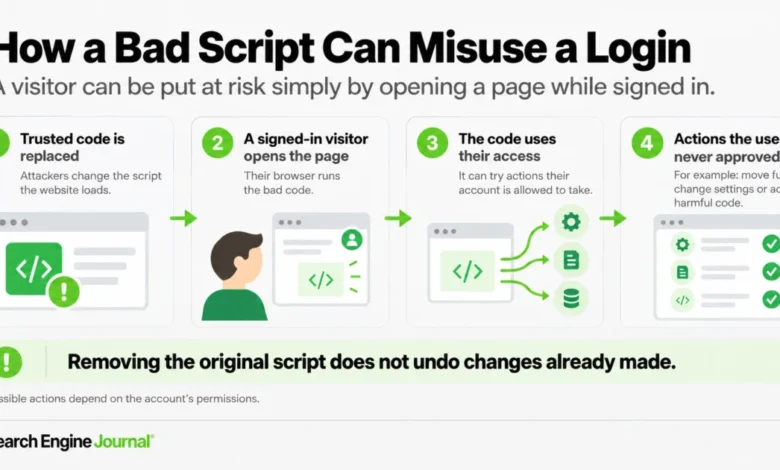
The technical mechanism behind the DebugBear incident highlights a sophisticated evolution in web-based cyberattacks: the weaponization of authenticated user states. Rather than attempting traditional credential harvesting, phishing, or direct database exfiltration, the malicious script deployed via the hijacked DNS records targeted browser sessions that were already active and authenticated.
When a user visits a high-value platform—such as a financial exchange, a software-as-a-service (SaaS) dashboard, or an e-commerce hub—their browser maintains active session tokens, cookies, or local storage tokens that prove their identity to the server. Under normal circumstances, a third-party script loaded onto the page is restricted by browser security policies, but scripts loaded directly from the domain or associated Content Delivery Networks (CDNs) of trusted monitoring tools often inherit broad execution privileges or can interact with the Document Object Model (DOM) of the host site.

In the case of Polymarket, the malicious JavaScript did not need to steal user passwords. Instead, it programmatically interacted with the trading client interface already present in the logged-in browser of the victim. Because the user was already authenticated, the script possessed the implicit authorization to execute trades, liquidate assets, and initiate fund transfers. This methodology transforms trusted infrastructure into a Trojan horse, where the victim’s own browser executes the malicious commands under the guise of legitimate user intent. Cybersecurity analysts have emphasized that this type of attack presents unique detection challenges, as the actions performed often mimic legitimate user sessions from an application-layer perspective.
Industry Impact and Implications for SEO and Development Teams
While initial forensic reports from DebugBear indicated that the direct targeting appeared largely concentrated on high-value integrations like Polymarket, the broader implications for the thousands of other websites utilizing the RUM tool remain critical. SEO experts, who frequently rely on DebugBear to track, diagnose, and optimize Core Web Vitals—such as Largest Contentful Paint (LCP), Interaction to Next Paint (INP), and Cumulative Layout Shift (CLS)—found themselves inadvertently exposed to supply chain risk.
For SEO and technical development teams, the incident serves as a stark reminder of the hidden dangers associated with third-party script management. Standard operational protocol often dictates that marketing and performance teams deploy tracking pixels and monitoring tags with minimal friction. However, this event demonstrates that performance monitoring tools possess the exact same operational vectors as advertising pixels or analytics trackers, making them prime targets for malicious actors seeking broad distribution across enterprise websites.
The primary concern for site owners who deployed the DebugBear script is twofold: immediate containment and retrospective auditing. Simply removing the script from the website’s source code halts the immediate vector of future script loads, but it does nothing to remediate potential lateral damage, unauthorized administrative modifications, or data exposure that may have occurred while the malicious code was actively serving payloads to visitors.
Recommended Action Plan for Affected Site Owners
In light of the security disclosures, cybersecurity professionals and technical stakeholders have outlined a rigorous remediation checklist for any organization that utilized DebugBear’s Real User Monitoring script:
- Immediate Script Removal: Development teams must purge all instances of the DebugBear monitoring script from website headers, tag management systems (such as Google Tag Manager), and codebase repositories immediately.
- Access Control Audits: Organizations must conduct comprehensive reviews of all administrative accounts associated with their content management systems (CMS), hosting environments, and third-party integrations to check for unauthorized privilege escalations or newly created user accounts.
- Log Analysis and Traffic Forensics: Security teams should examine server access logs and web application firewall (WAF) records for the duration the compromised script was active, searching for anomalous API requests, unauthorized database modifications, or unusual user session behaviors.
- Implementation of Subresource Integrity (SRI): Moving forward, engineering teams should enforce Subresource Integrity hashes for all third-party scripts where applicable, or adopt strict Content Security Policy (CSP) headers to limit the execution domains of external assets.
- Vendor Risk Assessment: Digital marketing and IT departments must re-evaluate their third-party vendor management policies, treating performance monitoring and analytics tools with the same rigorous security scrutiny applied to payment gateways and database administrators.
Broader Perspectives on Web Supply Chain Security
The DebugBear incident joins a growing list of supply chain compromises that have affected the digital ecosystem, illustrating the fragile interconnectedness of modern web applications. As organizations increasingly rely on specialized third-party SaaS vendors to handle auxiliary tasks like performance tracking, error logging, and user analytics, the attack surface expands far beyond traditional perimeter defenses.
Security analysts note that while Domain Registrar security—such as enabling registry locks, enforcing multi-factor authentication (MFA) on administrative portals, and utilizing robust DNS security extensions (DNSSEC)—remains the direct responsibility of the vendor, downstream consumers bear the ultimate risk when those defenses fail. The swift response by DebugBear in communicating the breach, coupled with rapid identification by external cybersecurity researchers like Hudson Rock, prevented a wider dissemination of the exploit across all connected properties, but the event cements a permanent shift in how technical SEO and web operations teams must evaluate external performance scripts. Moving forward, continuous script monitoring, behavioral analysis of browser-side execution, and zero-trust principles regarding third-party code integration will become standard prerequisites for enterprise web architecture.