How Switching From JSON to Markdown Can Cut AI Agent Token Costs by Up to 74 Percent

The rapid proliferation of autonomous artificial intelligence agents and large language models (LLMs) has introduced a hidden, yet escalating, operational expense for enterprises worldwide: token bloat. As artificial intelligence systems take on increasingly complex, multi-step workflows—ranging from automated market research to autonomous customer support and software debugging—they frequently interact with external web tools, search engines, and document repositories. Every time an agent initiates a search query or executes a file retrieval, it ingests massive payloads of unstructured and semi-structured data, including nested objects, tracking links, layout metadata, and redundant logs.
While much of this extraneous information is ultimately discarded by the model during the reasoning phase, organizations are billed for every single token processed within the input context window. This architectural inefficiency not only inflates operational budgets but also compromises model efficiency and crowds out valuable contextual information that the AI needs to maintain long-term coherence. To address this mounting challenge, developers and data infrastructure providers are increasingly looking at fundamental payload redesigns. Among the most promising recent developments in this space is the adoption of lightweight formatting standards, spearheaded by API providers like SerpApi, which recently introduced native Markdown output capabilities designed to strip away non-essential data structures and dramatically reduce token consumption without sacrificing semantic comprehension.
The Economics of Context Windows and Token Bloat
To understand the magnitude of the problem, one must examine how modern large language models process information. LLMs operate within fixed context windows—measured in tokens, which represent chunks of text or code. Every piece of data fed into the model, from system prompts and historical conversation logs to API responses and retrieved documents, must fit within this finite window. When an agent runs a standard web search for a routine query—such as looking up local businesses or gathering product specifications—the underlying search engine typically returns a response formatted in JavaScript Object Notation (JSON).
JSON has long been the gold standard for web APIs because it provides explicit data types, nested arrays, and strict key-value pairs that traditional software applications, frontend user interfaces, and relational databases can easily parse. However, JSON is notoriously verbose. It carries structural overhead, including quotation marks, brackets, commas, semantic keys repeated across thousands of list items, and tracking parameters intended exclusively for web analytics rather than machine reasoning.
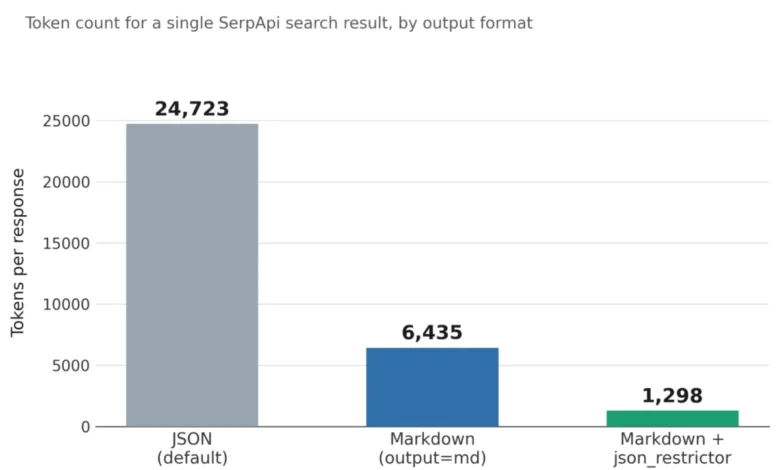
When an AI agent ingests a raw JSON payload, it must process all of this syntactic scaffolding. In empirical benchmarks conducted by SerpApi, a standard search query for the term "coffee" yielded a JSON response that consumed a staggering 24,723 tokens. For an enterprise running millions of automated queries daily, the cumulative cost of processing invisible metadata, tracking URLs, and redundant display instructions translates to thousands of dollars in wasted compute resources. Furthermore, this payload bloat consumes valuable space in the context window, leaving less room for the agent’s internal working memory, reasoning chains, and historical instructions, which can ultimately lead to degraded performance, hallucinations, or premature context truncation.
The Technical Mechanics of Markdown Optimization
The solution to token bloat lies in redefining the shape of data based on the intended consumer. While software applications and pricing engines require the rigid data typing of JSON, artificial intelligence agents require semantic clarity and relational context. Recognizing this dichotomy, data providers have begun rolling out optimized output formats specifically tailored for neural networks.
SerpApi’s Markdown output mechanism addresses the inefficiency of JSON by stripping out or fundamentally reshaping elements that inflate token counts without contributing to machine reasoning. Based on technical documentation and comparative analyses, typical optimizations include the removal of internal tracking identifiers, redundant metadata nodes, UI-specific rendering instructions, and deeply nested object trees that can be flattened into standard Markdown tables or bulleted lists.
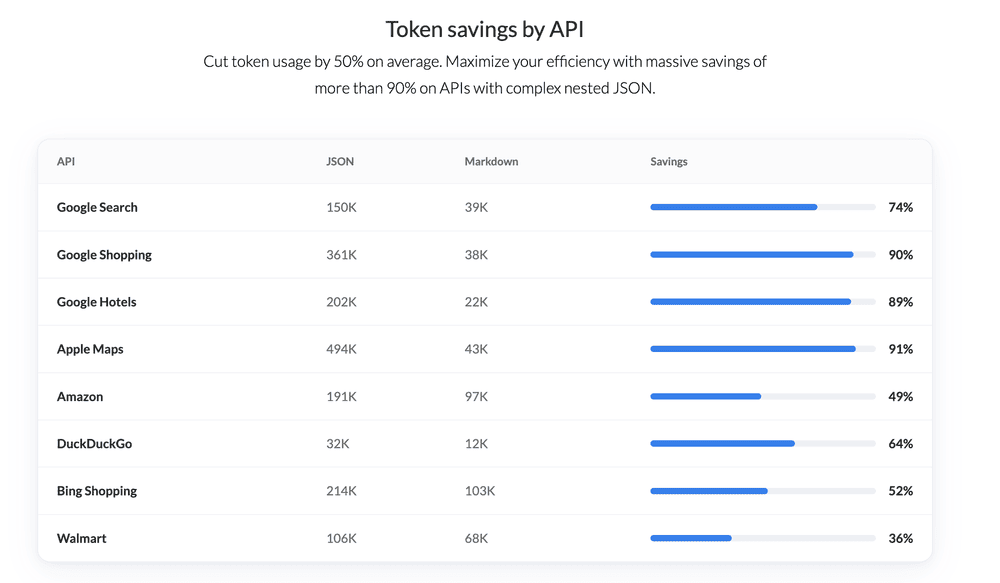
In comparative testing, executing the exact same "coffee" search query using SerpApi’s new Markdown output format required only 6,435 tokens. This represents a direct 74 percent reduction in token consumption for a single API call. Moreover, when combined with server-side filtering and restricted key sets, the same query footprint can be compressed down to a mere 1,298 tokens for targeted information retrieval.
This dramatic reduction is achieved by leveraging Markdown’s inherent lean syntax. Headers, bullet points, and inline links convey hierarchical information and relational links with a fraction of the structural characters required by JSON brackets and keys. For an AI agent, a clean Markdown table outlining top search results delivers the exact same semantic signal as a complex JSON array, but it allows the underlying model to operate with maximum efficiency, lower latency, and significantly reduced API costs.
Balancing Data Fidelity: When JSON Remains Indispensable
Despite the clear economic and performance benefits of Markdown in agentic workflows, industry experts emphasize that Markdown is not a universal replacement for JSON. The choice of data format must be dictated by the architectural requirements of the downstream pipeline.
Markdown output is heavily optimized for large language models, summarization tasks, natural language processing, and autonomous agent navigation. However, it falls short in environments where code requires strict, deterministic data types. If an enterprise data pipeline depends on precise numeric pricing, floating-point geographical coordinates, exact ratings, or strictly typed arrays for automated financial transactions or advanced algorithmic analytics, JSON remains the superior choice.
For example, consider a query targeting a retail aggregator like Naver Shopping. A JSON response for a product search exposes explicit keys such as price, old_price, and coupon_price formatted as integers, alongside rating formatted as a float, alongside nested arrays for reviews and stores. For a quantitative pricing engine, automated arbitrage bot, or financial analytics script, these typed fields are non-negotiable. Conversely, for an AI assistant tasked simply with summarizing the top three consumer product recommendations for a human user, those explicit data types represent unnecessary overhead. For the agent, Markdown table rows and inline links convey the necessary information with exponentially fewer tokens, demonstrating that the ideal data architecture depends entirely on whether the reader is a software compiler or a neural network.
Implementation and Developer Integration
To facilitate widespread adoption without requiring massive architectural overhauls, major API providers are ensuring that format switching is seamless. SerpApi, for instance, has integrated Markdown output across its entire suite of over 100 specialized search APIs at no additional cost to developers.
Implementation is typically handled via standard HTTP parameters, route extensions, or custom headers. Developers can request Markdown payloads by appending specific query parameters—such as output=md—directly to their existing API calls. In addition to Markdown conversion, advanced data minimization can be achieved through server-side field restrictors, such as SerpApi’s json_restrictor or CLI --fields flags. These tools allow engineers to prune unwanted keys at the server level before the payload ever crosses the network, compounding the token savings and further accelerating response times.
Industry Implications for the Future of Agentic AI
The shift toward model-optimized data formats signals a broader maturation phase in the artificial intelligence industry. As organizations move past the initial experimental phase of deploying generative AI and confront the harsh realities of unit economics at scale, infrastructure optimization has become a top priority.
In autonomous agentic systems—where an AI loops through multiple search queries, file retrievals, and self-correction cycles to complete a single user request—inefficiencies do not merely add up linearly; they compound exponentially. A bloated initial search result can trigger recursive loops that consume hundreds of thousands of unnecessary tokens within minutes. By systematically measuring payload sizes and tailoring data delivery mechanisms to the specific needs of neural networks, developers can drastically lower operational overhead.
As more data providers follow suit by offering multi-format outputs tailored for machine consumption, optimizing the shape of data will likely become a standard best practice in software engineering. For enterprises seeking to scale their AI operations sustainably, evaluating token usage at the API layer is no longer just a minor technical optimization—it is a critical financial and architectural necessity.