The Evolution of Authorship in the Age of Artificial Intelligence: Redefining Creative Control and Mastery

A decade ago, a visitor to the Musée Rodin in Paris might have been struck by a fundamental misunderstanding of artistic production. The prevailing public assumption—that Auguste Rodin was the solitary creator of every surface, line, and curve within his vast oeuvre—is a romanticized fiction. In reality, Rodin presided over a complex workshop. While he was the conceptual architect and visionary, his studio was a hive of specialized labor. Skilled artisans enlarged and reduced his models, marble carvers translated his plaster casts into stone, and foundries managed the intricate bronze casting process. Even notable sculptors like Camille Claudel served as essential collaborators on his most complex works. Despite this collaborative reality, the cultural shorthand for these works remains, simply, "a Rodin."
This historical framework provides a critical lens for examining the current crisis of authorship precipitated by the rise of generative artificial intelligence. As tools like ChatGPT and sophisticated image-generation models become integrated into professional workflows, the divide between creative direction and manual production has widened, prompting a re-evaluation of what it means to be an author in the twenty-first century.
The Industrialization of Creativity: From Rodin to Koons
The tension between the visionary and the fabricator is not a modern invention, but it has reached a new scale. Consider the career of contemporary artist Jeff Koons. A recent profile in The New York Times highlighted an operation that functions less like a traditional artist’s studio and more like a high-tech manufacturing firm. Koons has famously utilized teams of over 100 people, incorporating digital modeling, precision scanning, and standardized, paint-by-numbers protocols to ensure that every gesture and hue conforms to his exact specifications.

Koons’ methodology serves as a precursor to the current AI-integrated creative landscape. In both instances, the question remains: who is the author? The conventional view suggests that the team or the machine performs the labor, but the intellectual property and the creative vision reside solely with the director. As AI begins to automate cognitive tasks—researching, structuring, and drafting—writers and content creators are grappling with the same distinction. The industry is currently split between the purists, who view any machine-generated word as a breach of integrity, and the maximalists, who treat AI as a wholesale surrogate for human effort. Both positions are arguably flawed: the former conflates authorship with the physical act of keystroking, while the latter mistakes passive supervision for genuine creative synthesis.
The Productivity Paradox: Quantitative Gains and Qualitative Risks
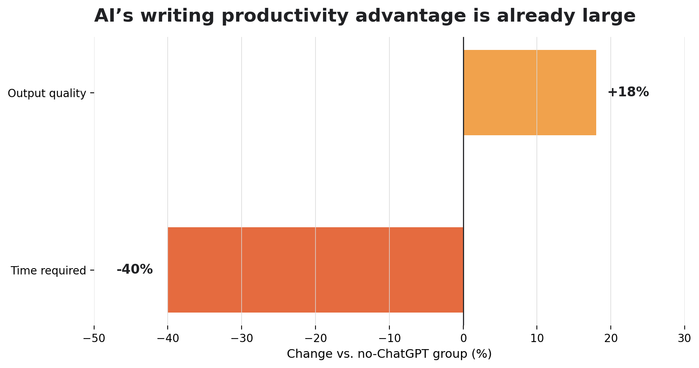
The shift toward AI-assisted production is driven by quantifiable performance metrics. A 2023 study published in the journal Science, led by researchers Shakked Noy and Whitney Zhang, provided empirical evidence for the efficacy of these tools. In an experiment involving 453 college-educated professionals, access to generative AI reduced the time required for writing tasks by an average of 40 percent, while simultaneously increasing the assessed quality of the output by 18 percent.
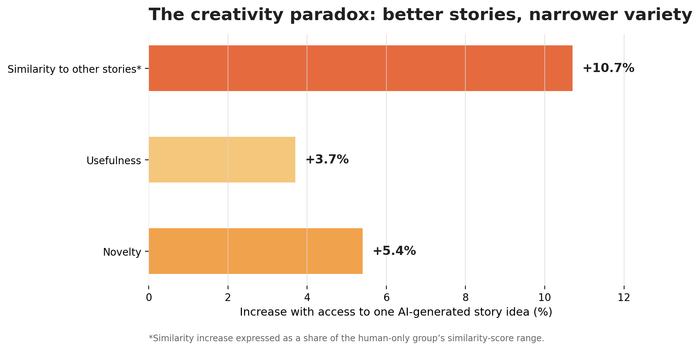
However, speed and quality metrics often mask a deeper, more insidious trend: homogenization. While individual writers may become more productive, collective output across the industry is trending toward the statistical mean. A 2024 experiment in Science Advances by Anil Doshi and Oliver Hauser revealed that while writers using AI produced work rated as more "novel" and "useful," their stories became increasingly similar to one another. The integration of AI tools reduced the semantic diversity of the work, effectively steering human creators toward a narrow, algorithmic "average."
This phenomenon, colloquially termed "AI slop," refers to the deluge of low-quality, derivative content that lacks a distinct voice or intent. By 2025, the term had gained enough cultural currency that Merriam-Webster named "slop" its word of the year, signaling a broad recognition of the risks posed by uncritical reliance on generative systems.
Chronology of the AI-Creative Shift
- 2022–2023: The widespread public release of large language models (LLMs) triggers an immediate shift in professional writing workflows. Early adoption is focused on speed and basic task automation.
- 2024: Research studies begin to identify the "homogenization effect," where AI-assisted writing starts to lose stylistic diversity, leading to concerns about the long-term impact on creative innovation.
- 2025: Regulatory and legal bodies, including the U.S. Copyright Office, issue formal reports clarifying that while AI-assisted content can be copyrighted, the mere act of prompting is insufficient for authorship. "Slop" enters the mainstream lexicon as a descriptor for the excess of machine-generated, low-value content.
- 2026: Meta-analyses of numerous studies confirm a statistically significant decline in semantic variety in AI-assisted human work, emphasizing the necessity of human "formative friction" to maintain unique voices.
The Role of Formative Friction in Mastery
The core danger in the widespread adoption of AI is the loss of "formative friction"—the difficult, often tedious processes that define true mastery. The act of wrestling with an argument, searching through disparate sources for a specific quote, or refining the rhythm of a sentence is not merely a production hurdle; it is the process through which a writer develops judgment.
A 2026 review in Trends in Cognitive Sciences warned of "cognitive offloading," noting that when humans stop performing the foundational tasks of their craft, they risk losing the ability to assess the quality of the work they are directing. Much like Rodin needed a deep, tactile understanding of clay to guide his assistants, a modern writer must possess the craft to know when a machine-generated paragraph is technically correct but intellectually hollow.
Redefining Authorship for the Modern Era
To survive the current transition, creators must distinguish between delegation and abdication. Effective authorship in the AI age relies on five distinct responsibilities:
- Origin: Defining why the work exists and what gap it intends to fill.
- Intent: Establishing a clear, human-centered objective for the communication.
- Direction: Exercising agency over research, content inclusion, and argument structure.
- Judgment: Applying human taste and ethics to verify the accuracy, beauty, and utility of the output.
- Responsibility: Taking ownership of the finished product, including the willingness to defend its claims.
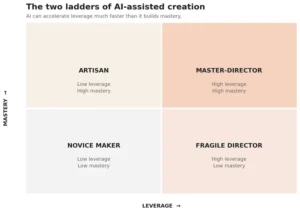
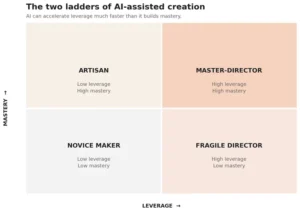
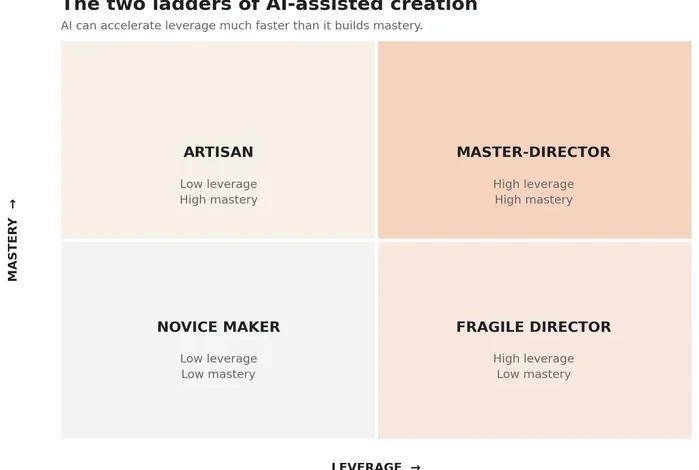
None of these pillars requires the author to type every character, but all of them require the author to be fully present. The most successful creators will be those who operate as "master-directors"—individuals who utilize high-leverage tools to amplify their output, but who have first built the high-mastery foundation necessary to guide the technology.
The Future of Creative Autonomy
The challenge moving forward is not how to write faster, but how to maintain a sense of purpose in an era of near-infinite creative options. As artificial intelligence continues to lower the barrier to entry for content production, the value of unique, human-centric observation will likely increase.
The goal should not be to automate the human out of the loop, but to automate the friction that wastes time, while preserving the friction that fosters growth. A society that prioritizes the role of the master-builder—one who holds the vision, understands the mechanics, and commands the tools—will be better equipped to navigate the deluge of digital content. In the final analysis, the measure of authorship is not found in the source of the prose, but in the strength of the intent and the depth of the human judgment behind it. Delegation can expand the reach of an author, but the moment the machine begins to dictate the meaning, the author has effectively abdicated their role.