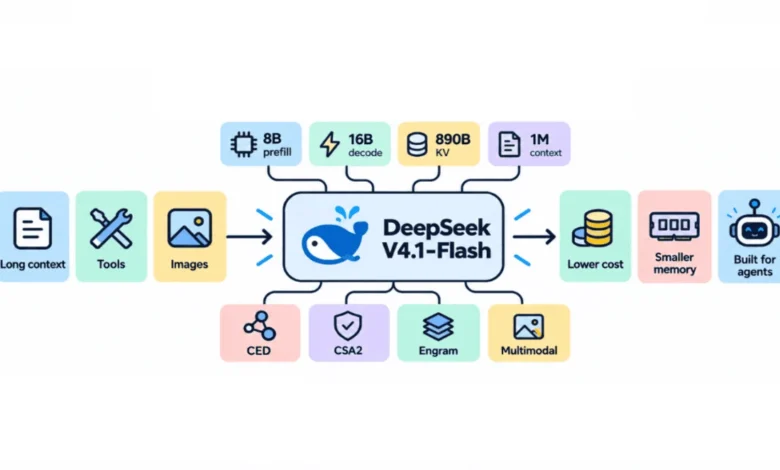
The landscape of artificial intelligence research and deployment has shifted profoundly with the official release of DeepSeek-V4.1-Flash. While initial industry reactions to any new large language model typically fixate on standard benchmark scores, this latest architecture from DeepSeek demands a deeper technical appraisal. Rather than simply scaling up raw parameter counts to achieve marginal accuracy gains, DeepSeek has engineered a systemic overhaul of both model architecture and the underlying inference stack. This comprehensive redesign directly addresses the most critical operational bottlenecks facing modern artificial intelligence deployment—specifically, the escalating costs and memory constraints associated with long-running autonomous agents.
As autonomous systems evolve from simple chat interfaces to complex, long-context operational loops, they encounter severe infrastructure challenges. These include expensive prompt prefill phases, massive memory consumption from key-value (KV) caches, high memory bandwidth requirements, and the persistent financial burden of maintaining agent state across extended interactions. DeepSeek-V4.1-Flash has been constructed from the ground up to mitigate these precise challenges. By introducing novel structural paradigms such as the Causal Encoder-Decoder framework, Compressed Sparse Attention 2, and conditional memory components, the model demonstrates that efficiency and high performance can be successfully scaled together.
Comprehensive Architectural Breakdown and Specifications
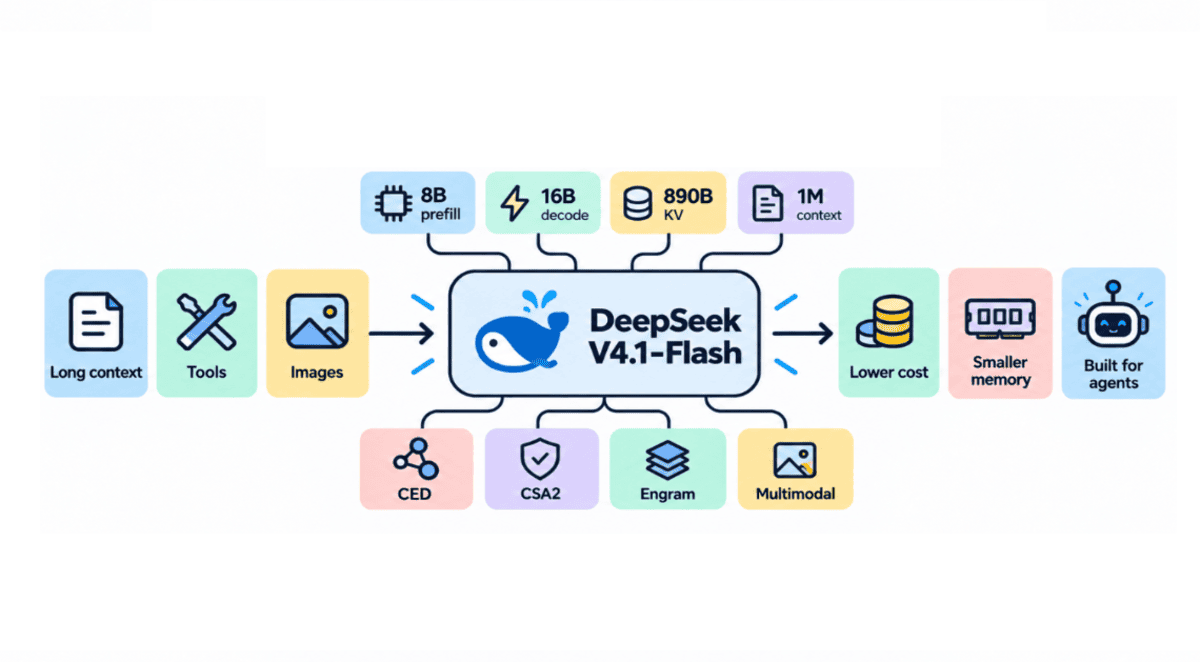
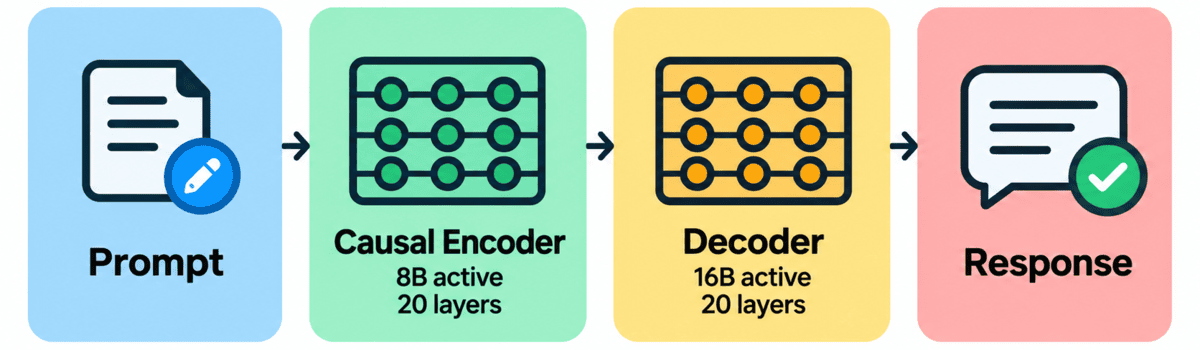
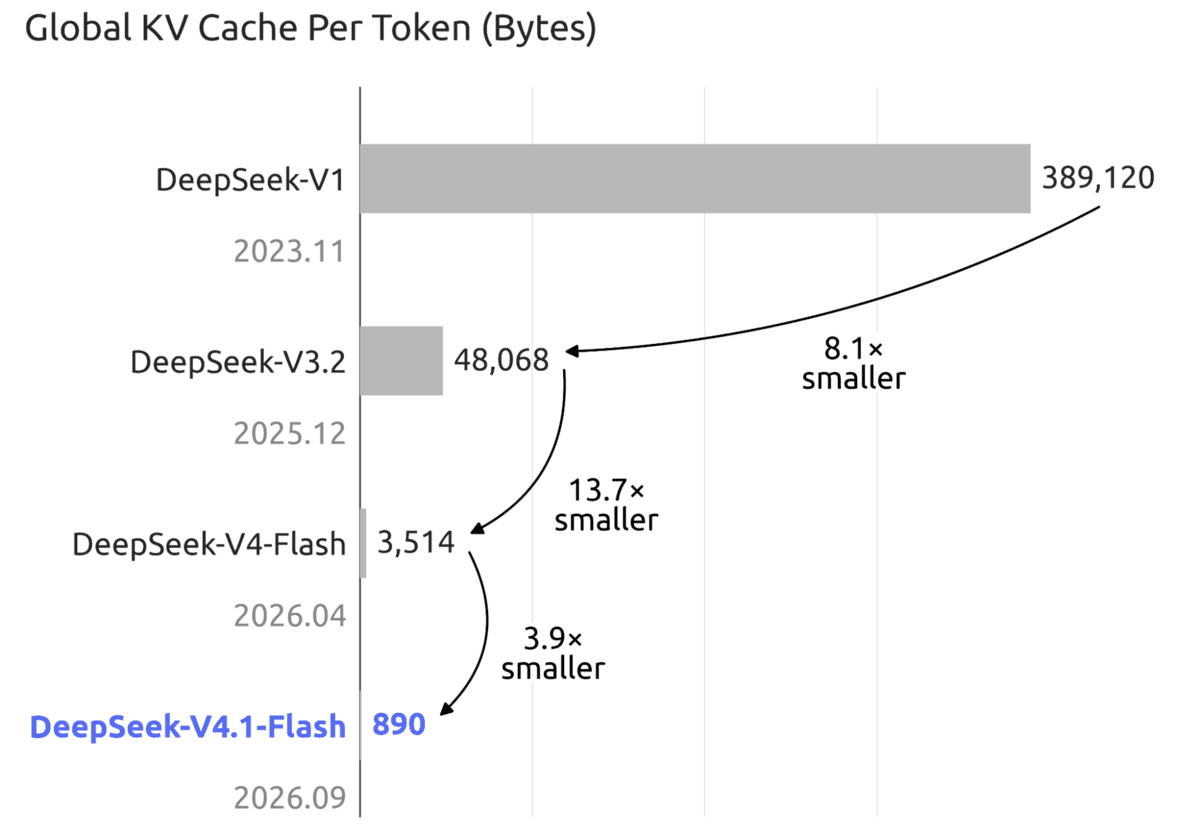
At its core, DeepSeek-V4.1-Flash is a massive 552-billion-parameter Mixture-of-Experts (MoE) model. However, its operational footprint is remarkably lean during critical phases: only 8 billion parameters are active per token during the prefill stage, while 16 billion parameters are active during decoding. The model natively supports an expansive one-million-token context window, accepts both text and multimodal image inputs, and maintains a remarkably compact global KV cache footprint of just 890 bytes per token.
Trained completely from scratch across a staggering corpus of 45 trillion multimodal tokens, the model also incorporates a separate 196-billion-parameter Engram conditional-memory component. Unlike traditional backbone parameters that execute continuously, this conditional memory is accessed sparsely, allowing the system to retrieve contextual information without incurring a heavy compute penalty on every token processed. Released under the permissive MIT license, the model provides developers and researchers with complete reference inference code and implementation details, ensuring its foundational concepts can be widely audited and adopted.
The architectural innovations packed into DeepSeek-V4.1-Flash are extensive. Key components include the Causal Encoder-Decoder (CED), Compressed Sparse Attention 2 (CSA2), FP4 KV caching, SWA Bounded Replay, the aforementioned Engram conditional memory, and Single-Pass mHC. Each of these elements targets a specific friction point in standard transformer architectures, collectively driving down compute requirements, memory usage, long-term storage overhead, and overall generation costs.
Optimizing the Economics of Long-Context Prompts
To understand the engineering significance of DeepSeek-V4.1-Flash, one must examine the fundamental duality of large language model inference: the prefill phase and the decoding phase. During prefill, the model reads and ingests the input prompt; during decoding, it generates the response sequentially, token by token. In traditional decoder-only transformer architectures, both phases consume substantial computational resources uniformly, creating severe inefficiencies for input-heavy workloads.
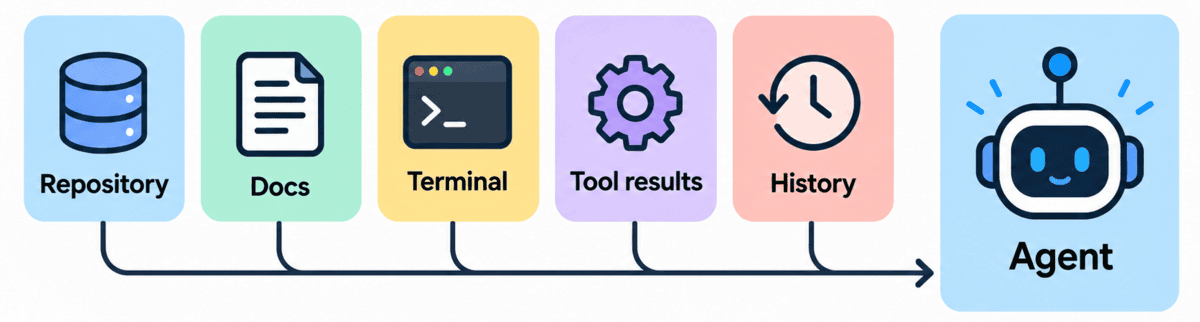
Modern AI agents—particularly those designed for software development, terminal operations, and automated cybersecurity workflows—frequently operate in input-heavy environments. A typical coding agent might ingest hundreds of thousands of lines of repository documentation, historical chat logs, and codebase architecture files before producing a concise output of only a few thousand tokens. Standard decoder-only models penalize developers during the prefill phase by allocating equal compute resources to reading text as they do to reasoning and generation.
DeepSeek-V4.1-Flash alters this paradigm through its Causal Encoder-Decoder (CED) architecture, which features a 20-layer causal encoder coupled with a 20-layer decoder. In this configuration, the decoder derives its global key-value representations directly from the encoder’s final output, eliminating the redundant KV generation typical of traditional stacks. This structural split produces an asymmetric compute profile: 8 billion active parameters per token during prefill, scaling up to 16 billion active parameters per token during decoding. By spending less compute on ingesting prompts and dedicating more compute to active reasoning and generation, DeepSeek has aligned the hardware economics of the model directly with the operational realities of autonomous agents.
Mitigating Memory Bottlenecks Through Advanced KV Caching
As context windows expand toward the million-token threshold, the management of the key-value (KV) cache becomes a primary scaling bottleneck. Storing the representations of previous tokens prevents the system from recomputing context, but at scale, the cache consumes massive amounts of High Bandwidth Memory (HBM), driving up infrastructure costs and limiting deployment density.
DeepSeek-V4.1-Flash drastically compresses this overhead, reducing its global KV cache size to 890 bytes per token. For a full one-million-token context window, this translates to roughly 890 megabytes of global KV data—a fraction of the memory footprint demanded by predecessor models. According to internal benchmarks released by DeepSeek, V4.1-Flash requires approximately one-quarter of the HBM for its global KV cache compared to previous iterations.
This efficiency is largely achieved through Compressed Sparse Attention 2 (CSA2). In standard attention mechanisms, multiple layers independently generate and store duplicate KV information, repeatedly searching through identical data structures to determine token relevance. CSA2 introduces a structured sharing model operating across three distinct modes: Full (creating new KV data and executing a search), Reindex (reusing existing KV information while performing a fresh search), and Reuse (reusing both the underlying KV data and prior search results).
Furthermore, DeepSeek integrates a Hierarchical Sparse Indexer. Instead of forcing every subsequent layer to exhaustively parse a million-token context window, an initial stage narrows the candidate set down to a highly probable subset of relevant tokens. Subsequent layers then search exclusively within this localized index. Combined with FP4 KV caching—which stores KV states in an ultra-compact numeric format—these innovations successfully resolve the memory constraints that have historically limited long-context deployment.

Additional Architectural Enhancements for Maximum Efficiency
Beyond the primary encoder-decoder restructuring and CSA2, DeepSeek-V4.1-Flash incorporates several supplementary design patterns aimed at maximizing hardware utilization and execution speed:
SWA Bounded Replay: This technique minimizes the amount of recent attention state that must be persistently stored in memory. By intelligently discarding select states and dynamically rebuilding a small recent window when required, the model reduces persistent KV storage requirements to roughly one-eighth of previous generations.
Engram Conditional Memory: The inclusion of a 196-billion-parameter conditional memory bank allows the system to look up stored knowledge dynamically rather than computing it through dense neural network layers on every token pass. This decouples model capacity from per-token compute cost.
Single-Pass mHC: By reorganizing how internal activations are mixed and read, this optimization reduces internal memory traffic by approximately 50%, accelerating overall data movement through the accelerator hardware.
DSpark Speculative Decoding: To combat generation latency, DSpark generates multiple draft tokens in parallel, which the primary model then verifies and accepts in batches. This speculative approach significantly enhances token generation throughput.
Agentic Performance Benchmarks and Real-World Evaluation
The true test of architectural innovation lies in its practical application. While DeepSeek-V4.1-Flash was engineered with structural efficiency in mind, its empirical performance on rigorous agentic benchmarks demonstrates that efficiency did not come at the expense of capability. The model excels across evaluations specifically designed to measure proficiency in terminal usage, software engineering, cybersecurity, and complex automation.

On the DeepSWE v1.1 software engineering benchmark, V4.1-Flash achieved a score of 74.2, outperforming both the V4-Flash (54.4) and V4-Pro (62.7) iterations. Similar performance gains were recorded across other standardized tests, including Terminal-Bench 2.1 (90.6), CyberGym (88.1), AutomationBench (54.8), and Agent’s Last Exam (31.8). These metrics confirm that the model’s asymmetric compute allocation and advanced memory management effectively support the complex, multi-step reasoning loops required by modern AI agents.
Industry Implications and the Open-Source Landscape
The broader significance of the DeepSeek-V4.1-Flash release extends far beyond the performance metrics of a single model. By publishing the architecture under an open MIT license alongside comprehensive implementation details, DeepSeek has provided the global AI research community with a blueprint for next-generation inference optimization.
As the industry grapples with the economic realities of deploying large-scale AI infrastructure, the design principles demonstrated in V4.1-Flash—such as asymmetric prefill-decode compute ratios, cross-layer KV cache sharing, sparse conditional memory, and advanced quantization techniques—are expected to heavily influence upcoming open-source models and commercial inference engines. While proprietary models may continue to compete fiercely on raw intelligence benchmarks, DeepSeek has redirected the industry’s focus toward structural sustainability, proving that the future of artificial intelligence depends as much on clever engineering and memory efficiency as it does on raw scale.