The rapid acceleration of artificial intelligence across global enterprise landscapes has triggered a profound shift in technical hiring demands. Among the most sought-after and complex roles to emerge from this technological boom is the Forward Deployed Engineer (FDE). Positioned at the intersection of traditional software engineering, systems design, applied artificial intelligence, and client-facing consulting, FDEs have quickly become critical assets for organizations attempting to integrate advanced models into mission-critical infrastructure.
Major technology firms and enterprise consulting giants are rapidly scaling their deployments to meet this demand. Notably, industry leaders like Anthropic have announced multi-year strategic alliances—such as partnerships with global IT services firms like DXC—to train tens of thousands of Claude-certified forward-deployed engineers specifically for enterprise environments. Concurrently, labor market trackers including ZipRecruiter report that U.S. salaries for FDEs average approximately $116,463 annually, with median compensation hovering near $124,300, while specialized roles at tier-one AI labs command significantly higher packages.
Deconstructing the FDE Role: Beyond Traditional Software Development
To understand why the FDE skill set is so distinct and demanding, one must examine the fundamental divergence between a traditional software engineer and a forward-deployed counterpart. A conventional software engineer typically operates within a defined scope, receiving specific technical tickets such as building a dedicated microservice or optimizing an existing database query.
Conversely, a Forward Deployed Engineer is routinely handed ambiguous, sprawling business challenges. For instance, an FDE might be tasked with modernizing a legacy insurance firm that maintains nearly two decades of fragmented claims data distributed across half a dozen disparate systems. When internal analysts require hours to investigate a single claim, the FDE must conceptualize, architect, and deploy an AI-driven solution that slashes processing times to minutes—all while strictly adhering to data privacy regulations and avoiding unreliable AI outputs.
Leading AI labs like OpenAI outline the FDE lifecycle as end-to-end ownership. This responsibility spans from initial discovery and technical scoping through system design, implementation, evaluation, and final production rollout. Consequently, the modern FDE functions as a hybrid entity: part software engineer, part data engineer, part solutions architect, and part technical consultant.
A Chronological Evolution: The Rise of the FDE in the Enterprise AI Era
The genesis of the Forward Deployed Engineer role traces back to specialized defense-tech and enterprise-data giants like Palantir, which pioneered the deployment of embedded engineers directly onto client sites to bridge the gap between complex software and legacy government or commercial infrastructure. However, the paradigm shifted dramatically following the widespread commercialization of large language models (LLMs) beginning in 2023.
By 2024 and 2025, as enterprises moved past proof-of-concept AI experiments into actual production, companies discovered that off-the-shelf software rarely integrated smoothly with legacy internal databases, custom security perimeters, and complex organizational workflows. This realization sparked a massive hiring surge throughout 2025. Entering 2026, the role has transitioned from a niche startup function to a core enterprise strategy, underscored by massive training pipelines established by cloud providers and AI vendors to supply certified engineering talent.
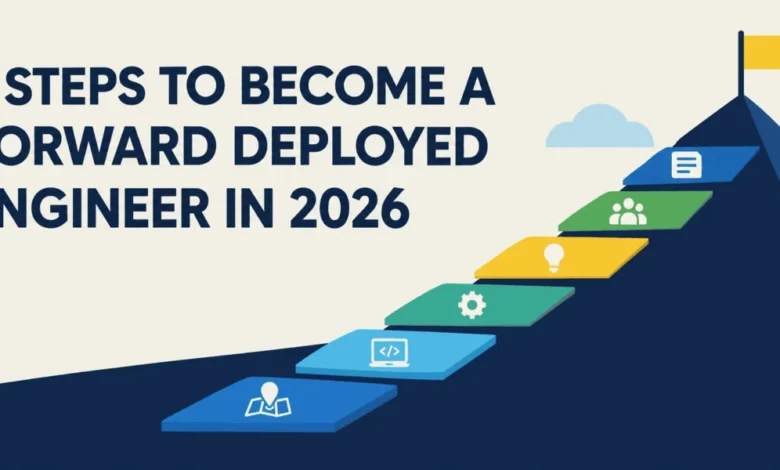
Step 1: Mastering Foundational Software Engineering
Prospective FDEs must first establish rigorous software engineering fundamentals. Data from the 2026 State of FDE Jobs analysis highlights Python as the paramount technical skill in the sector, appearing in thousands of analyzed job descriptions due to its versatility across backend development, automation pipelines, and machine learning integration.
Aspiring candidates should prioritize mastering version control systems like Git, developing robust backend logic, writing clean and maintainable code, and understanding asynchronous programming. Although day-to-day FDE work rarely requires competitive programming heroics, technical interview loops at top-tier firms routinely feature standard algorithmic and system design evaluations.
Step 2: Navigating APIs, Databases, and Complex Data Integration
Enterprise environments rarely present engineers with immaculate, pre-cleaned CSV files. Instead, FDEs encounter an intricate web of legacy systems, including PostgreSQL databases, Salesforce CRM instances, Snowflake data warehouses, internal REST APIs, Amazon S3 buckets, OAuth configurations, webhooks, and archaic data schemas.
Mastering data integration requires proficiency in reading unfamiliar API documentation on short notice, handling data serialization formats like JSON and protocol buffers, and writing efficient queries to extract information from relational and non-relational databases. The ability to ingest messy, unstructured enterprise data—ranging from PDFs and spreadsheets to legacy message queues—is a non-negotiable competency.
Step 3: Deploying and Operating Production Systems
A core tenet of the FDE role is accountability. An engineer cannot rely on code that merely functions on a local laptop environment; systems must be resilient, scalable, and observable in production.
Candidates must become proficient in containerization technologies such as Docker, orchestration tools like Kubernetes, and cloud platforms including AWS, Google Cloud, or Microsoft Azure. Furthermore, understanding continuous integration and continuous deployment (CI/CD) pipelines, infrastructure as code (IaC), and system monitoring tools ensures that deployed applications remain stable under enterprise workloads.
Step 4: Specializing in Applied AI Engineering
The defining characteristic of the 2026 FDE landscape is its heavy integration with artificial intelligence. Organizations frequently recruit FDEs to build applications leveraging large language models, autonomous agents, retrieval-augmented generation (RAG) pipelines, and enterprise vector databases.
Rather than spending months studying the deep mathematical foundations of transformer architectures—which is typically reserved for foundational research scientists—an FDE focuses on practical application. This includes prompt engineering, orchestrating multi-agent frameworks, managing context windows, implementing semantic search, and connecting models to external enterprise tools via function calling.
Step 5: Implementing Enterprise Security, Privacy, and Reliability
The gap between a compelling portfolio prototype and a production-ready enterprise deployment lies in rigorous security architecture. Job descriptions for senior FDE roles consistently emphasize tenant isolation, role-based access control (RBAC), data encryption in transit and at rest, and adherence to strict compliance frameworks like SOC 2 and GDPR.
FDEs must design systems that operate under the principle of least privilege, ensuring that AI agents or connected services cannot access unauthorized data silos or execute high-risk operations without human-in-the-loop verification and comprehensive audit logging.
Step 6: Cultivating Customer Discovery and Consultative Problem-Solving
Perhaps the most significant differentiator between a traditional backend engineer and a Forward Deployed Engineer is the requirement for elite soft skills and client communication. FDEs must navigate conversations with diverse stakeholders, including non-technical business leaders, software developers, cybersecurity teams, and executive management.
When a client requests a generic solution—such as asking for an AI chatbot—the FDE must possess the investigative acumen to unpack the underlying business constraint. By asking targeted questions about operational bottlenecks, data flows, accuracy tolerances, and user friction points, the engineer may ultimately determine that the client requires an automated document-processing workflow rather than a conversational interface. Translating organizational ambiguity into precise technical architecture is the hallmark of an exceptional FDE.
Step 7: Curating a Production-Grade FDE Portfolio
To validate these competencies to prospective employers, candidates should avoid assembling disparate, surface-level tutorial projects. Instead, portfolios should feature two or three comprehensive, end-to-end systems that showcase integration capabilities, robust deployment strategies, and decision-making under realistic constraints.
A stellar portfolio project might involve building an enterprise support agent that synthesizes RAG with internal ticketing databases, complete with authentication protocols, compliance guardrails, evaluation datasets, human-in-the-loop approval loops, and granular cost tracking. Alternatively, candidates can construct automated document-workflow engines that ingest unstructured PDFs, validate structured fields against relational databases, handle parsing exceptions, and expose the service via secure APIs deployed within containerized cloud environments.
Broader Market Implications and Strategic Outlook
The proliferation of the Forward Deployed Engineer signifies a broader maturation in how enterprises consume artificial intelligence. As the initial hype of standalone chatbot implementations gives way to rigorous return-on-investment calculations, organizations recognize that the primary bottleneck to AI adoption is not model capability, but systems integration.
By positioning technical talent directly at the boundary between software capability and human operational reality, companies can bridge the persistent gap between theoretical technological power and practical business value. For software engineers willing to cultivate the multidisciplinary skill set spanning systems architecture, applied AI, and consultative problem-solving, the Forward Deployed Engineer role represents one of the most dynamic, lucrative, and strategically vital career trajectories of the decade.