Why Brave Leo Has Become the Privacy-First Browser AI of Choice for Data Professionals

Data professionals spend the vast majority of their working hours inside web browsers. Whether they are combing through complex technical documentation, dissecting peer-reviewed research papers, verifying open-source model cards, tracing GitHub repositories, or synthesizing sprawling industry reports, the modern analytical workload is inherently web-centric. Increasingly, artificial intelligence assistants are woven directly into these daily routines, sitting alongside developers, researchers, and engineers as they process information.
The mainstream utilities that most knowledge workers automatically reach for—such as Google Chrome integrated with Gemini, Perplexity, or OpenAI’s ChatGPT housed within a pinned browser tab—are undeniably powerful. However, these tools carry an implicit privacy cost that is easily overlooked during high-velocity work sessions. Consumer-grade versions of Gemini may utilize user conversations to train and improve Google’s broader service ecosystem, and select dialogues remain subject to human reviewer auditing. Similarly, Perplexity routes user queries and active page content directly to its cloud infrastructure for remote processing. Unless users actively locate and toggle off specific settings, ChatGPT retains input data for subsequent model training iterations.
For casual web browsing or generic tasks, this trade-off is often deemed acceptable. Yet, for data scientists, machine learning engineers, and quantitative analysts handling proprietary enterprise datasets, confidential client research, unreleased neural network architectures, or sensitive business intelligence, these data-handling policies present unacceptable security vulnerabilities.
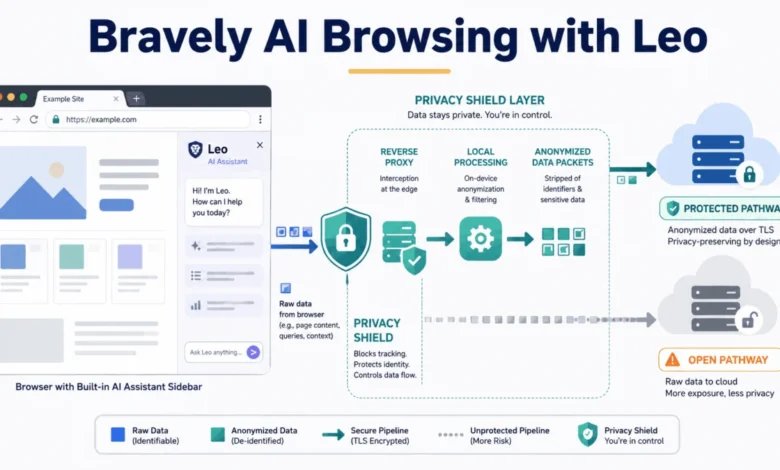
Enter Brave Leo, an alternative privacy-first AI assistant integrated directly into the Brave browser. Rather than operating as a separate browser tab or a third-party browser extension, Leo functions as a native sidebar tool capable of reading the active webpage and generating contextual responses without retaining, logging, or utilizing user data for training. The free tier operates without requiring a user account or formal sign-up, offering a model lineup that frequently exceeds technical expectations.
The Architectural Foundation: Why AI Privacy Matters in Enterprise Environments
To understand the value proposition of browser-integrated privacy tools, one must examine the structural data pipelines of mainstream AI offerings. When utilizing Google’s Chrome-native Gemini, official documentation explicitly warns against inputting sensitive corporate or personal data that a human reviewer should not access. Furthermore, background models like Gemini Nano are often downloaded silently to local storage during routine browser initialization.
Perplexity remains a robust research assistant, praised for its citation-backed synthesis and exploratory utility. However, its core functionality relies on a cloud-first architecture where queries and scraped page content leave the local machine entirely. Meanwhile, Apple Intelligence within Safari offers strong on-device privacy protections, but it is strictly hardware-locked to Apple ecosystems, rendering it unviable for data professionals operating on enterprise Windows or Linux machines.
Brave Leo circumvents these limitations through a distinct architectural framework. All user queries are routed through an anonymous reverse proxy designed to strip incoming IP addresses before requests ever reach the underlying large language model. Furthermore, conversation logs are systematically purged immediately after a response is rendered, ensuring no persistent records are maintained on Brave’s cloud infrastructure. No user accounts are linked to standard interaction sessions, and no inputs contribute to third-party model training datasets. This privacy-first posture is applied uniformly across both free and paid tiers.
Consequently, data practitioners can safely paste proprietary codebase documentation, query internal schema designs, or analyze unpublished academic manuscripts without risking data leakage or violating non-disclosure agreements.
Evolution and Feature Expansion: From Launch to Modern Capabilities
Launched initially to bring native intelligence to the Brave ecosystem, Leo has evolved rapidly through successive software updates. The core distribution is bundled directly into Brave installations across Windows, macOS, Linux, Android, and iOS. Because the browser shares the underlying Chromium engine with Chrome, user migration is frictionless, allowing bookmarks, extensions, and saved credentials to transfer seamlessly.
The platform employs a flexible model tiering system. The free iteration grants access to competent open-weights models capable of managing routine summarization, code explanation, and documentation reviews. For advanced requirements, Brave offers Leo Premium, priced at $14.99 monthly or approximately $12.50 monthly on an annual commitment, which extends coverage across up to five distinct devices. Premium subscriptions unlock frontier models such as Anthropic’s Claude Sonnet series, DeepSeek R1, and specialized variants, alongside elevated rate limits during periods of high network congestion.
Significantly, upgrading to Premium does not compromise the underlying privacy architecture. Brave utilizes a blind token verification system that decouples financial payment details from active chat sessions, ensuring that even paying subscribers remain anonymous. Furthermore, Brave introduced local-first summarization models designed to execute inference directly on local hardware, ensuring absolute zero-data transmission for ultra-sensitive corporate reviews. The platform also incorporates a "Bring Your Own Model" (BYOM) configuration, empowering advanced users to integrate local weights or custom API keys.
Core Analytical Workflows and Practical Applications
Leo’s defining technical advantage lies in its native page-awareness. Traditional standalone chatbots require manual copying and pasting of text blocks; Leo continuously parses the active browser tab in real time.
When navigating academic repositories like arXiv or dense engineering whitepapers, users can invoke Leo to extract evaluation metrics, outline experimental methodologies, or summarize performance benchmarks without lifting a finger to copy text. Structured prompts allow analysts to instantly categorize model training corpora, documented limitations, and recommended production use cases.
Similarly, Leo natively parses browser-displayed PDFs, Google Workspace documents, and Google Sheets. Quantitative analysts can interrogate dataset documentation files to clarify unfamiliar column descriptions, verify data collection parameters, or check for documented sample biases. For multimedia research, Leo can read native transcripts of technical conference talks hosted on platforms like YouTube, allowing researchers to extract core conclusions and locate specific experimental timestamps without reviewing hours of video footage.
Advanced features introduced in recent development cycles include multi-tab context awareness, allowing Leo to draw comparisons across multiple active browser tabs simultaneously. Tab Focus Mode enables users to anchor the assistant’s attention to a single authoritative documentation source while browsing supplemental materials. Additionally, saved prompt chains known as "Skills" allow data practitioners to automate repetitive auditing tasks across multiple documents, effectively transforming the browser sidebar into a customized analytical workstation.
Strategic Comparison and Workflow Integration
Industry analysts emphasize that Leo is not intended to replace every specialized utility within a data scientist’s toolkit. Instead, it serves a distinct operational niche.
While Perplexity remains the superior option for broad web-scale research requiring live citation crawling and general knowledge discovery, and local large language models are ideal for air-gapped enterprise environments, Leo fills the gap for real-time, privacy-guaranteed page interaction. By deploying Leo for day-to-day documentation review, code interpretation, and handling sensitive institutional research, data professionals can maintain strict operational security without sacrificing computational assistance.
As data privacy regulations tighten globally and corporate anxiety surrounding proprietary data exposure grows, tools that merge frontier AI capabilities with zero-retention architectures are transitioning from niche alternatives to essential workplace infrastructure. Brave Leo represents a significant step forward in reconciling the productivity gains of artificial intelligence with the non-negotiable security demands of modern data science.