A pervasive assumption within the technology industry, particularly among those driving artificial intelligence development, is that consumers and professionals alike are clamoring for more AI-infused features and products. This belief posits that a constant stream of new AI capabilities will inevitably replace outdated practices and resolve existing inefficiencies. However, emerging evidence and user sentiment analysis suggest a starkly different reality: many individuals do not necessarily desire more AI, especially when it is introduced in ways that disrupt established workflows or fail to deliver tangible, consistent value. This disconnect between industry vision and user experience has led to significant challenges in AI adoption, often resulting in low retention rates despite substantial investment in development and deployment.
The current landscape of AI integration is frequently characterized by features that are bolted onto existing systems rather than being seamlessly woven into them. This approach often necessitates that users deviate from their familiar work patterns to engage with new AI tools, creating friction rather than facilitating efficiency. A key issue highlighted by experts is that AI, while powerful, is not an inherent value proposition. Simply labeling a feature as "AI-powered" does not automatically translate into user satisfaction or excitement. Instead, AI can inadvertently amplify existing organizational weaknesses, such as poor data quality, inconsistent decision-making processes, and the cumulative effects of technical debt and internal politics. When AI tools are introduced into environments with these underlying issues, they can make these problems more visible, presenting inconsistencies and conflicting priorities directly to end-users who are then tasked with navigating the resulting complexities.
The fragmented nature of many modern work environments, which often require users to switch between numerous disconnected systems, is further exacerbated by the addition of new AI tools. Each new AI application can become another system to toggle between, potentially increasing the overall workload and demanding effort that is not always perceived as rewarding. Moreover, users are increasingly aware of the hidden costs associated with AI, particularly the time and effort required to identify and rectify AI "hallucinations" or inaccuracies. While generating content with AI might initially seem faster than creating it from scratch, this perceived ease comes at the cost of diligent verification and correction.
Background and Context: The AI Hype Cycle
The current surge in AI development and deployment follows a familiar pattern seen in previous technological revolutions. Companies, eager to capitalize on the perceived potential of AI, have invested heavily in research, development, and marketing. This has led to a proliferation of AI-powered features across various sectors, from productivity software and customer service platforms to creative tools and consumer electronics. The narrative has often been driven by the potential for unprecedented innovation and disruption, creating an expectation that AI will fundamentally transform how we live and work.
However, this rapid pace of innovation has sometimes outstripped a thorough understanding of user needs and the practical implications of integrating AI into daily life. Early adopters and tech enthusiasts may be quick to embrace new AI capabilities, but a broader segment of the population approaches these advancements with caution, informed by past experiences with technology rollouts that promised much but delivered less. The focus on "AI first" development, while ambitious, has often overlooked the importance of user-centric design and the need for AI to augment, rather than replace, existing human capabilities and preferences.
The Economic Implications of AI Adoption Gaps
The low adoption and retention rates for many AI features carry significant economic consequences. Companies invest substantial resources in developing and implementing these technologies, expecting a return on investment through increased productivity, enhanced customer satisfaction, or new revenue streams. When these features fail to gain traction, these investments can be written off, leading to financial losses and potential reputational damage. Furthermore, the perceived failure of AI initiatives can create a climate of skepticism, making it more challenging to secure buy-in for future technological advancements.
A 2023 study by IBM highlighted a significant "AI adoption gap," indicating that while many organizations are exploring AI, a smaller percentage are successfully integrating it into their core operations. This gap is often attributed to a lack of clear use cases, insufficient employee training, data privacy concerns, and the perceived complexity of AI tools. The cost of delivering these often-underutilized features adds to the financial burden, making the return on investment even more elusive.

The AI Productivity Paradox: Intensification, Not Reduction of Work
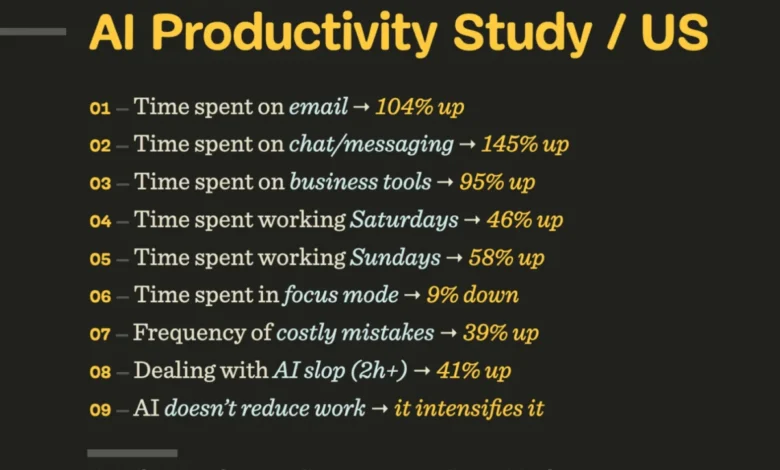
Contrary to the initial promise of AI automating tedious tasks and freeing up human time for more creative or strategic endeavors, some studies suggest a paradoxical outcome: AI is intensifying work rather than reducing it. A recent analysis of AI productivity in the US, as reported by various news outlets, indicated that while AI tools are being used, they have not necessarily led to a decrease in overall workload. Instead, metrics have shown increases in time spent on tasks like email, chat, and business tools, as well as a rise in weekend work. This suggests that AI, in its current implementation, may be contributing to a more demanding work environment, requiring employees to spend more time managing AI outputs and dealing with the consequences of AI-generated content.
This phenomenon, often referred to as the "AI productivity paradox," raises questions about the effectiveness of current AI integration strategies. If AI tools are not demonstrably reducing work or improving work-life balance, their perceived value diminishes, leading to user disengagement. The added burden of correcting AI errors, managing AI-generated content, and adapting to new AI-driven workflows can negate any potential time savings, creating a net increase in effort and stress.
The Emotional and Psychological Impact of AI Integration
Beyond the practical and economic considerations, the introduction of AI into people’s lives also carries significant emotional and psychological weight. Many individuals harbor anxieties about AI’s potential to automate jobs, leading to fears about job security and their place in a rapidly evolving economy. This underlying anxiety can color their perception of new AI features, making them resistant to change even when the technology is presented as beneficial.
The narrative surrounding AI often amplifies these fears. News reports and public discourse frequently focus on AI’s disruptive potential, its capacity to outperform humans in certain tasks, and the possibility of widespread job displacement. This constant influx of potentially alarming information creates a climate of apprehension, where skepticism and caution are natural responses. For many, AI is not an exciting prospect for innovation but a source of unease about their future.

Furthermore, the way AI is introduced can contribute to a sense of powerlessness. When AI features are deployed unilaterally by organizations without user input or choice, they can feel like an imposition rather than a collaborative tool. This lack of agency can foster resistance and a feeling of being left behind as the world changes around them, often without their active participation or consent.
The Case Against "AI-First" and for "AI-Second"
The author of the original article argues that the prevalent "AI-first" approach to product development is fundamentally misguided. Instead, a more effective strategy is to be "AI-second." This means that AI should not be the primary driver of a product or feature but rather a subtle, supportive element that enhances existing functionality. AI should operate in the background, performing mundane, repetitive, and time-consuming tasks that users find tedious, thereby freeing them up for more engaging and rewarding activities.
This "AI-second" philosophy aligns with user desires for reliability, predictability, and utility. People do not typically dream of AI-powered refrigerators or AI-narrated children’s books. Their needs are more grounded: they want tools that consistently perform essential functions, augment their abilities, and make their lives easier without demanding significant behavioral changes. The goal is not to replace human interaction or creativity but to support and enhance it by automating the less desirable aspects of work and life.
Bo Young Lee, in a widely shared sentiment, articulated this desire clearly: "I want AI to do all the physical and mental labor that taxes me so I can read books written by humans and go to art galleries to engage with art made by humans. I want AI that makes my life easier rather than forces me to change myself." This sentiment underscores the core of what users truly seek from AI: not more AI interaction, but less drudgery, enabling more time for human connection and meaningful experiences.

The Need for Reliable, Augmentative AI
The fundamental truth is that user expectations for technology have remained remarkably consistent over time. People desire features that are fast, accessible, reliable, predictable, and useful – every single time. They do not seek to overhaul their entire workflows for the sake of integrating AI; rather, they look for tools that seamlessly augment their existing methods of working. The ideal AI solution is one that takes over the most mundane, annoying, and boring tasks, freeing up cognitive load and allowing individuals to focus on aspects of their work that require critical thinking, creativity, and human judgment.
The comparison often drawn between the unreliability of AI and the unreliability of humans is misplaced. Users do not compare software features to human behavior; they compare them to other software features. If one product’s AI feature is consistently unreliable while a similar feature in another product works flawlessly, users will naturally gravitate towards the latter. The deciding factor is not whether a feature is powered by AI, but whether it functions consistently and reliably.
Furthermore, the speed of delivery, often a key metric in the tech industry, is not always the most valued aspect for end-users. Many individuals prioritize doing things well, with adequate time for thoughtful decision-making, over simply shipping faster. There is a profound sense of reward and accomplishment derived from a job done meticulously, a feeling that can be eroded by the relentless pressure for rapid output, often facilitated by imperfect AI tools.
Implications for the Future of AI Development
The implications of this user-centric perspective for the future of AI development are significant. Companies that continue to push for "AI-first" solutions without deeply integrating them into existing user mental models and workflows are likely to face continued challenges with adoption. The focus must shift from simply creating novel AI capabilities to developing AI that is deeply embedded, intuitive, and genuinely supportive.

AI should adapt to human cognitive processes and decision-making patterns, not the other way around. This requires a profound understanding of user behavior, context, and needs. The branding of features as "AI," "smart," or "automation" becomes secondary to their actual performance and utility. For AI to be truly successful, users must be made aware of its practical applications and be empowered to discover its potential for their specific use cases.
The success stories in AI integration are often found in products that are "AI-second" – subtle, humble, and ambient tools that support users in overcoming the drudgery of everyday tasks. These are the AI solutions that enhance productivity and bring more joy into daily life by automating the tedious and mentally exhausting aspects of work, thereby allowing individuals to focus on the rewarding, unique, and creative elements of their professions.
Conclusion: Prioritizing Human Connection and Meaningful Work
Ultimately, the desire for more AI in our lives is a mischaracterization of human needs. What people truly require is AI that can effectively automate the monotonous and burdensome aspects of their daily routines. This automation should not lead to increased interaction with machines but should instead create more time and mental space for activities that are genuinely enjoyable and fulfilling, fostering deeper human connections and enabling individuals to engage in work that provides a sense of purpose and satisfaction. The enduring value lies not in the quantity of AI features, but in the quality of human experience they enable.
The development of "Design Patterns for AI Interfaces," a video course by Vitaly Friedman, aims to address this critical gap. It provides practical guidance and real-life examples of how to design AI interfaces that are user-friendly, effective, and aligned with human needs. By focusing on UX principles and established design patterns, such courses can help bridge the divide between AI innovation and user adoption, ensuring that artificial intelligence serves to enhance, rather than complicate, human lives and work. The emphasis is on creating AI that is a supportive, unobtrusive assistant, allowing humans to focus on what they do best: connect, create, and contribute meaningfully.