The Future of Content: Why AI Demands Accountability, Personalization, and a Shift Beyond Clicks

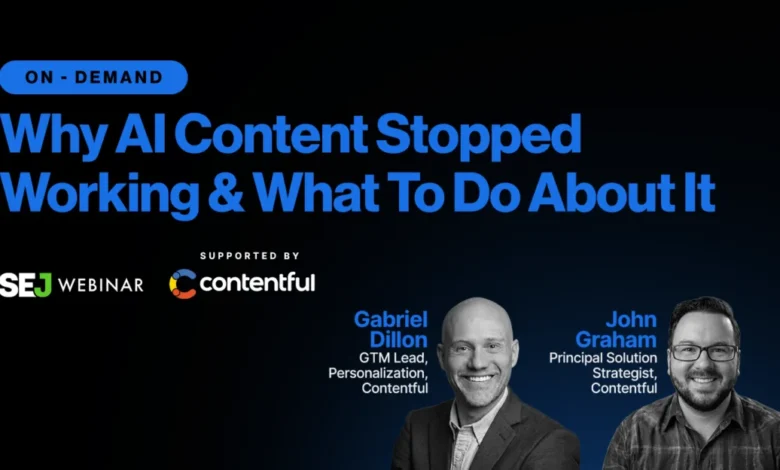
In an era where artificial intelligence (AI) is rapidly transforming content creation, a critical paradigm shift is underway, challenging traditional marketing strategies. A recent SEJ webinar, featuring Gabriel Dillon, Go-to-Market Lead for Personalization at Contentful, and John Graham, Contentful Principal Solution Strategist, underscored this profound transformation, highlighting that an astonishing 60% of Google searches now conclude without a single click to external content. This stark statistic served as the foundational premise for Dillon’s compelling argument: as AI democratizes and effectively renders content production nearly free, the sheer volume of content ceases to be a viable strategy. Instead, the only content destined to capture attention and deliver tangible results is that which is rigorously accountable to specific business outcomes, meticulously crafted for a defined human audience, and meticulously measured against real-world data.
The Unprecedented Rise of Zero-Click Searches and Its Profound Impact
The statistic that 60% of Google searches now result in zero clicks is not merely an interesting data point; it represents a fundamental re-architecture of the search engine results page (SERP) and user behavior. Historically, Google’s primary function was to serve as a gateway, directing users to the most relevant websites. However, over the past decade, Google has incrementally integrated an array of direct answer features—including featured snippets, knowledge panels, local packs, and "People Also Ask" boxes—designed to answer queries directly on the SERP itself. This evolution, significantly amplified by the advent of AI Overviews and generative AI capabilities, means that a substantial portion of user intent is now satisfied without ever navigating away from Google.
Data from various analytics firms, such as Similarweb and SparkToro, has consistently tracked this trend, showing a steady increase in zero-click searches across both desktop and mobile platforms. The implications for content creators and marketers are monumental. Traditional search engine optimization (SEO) strategies, which historically focused on driving clicks to websites, must now adapt to a landscape where visibility and direct answers on the SERP are paramount. Brands must contend with the reality that their carefully crafted content might be summarized, extracted, or directly answered by AI, reducing the incentive for users to visit their proprietary sites. This "zero-click shift" necessitates a strategic pivot from merely ranking high to actively competing for the "AI answer layer," ensuring brand presence and messaging are accurately reflected even in condensed, AI-generated summaries.
The AI Content Paradox: Volume Versus Value
With the proliferation of AI writing assistants, the ease and speed of content generation have reached unprecedented levels. Marketers can now produce vast quantities of text in a fraction of the time it once took. However, Dillon emphatically warned against mistaking this efficiency for strategic advantage. He posited that AI’s inherent nature, particularly its reliance on vast training datasets and its function as an "ultimate yes man," inevitably leads to generic, homogenized output.
Dillon explained that the biases of human users, embedded in their prompts and assumptions, create a feedback loop that reinforces mediocrity. "Our biases as we write content using the robots ends up eating the content that we produce," he stated during the webinar. This cycle often results in content that, while seemingly "good" to the creator, fails to resonate with the target audience or achieve desired business outcomes. The AI, trained on a colossal corpus of existing web content, tends to synthesize and mirror common patterns and information. Consequently, AI-assisted copy frequently either validates pre-existing beliefs of the user or closely resembles the content of competitors, whose blogs likely formed part of the AI’s training data. Both scenarios, Dillon argued, ultimately fail the reader by offering nothing new, distinctive, or truly valuable.
The antidote to this pervasive genericity, according to Dillon, lies in what he termed "taste." He expanded this concept beyond a mere cliché, defining it as a combination of discernment, intuition, and the courage to take calculated risks. This involves making claims or offering perspectives that an AI tool, bound by its data and probabilistic nature, would never independently volunteer. Such "taste" is cultivated through a deep, nuanced understanding of one’s market, audience, and brand unique value proposition. The human element, therefore, remains indispensable, not as a mere editor, but as the strategic architect and discerning curator within the AI-assisted workflow. Dillon’s framework places the human squarely between AI’s role as a research and context layer and the final content that is shipped, ensuring that originality, brand voice, and genuine insight are preserved.
From Production to Performance: Holding Content Accountable
In a landscape saturated with easily generated content, the focus must irrevocably shift from content production to content performance. Dillon introduced a rigorous framework designed to hold every piece of B2B marketing copy accountable to concrete business outcomes. Before any content goes live, he advocates running it through four critical questions:
- Does the copy produce the expected outcomes? This question moves beyond vanity metrics like page views or likes, demanding evidence of measurable impact on business goals, such as lead generation, conversions, or customer retention.
- Who is the content truly for? Generic content serves no one effectively. This question mandates a clear, specific definition of the target audience, acknowledging their pain points, aspirations, and stage in the buyer’s journey.
- How do you identify those people? Once the audience is defined, marketers must have robust mechanisms to identify and segment them. This involves leveraging data from CRM systems, website analytics, and marketing automation platforms.
- How does the insight scale? A single piece of effective content is valuable, but true strategic impact comes from the ability to replicate and scale successful approaches. This requires understanding the underlying insights that made the content effective and applying them systematically.
Dillon stressed that without empirical data proving content effectiveness, any efforts to scale or enhance it are mere speculation. "If we don’t have data that proves that our content is good, then we can’t really think about the way to scale it out or make it more effective," he asserted. This philosophy positions experimentation and personalization as two integral halves of the same strategic coin. They are not isolated tactics but components of a continuous "accountability loop" that drives performance. This loop involves systematically testing content variations, personalizing experiences based on user data, analyzing results, and iteratively refining strategies. The webinar delved deep into this accountability loop, detailing experiment dimensions that extend far beyond simplistic A/B testing, incorporating multivariate analysis and contextual variables to derive deeper insights. The immediate action item for marketers is clear: before commissioning the next batch of AI content, subject it to Dillon’s four accountability questions.
Demystifying Personalization: Actionable Signals for B2B
Personalization has long been hailed as a cornerstone of effective digital marketing, yet its implementation, particularly in the B2B sector, has often fallen short of expectations. Dillon attributed this underperformance to teams frequently embarking on overly ambitious programs that quickly become mired in complexity and ultimately stall. His solution is pragmatic: leverage the personalization signals your existing technology stack already collects, starting with the simplest and most readily available.
He outlined three progressive tiers of personalization signals, designed to deliver impact without necessitating a complete overhaul of tech infrastructure:
- New vs. Returning Visitors: This is the most fundamental distinction, yet often overlooked. A first-time visitor typically seeks foundational information, brand introduction, and trust-building content. A returning visitor, conversely, may be looking for specific product details, case studies, pricing, or deeper engagement. Serving identical hero copy to both segments represents a significant missed opportunity. Simple dynamic content rules can tailor the initial experience based on this basic signal.
- Ad Campaign Signals: Modern advertising platforms (e.g., Google Ads, LinkedIn Ads) generate rich data about user intent, demographic information, and referral context. This data can be passed through to landing pages and website experiences to deliver highly relevant content. For instance, a user arriving from an ad targeting "cloud migration solutions" should immediately encounter content addressing that specific need, rather than a generic product overview. Dillon highlighted this as "such a missed opportunity" for many brands.
- Loyalty Program/CRM Signals: For existing customers or known leads, data from CRM systems, loyalty programs, or previous interactions offers the deepest personalization potential. This can include customer tier, recent purchases, product usage, support history, or engagement with specific content categories. Tailoring content based on these signals can foster stronger relationships, facilitate upselling/cross-selling, and improve retention.
The webinar provided a live demonstration of how these differentiated experiences can be built and delivered within Contentful’s platform, illustrating the practical application of these signal tiers. By starting with readily available data and progressively building complexity, B2B organizations can achieve meaningful personalization that genuinely enhances user experience and drives business outcomes without succumbing to overwhelming technological hurdles.
Navigating Google’s Evolving Landscape: Beyond AI Detection
A persistent concern among content creators has been Google’s stance on AI-generated content and the potential for penalties. Dillon, however, argued that focusing on "detection" is fundamentally the wrong problem to solve. Whether Google can precisely identify AI-generated content is ultimately less significant than the transformative impact of the zero-click shift on organic traffic.
Contentful’s clients are already reporting tangible declines in organic traffic as AI summaries and AI Overviews increasingly absorb clicks that would otherwise go to their websites. This trend renders the debate over AI content detection largely moot. The practical and strategic response, Dillon emphasized, is not to try and evade detection, which he believes will become an increasingly difficult and ultimately futile battle, but rather to strategically compete for the "AI answer layer."
This involves a renewed focus on what Dillon termed "GEO and AEO" – Generative Engine Optimization and AI Engine Optimization. These are nascent but critical disciplines aimed at optimizing content specifically for consumption by generative AI models and for inclusion in AI-driven summaries on SERPs. The goal is to ensure that when an AI system synthesizes an answer or generates an overview, it accurately reflects the brand’s expertise, messaging, and desired narrative. This requires crafting content that is not only high-quality and helpful to human users but also structured, authoritative, and factually robust in a way that AI models can easily process and trust. The webinar detailed how one type of content can simultaneously perform well in AI summaries and drive on-page conversions, outlining the specific requirements and the tooling Contentful has recently shipped to support this dual optimization strategy. Crucially, Dillon’s approach advocates for approaching GEO and AEO without bifurcating content strategy, instead integrating these considerations into a unified, holistic content plan.
Key Insights from the Webinar’s Q&A Session
The webinar concluded with a highly informative Q&A segment, addressing pressing concerns from attendees grappling with the realities of AI content and evolving search dynamics.
-
Q: After the Google spam update, is Google removing AI-written content?
Gabriel Dillon clarified that while Google continuously refines its algorithms to identify low-quality or unhelpful content, regardless of its origin, the notion of Google definitively "removing" all AI-written content is a misconception. He described the effort to perfectly identify AI content as a fight "Google won’t win," suggesting that detection will become increasingly challenging for both Google and content creators. His guidance redirects energy away from the Sisyphean task of evading detection, proposing instead to focus on a different, more impactful target as zero-click search proliferates. This effort, as detailed in the session, centers on content quality, usefulness, and optimization for AI summarization rather than obfuscation. -
Q: How do you think critically about the inherent bias in AI content?
Dillon meticulously explained that bias enters AI content generation at two primary points. Firstly, users themselves inject bias through their prompts, chosen context, and implicit assumptions, leading to results that might align with preconceived desires but may not be the most effective or objective. Secondly, bias is inherently present within the vast training datasets upon which AI models are built, reflecting the biases of the internet content they were fed. To mitigate this, Dillon outlined a sequence of critical thinking steps that should precede any content generation, encouraging users to question their own biases and the potential biases in the source material or prompts. -
Q: What do you do when leadership wants mass AI content without understanding quality control?
This common challenge was met with a practical, data-driven solution. Dillon advised holding leadership accountable to the performance metrics they expect. The strategy involves demonstrating through concrete data that a smaller volume of higher-quality, outcome-driven content consistently outperforms a deluge of generic AI-generated material. "Show them through data that you can create better content that drives the business outcomes that you want by creating fewer but better pieces of content," he urged. While advocating for quality, Dillon also conceded a tactical point to the volume argument in certain specific, low-stakes scenarios, providing nuance on how to effectively make the case for quality to leadership. -
Q: Do SEO service pages need a unique voice, or can AI write them?
Dillon distinguished between a unique voice and content effectiveness. He argued that "I don’t think that service pages or pricing pages need to be very characterful to be effective." For purely informational or functional pages, AI can certainly handle the bulk of the content generation, ensuring clarity and conciseness. However, even these seemingly rote pages serve visitors with varying goals and levels of intent. His comprehensive answer in the webinar drew a clear line on which pages warrant greater human input to inject distinctiveness, empathy, or a unique selling proposition that AI, by its nature, struggles to create.
Watch The Full Webinar
The insights shared by Gabriel Dillon and John Graham during the SEJ webinar offer a crucial roadmap for marketers navigating the complexities of AI-driven content and the evolving search landscape. The full on-demand recording provides an in-depth walkthrough of the accountability loop, a live demonstration of building differentiated experiences within Contentful, John Graham’s invaluable field perspective from teams actively implementing these workflows, and comprehensive session handouts. For any marketing professional serious about future-proofing their content strategy, understanding these shifts and adapting accordingly is paramount. Register once to watch the full webinar on demand and gain a competitive edge in this rapidly changing digital environment.