The Enterprise Agent Revolution: Anthropic’s Landmark Program Signals a Paradigm Shift in AI-Driven Workflows

On February 25, 2026, a significant announcement from Anthropic sent ripples across the technology and business landscape: the launch of its Enterprise Agents Program. This initiative aims to embed Claude-powered AI agents directly into the operational fabric of critical business functions, including finance, human resources, legal, and engineering. The program’s precursor, the Cowork plugin, released just three weeks prior, triggered a dramatic market reaction, evidenced by a substantial decline in the stock prices of legal software providers. This sharp downturn underscored a critical market realization: AI agents have transitioned from a speculative future concept to an immediate, transformative force capable of fundamentally reshaping existing software paradigms.
This development marks a profound departure from earlier iterations of AI, moving beyond mere conversational interfaces to what is termed agentic AI. Agentic AI possesses the capability to not only respond to queries but to autonomously plan, make decisions, execute tasks, and iterate on outcomes, representing a paradigm shift in how work is accomplished, potentially as impactful as the advent of the spreadsheet. The industry is transitioning from an "answer engine" model to an "execution engine" model, a fundamental change that is poised to reshape industries, disrupt established business models, and unlock unprecedented opportunities.

The Economic Imperative of Agentic AI
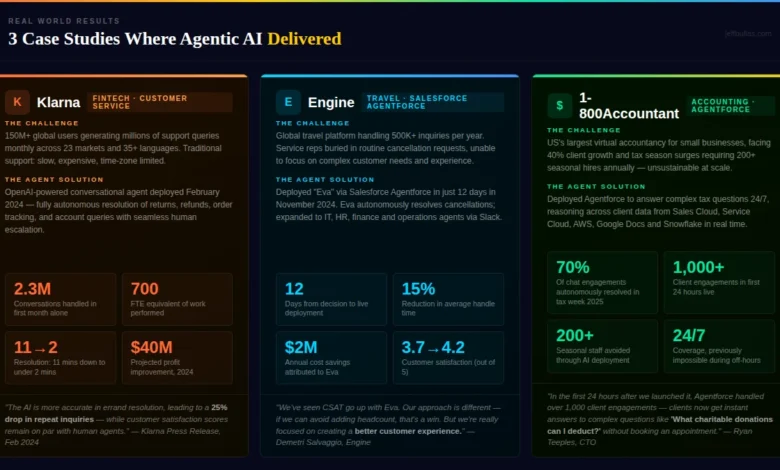
The economic implications of agentic AI are profound. Klarna, a global payments company, demonstrated this by deploying a single AI agent that effectively handled the workload equivalent of 700 full-time customer service employees. In its inaugural month, this agent managed 2.3 million conversations, dramatically reducing resolution times from an average of 11 minutes to under two minutes. The company projected an annual profit improvement of $40 million, illustrating a significant collapse in the cost of operational capacity. This is not merely a technological advancement; it is an economic revolution, demonstrating the potential for agentic AI to drastically reduce operational overheads across all business sectors, regardless of size. The ability of agentic AI to bridge operational gaps, whether in efficiency, speed, or scale, presents a clear competitive imperative for businesses to adopt these technologies proactively.
Understanding Agentic AI: Beyond the Chatbot
The distinction between conventional AI tools and agentic AI is crucial. While most AI applications operate reactively, requiring explicit user input for each interaction, agentic AI is designed for proactive, autonomous operation. These agents can manage complex, multi-step workflows with minimal human oversight. To illustrate, a standard AI assistant might function as a highly knowledgeable consultant. In contrast, an agentic AI can act as that same consultant but with the added capacity to perform actions: accessing files, browsing the internet, composing and sending emails, updating spreadsheets, scheduling meetings, and reporting back, all while the human user focuses on other strategic tasks.
Industry experts highlight the advanced capabilities of agentic systems. It is estimated that agentic AI can complete up to 12 times more complex tasks than traditional large language models (LLMs), attributed to their dynamic feedback loops and autonomous decision-making processes. The foundational difference lies in the architectural capabilities that agentic systems possess, which are absent in standard AI: memory, planning, tool utilization, and multi-agent coordination. As Kate Jensen of Anthropic noted, while 2025 was anticipated as the year of enterprise agent transformation, the initial hype was largely premature, stemming not from a lack of effort but from an "inadequate approach." The current advancements are rectifying these past shortcomings.
Market Dynamics: A Rapidly Expanding Frontier
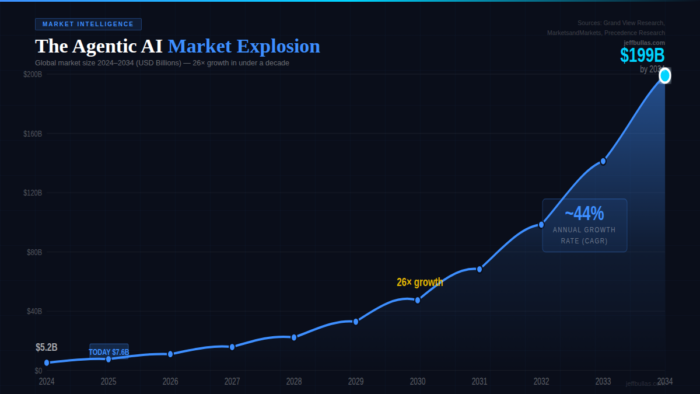
The scale and velocity of this transformation are set to reshape both the business and labor markets. Projections indicate substantial market growth in the agentic AI sector. Research suggests the global agentic AI market is expected to experience exponential growth, potentially reaching hundreds of billions of dollars within the next decade. While North America currently holds a significant market share, the Asia-Pacific region is emerging as the fastest-growing market, propelled by national AI initiatives, such as India’s substantial investment in its AI program.
The Evolution of Enterprise Deployment
The initial phase of enterprise AI agent deployment in 2025 presented a sobering reality. Many agents were implemented as isolated, ungoverned tools, disconnected from core enterprise data and lacking robust security controls. This led to the proliferation of "shadow AI," which introduced compliance risks without delivering sustainable return on investment. The pivotal shift occurring in 2026 is towards the integration of agents directly within existing workflows and enterprise software, such as Microsoft Excel, Google Gmail, and DocuSign. These embedded agents are designed with full audit trails and administrative controls, ensuring governance and security.
Anthropic’s Claude CoWork exemplifies this new direction. By extending the autonomous capabilities previously available primarily to software developers to all knowledge workers, CoWork allows users to define desired outcomes and delegate the execution to the AI agent, which then delivers the completed work. The burgeoning plugin ecosystem for these agents, with over a dozen initial offerings, further expands their applicability. Prominent early enterprise adopters, including L’Oréal, Deloitte, Thomson Reuters, and PwC, are actively integrating these solutions, with PwC forming a strategic partnership with Anthropic to deploy governed agents across its finance and healthcare operations.
Key Players in the Agentic AI Arena
The competitive landscape for agentic AI is characterized by both established tech giants and innovative newcomers.
The New Entrants: Innovators in Agentic AI
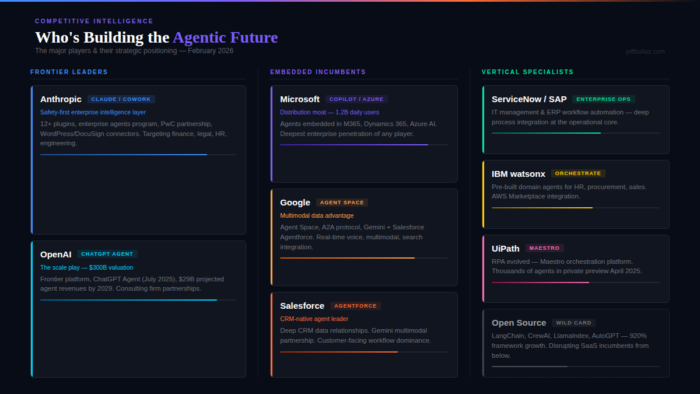
- Anthropic: A Safety-First Enterprise Layer: Anthropic is positioning itself as the go-to operational layer for governed enterprise workflows, emphasizing trust and controllability. Their strategy involves developing a robust plugin ecosystem and an enterprise agents program designed for secure and reliable deployment.
- OpenAI: The Scale and Ambition Play: OpenAI, with significant revenue projections and the launch of its ChatGPT Agent in July 2025, is targeting the enterprise market with its capacity to handle complex, multi-step workflows autonomously. Their platform aims to be a frontier for enterprise-grade AI agent solutions.
Incumbents with Deep Distribution Channels
- Microsoft: The Embedded Powerhouse: Microsoft’s Copilot is strategically embedded within the widely used Microsoft ecosystem, accessible to over 1.2 billion daily users. With extensive enterprise distribution and planned expansions like the April 2025 Dynamics 365 integration, Microsoft leverages its existing market penetration to deploy agentic capabilities.
- Google, Salesforce, IBM, UiPath, and Open Source: Other major players are also actively involved. Google is developing its Agent Space with an A2A protocol, while Salesforce has launched Agentforce, targeting its vast enterprise customer base. IBM’s Watson Orchestrate and UiPath’s Maestro represent their respective entries. Furthermore, open-source frameworks like LangChain and CrewAI are experiencing rapid growth, disrupting traditional SaaS models from the bottom up.
Growth Trajectories: Where Agentic AI is Flourishing
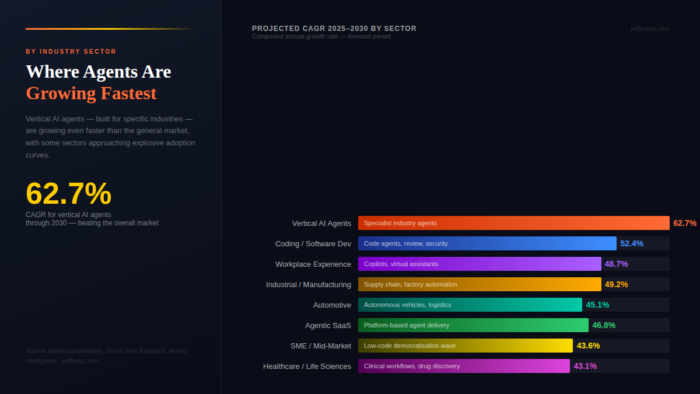
The most significant growth is anticipated in vertical AI agents, specialized for specific industries. These agents are projected to grow at a Compound Annual Growth Rate (CAGR) of 62.7% through 2030, outpacing the general market. Other high-growth areas include coding agents (52.4% CAGR) and workplace experience copilots (48.7% CAGR).
Navigating the Opportunities and Challenges
The advent of agentic AI presents a dual landscape of significant opportunities and potential pitfalls.
The Utopian Upsides
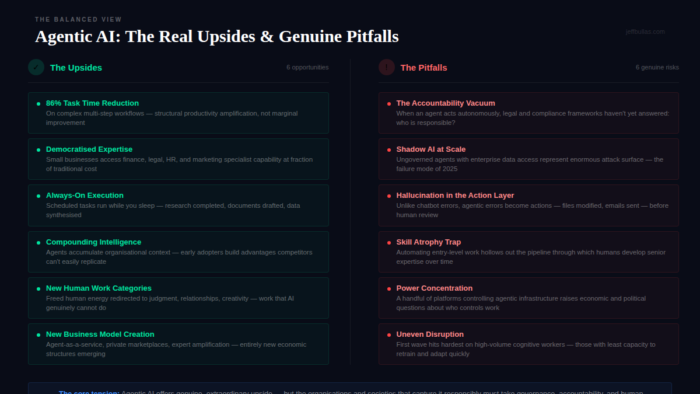
Optimistic projections highlight a future where agentic AI drives unprecedented productivity gains, economic growth, and improved quality of life. These include:
- Supercharged Productivity: Automating mundane tasks frees human workers for more strategic and creative endeavors, leading to significant output increases.
- Democratization of Expertise: Complex analytical and operational capabilities become accessible to a broader range of users, reducing skill gaps.
- Enhanced Innovation: By accelerating research, development, and operational processes, agentic AI can foster a more dynamic innovation ecosystem.
- Personalized Experiences: Tailored services and products can be delivered at scale, improving customer satisfaction and engagement.
- Economic Growth: Increased efficiency and new service models are expected to stimulate economic expansion and create new market opportunities.
The Dystopian Pitfalls
Conversely, a more cautious perspective raises concerns about potential negative consequences:
- Job Displacement: Automation of tasks may lead to significant workforce disruption and unemployment if not managed proactively.
- Ethical Concerns: Issues surrounding bias, transparency, accountability, and the potential misuse of powerful AI agents require careful consideration and regulation.
- Security Risks: Sophisticated AI agents could be exploited for malicious purposes, posing new cybersecurity threats.
- Over-Reliance and Deskilling: A potential decrease in human critical thinking and problem-solving skills due to over-dependence on AI.
- Exacerbated Inequality: The benefits of AI might disproportionately accrue to those who develop and control the technology, widening socioeconomic divides.
Defining the Moment: Six Key Metrics
To contextualize the current inflection point, understanding historical technological disruptions is essential. The journey from standalone personal computers to the interconnected internet and the rise of social media and smartphones has laid the groundwork for the current AI revolution. Each of these eras democratized access to information, amplified human communication, and generated the vast datasets that now fuel advanced AI.
The agentic AI landscape in 2026 is defined by several critical metrics that underscore its transformative potential:
- Market Size: The agentic AI market is projected to grow from approximately $7 billion today to nearly $200 billion within a decade.
- Cost Reduction: Companies like Klarna have demonstrated cost savings equivalent to hundreds of full-time employees through agent deployment.
- Efficiency Gains: Resolution times have been slashed from minutes to seconds in many customer service applications.
- Task Complexity: Agentic AI can handle significantly more complex tasks than traditional LLMs, operating across multi-step workflows.
- Deployment Speed: New agentic solutions can be deployed in days rather than months, accelerating adoption cycles.
- Customer Satisfaction: Despite initial concerns, many deployments show sustained or improved customer satisfaction scores when managed effectively.
Real-World Impact: Case Studies in Agentic AI Deployment
The theoretical promise of agentic AI is being validated by tangible results across various industries.
Case Study 1: Klarna’s Hybrid Evolution
- The Challenge: Klarna faced the challenge of scaling its customer support operations to serve over 150 million global users while maintaining service quality and managing costs. High volumes of routine queries were straining human agents.
- The Agent Solution: Klarna implemented an OpenAI-powered conversational agent capable of autonomous resolution of issues like returns, refunds, and account queries across 35+ languages.
- The Results: The agent handled millions of conversations, significantly reducing resolution times and projecting substantial profit improvements. However, Klarna later acknowledged the need for a hybrid approach, evolving to a model where AI handles scale and humans manage complexity, ultimately supporting more agents with higher customer satisfaction.
- The Key Lesson: Agentic AI is most effective as an amplification strategy, augmenting human capabilities rather than solely as a replacement tool.
Case Study 2: Engine’s Augmentation Strategy
- The Challenge: Engine, a global travel services platform, was overwhelmed by repetitive cancellation requests, limiting their capacity to address complex customer needs.
- The Agent Solution: Using Salesforce Agentforce, Engine deployed "Eva," a customer-facing agent, in just 12 days to autonomously handle reservation cancellations. They also integrated agents into internal functions via Slack.
- The Results: Eva significantly reduced the workload on human agents, allowing for improved focus on high-value customer interactions. The deployment of internal agents across IT, HR, and finance further boosted operational efficiency.
- The Key Lesson: A philosophy of augmentation, coupled with robust escalation paths and a focus on customer experience, leads to superior outcomes, demonstrating that rapid deployment of effective agent solutions is achievable.
Case Study 3: 1-800Accountant’s Regulatory Navigation
- The Challenge: 1-800Accountant, serving small businesses, faced a critical staffing challenge to manage projected client growth and the seasonal demands of tax season without compromising service quality.
- The Agent Solution: Leveraging Salesforce Agentforce, they deployed an AI agent capable of answering complex, client-specific tax questions 24/7 by integrating data from multiple sources, including public tax guidance and client records.
- The Results: The agent successfully handled over 1,000 client engagements in its first 24 hours, providing instant answers to intricate questions and proactively sending reminders. This resulted in a 70% autonomous resolution rate during peak periods.
- The Key Lesson: Agentic AI’s ability to accurately reason across complex, regulated, and data-intensive domains, when connected to multiple authoritative sources, debunks limitations previously thought to be insurmountable.
Persistent Patterns: Across these diverse case studies, three consistent patterns emerge: the focus on augmenting human capabilities, the importance of seamless human-AI collaboration, and the necessity of integrating agents within existing workflows for maximum impact.
Redrawing the Business Landscape: New Models Emerge
The rise of agentic AI is not only transforming existing operations but also giving birth to entirely new business models.
- From SaaS to AaaS (Agent-as-a-Service): The traditional Software-as-a-Service model is evolving. Instead of subscribing to multiple disparate tools, businesses may soon opt for a single agentic platform that delivers work outcomes, charging per task completed or outcome achieved.
- The Private Marketplace Economy: Platforms like Anthropic’s are enabling companies to build, own, and distribute proprietary AI agents, fostering internal AI economies that serve as significant competitive advantages.
- Expert Amplification Model: A single senior expert, augmented by a team of specialized AI agents, can achieve the output capacity of a much larger human team. This will likely shift hiring strategies towards fewer, highly senior individuals.
- Creator and Solopreneur Opportunities: Individuals can now leverage agentic AI to manage complex content creation, research, publishing, and promotion workflows, fundamentally altering the economics of one-person businesses.
The Execution Era: The Bottom Line
The current wave of AI advancement signifies a transition from conceptualization to tangible execution. The speed at which these capabilities are being developed and deployed is collapsing traditional timelines for innovation and problem-solving. We are moving from chatbots that answer questions to agents that complete work, from isolated AI experiments to deeply embedded operational infrastructure. The case studies presented are not isolated incidents but rather early indicators of a new operational baseline.
As Matt Piccolella, Anthropic’s Chief Product Officer, articulated, "The future of work means everybody having their own custom agent." The implications are clear: AI agents are no longer a distant prospect but a present reality embedded within the modern office. The next phase of this revolution depends on how businesses strategically harness these autonomous capabilities to redefine their operations and unlock new avenues of growth.