F5 Issues Urgent Security Patches for Critical NGINX Heap Buffer Overflow Vulnerability CVE-2026-42533

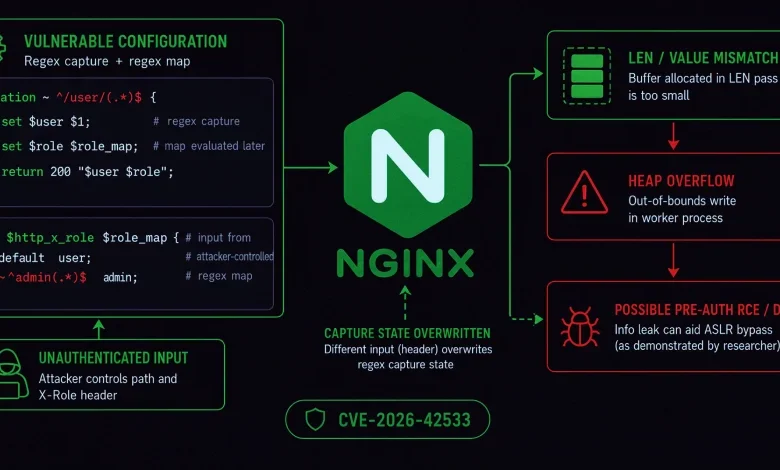
F5 has officially released critical security updates to address a high-severity vulnerability in the NGINX web server, identified as CVE-2026-42533. This flaw, which resides in the NGINX script engine, could allow a remote, unauthenticated attacker to trigger a heap buffer overflow in the NGINX worker process by sending specially crafted HTTP requests. Under certain conditions, this vulnerability can lead to a denial-of-service (DoS) condition or, more alarmingly, remote code execution (RCE). The security patches, issued on July 15, affect both the stable and mainline versions of the open-source NGINX server, as well as the commercial NGINX Plus offering. Organizations utilizing NGINX in their infrastructure are strongly urged to transition to the fixed versions—NGINX 1.30.4 (stable), 1.31.3 (mainline), or NGINX Plus 37.0.3.1—to mitigate the risk of exploitation.
The vulnerability stems from a specific architectural flaw in how NGINX evaluates string expressions during request processing. According to technical advisories, the overflow is located within the NGINX script engine, the component responsible for assembling strings from configuration directives at runtime. The flaw is not present in all NGINX deployments but rather surfaces under a specific, albeit common, configuration pattern: the use of a regex-based map directive where the output variable is subsequently referenced in a string expression following a capture from a previous regex match. This pattern triggers a failure in NGINX’s "two-pass" evaluation system, leading to a memory corruption event that can be weaponized by an attacker.
Technical Analysis of the Two-Pass Evaluation Failure
To understand the mechanics of CVE-2026-42533, one must look at how NGINX handles dynamic string evaluation. NGINX employs a two-pass mechanism to optimize memory allocation. In the first pass, the engine iterates through the required components of a string to calculate the total number of bytes needed, subsequently allocating a buffer of that exact size on the heap. In the second pass, the engine writes the actual data into the pre-allocated buffer.
The security failure occurs because both passes rely on a shared capture state. When a configuration uses a map directive with a regular expression between the first and second passes, the evaluation of that map’s regex can overwrite the capture state. Consequently, the first pass may calculate a buffer size based on an original, smaller capture (such as a $1 variable from a location block), while the second pass writes data from a different, larger capture injected by the attacker. Because the buffer was sized for the smaller string, the writing process overflows the heap boundary. This allows an attacker to control both the length and the content of the data that overruns the buffer, providing a classic pathway for memory corruption exploits.

While F5’s official advisory notes that the primary result of such an overflow is the crashing or restarting of the NGINX worker process—resulting in a denial of service—it also acknowledges that remote code execution is possible in environments where Address Space Layout Randomization (ASLR) is disabled or can be bypassed. However, independent research suggests that the vulnerability may be even more potent than initially reported.
Researcher Findings and the ASLR Bypass Threat
The vulnerability was reported to F5 by a consortium of more than a dozen security researchers, including Mufeed VH of Winfunc Research and NGINX maintainer Maxim Dounin. Among the contributors, independent researcher Stan Shaw, known online as "cyberstan," has provided a deeper analysis that challenges the conservative risk assessment provided in the official advisory. Shaw argues that the flaw itself provides the necessary mechanism to bypass ASLR, a key defensive layer designed to prevent RCE by randomizing the memory addresses used by system processes.
In his detailed write-up, Shaw explains that the "capture clobbering" mechanism can be manipulated in reverse. When an attacker-controlled capture is smaller than the original capture used for sizing, the oversized buffer is not fully overwritten. This results in the server returning uninitialized heap data to the attacker. In testing conducted on a default Ubuntu 24.04 build, Shaw demonstrated that a single, unauthenticated GET request could recover the specific memory addresses required to construct a functional RCE payload.
"A reader of the F5 advisory could reasonably conclude this is DoS-only on default systems. It is not," Shaw stated in communications with cybersecurity news outlets. He claims a 100% success rate in his testing environment for achieving memory leaks. While Shaw has currently withheld a public proof-of-concept (PoC) and specific exploitation details to allow organizations time to patch, he has indicated that a PoC will likely be released 21 days after the initial patch date. This timeline places significant pressure on system administrators to update their NGINX instances before automated exploitation tools become widely available.
Chronology of NGINX Vulnerabilities in 2024
The discovery of CVE-2026-42533 marks the third significant heap overflow vulnerability found in NGINX’s expression-evaluation code within a two-month window. This trend has raised concerns regarding the underlying security architecture of NGINX’s script engine.

- May 2024 (CVE-2026-42945): Known as "Rift," this vulnerability was actively exploited in the wild shortly after its disclosure. It involved a heap overflow triggered by a stale flag in the NGINX evaluation logic.
- June 2024 (CVE-2026-9256): A vulnerability involving overlapping captures in the rewrite module was disclosed, which allowed for similar memory corruption scenarios.
- July 2024 (CVE-2026-42533): The current vulnerability involving clobbered capture states in regex-based maps.
All three vulnerabilities share a common root cause: the NGINX two-pass script engine trusts its own initial measurement for buffer allocation without verifying that the state remains consistent during the writing phase. This architectural reliance on shared state across two distinct processing passes appears to be a systemic weakness that security researchers are now aggressively scrutinizing.
The historical reach of CVE-2026-42533 is particularly notable. F5 has confirmed that every NGINX version from 0.9.6 through 1.31.2 is vulnerable. This range extends back to 2011, the year regex support was first introduced to the map directive. This means the flaw has existed silently in the NGINX codebase for over 13 years, potentially leaving millions of legacy systems exposed.
Affected Products and Configuration Risks
The scope of the vulnerability extends beyond the core NGINX server. F5’s security advisory lists several downstream products that incorporate NGINX and are therefore affected by the flaw:
- NGINX Ingress Controller
- NGINX Gateway Fabric
- NGINX App Protect WAF
- NGINX Instance Manager
At the time of publication, F5 had not yet released specific fixed builds for these four products, though updates are expected imminently. The risk is scored at 9.2 on the CVSS v4 scale and 8.1 on the CVSS v3.1 scale. While F5 rates the attack complexity as "high" due to the specific configuration requirements, the widespread use of regex-based mapping in complex load balancing and reverse proxy setups suggests a broad attack surface.
The specific exposure can be identified by searching for a regex-based map whose variable appears in a string expression alongside a numbered capture (e.g., $1, $2) from an earlier regex, where the capture is positioned before the map variable in the expression. To assist administrators, Stan Shaw has released an open-source configuration scanner that automates the detection of these exploitable patterns across complex configuration files, including those with multiple include directives.

Mitigation Strategies and Official Responses
For organizations that cannot immediately perform a full software upgrade, F5 has suggested a temporary mitigation: switching affected regex maps to named captures. By using named groups (e.g., (?<name>regex)) instead of numbered captures, the primary path to the overflow is theoretically closed.
However, researchers have warned that this mitigation is incomplete. Shaw identified a secondary code path where a map that defines the same named group as a location regex can still trigger the overflow. This "variant" path was confirmed using AddressSanitizer but was not explicitly mentioned in the initial F5 advisory. Consequently, security experts emphasize that upgrading to the patched versions (1.30.4 or 1.31.3) is the only comprehensive solution to the problem.
F5 has been praised for its coordinated response and for acknowledging the independent researchers who brought the issue to light. However, the company has yet to provide a definitive timeline for the release of patches for its NGINX-integrated enterprise products, such as the Gateway Fabric and App Protect WAF.
Broader Implications for Web Infrastructure
NGINX is a cornerstone of modern web infrastructure, powering approximately one-third of all websites globally. Because NGINX is often deployed at the very edge of a network as a load balancer or reverse proxy, a vulnerability that allows unauthenticated remote code execution represents a tier-one security threat. If exploited, an attacker could gain a foothold in a DMZ (Demilitarized Zone), allowing for lateral movement into more sensitive internal networks.
The "Rift" vulnerability (CVE-2026-42945) serves as a cautionary tale for the current situation. In that instance, functional exploit code was published within days of the patch release, followed immediately by reports of active exploitation by threat actors. Given the 21-day window suggested by researchers for CVE-2026-42533, the global security community is currently in a race against time to secure infrastructure before the "exploitation phase" begins.

As of late July, CVE-2026-42533 has not yet been added to the Cybersecurity and Infrastructure Security Agency’s (CISA) Known Exploited Vulnerabilities (KEV) catalog. However, given the severity of the flaw and the history of similar NGINX vulnerabilities, its inclusion is considered likely if patching rates do not accelerate. Administrators are advised to prioritize these updates immediately, particularly for internet-facing instances that utilize complex regex-based routing and variable mapping.
Related posts: