Optimizing Small Language Models for Narrow Automation: Reusing Prompt Prefixes with Key-Value Caches

The deployment of small language models (SLMs) in production environments has increasingly shifted from broad, general-purpose conversational agents to highly specialized, narrow automation tasks. In enterprise workflows such as customer support ticket routing, document classification, and automated triage, models must operate under strict latency, cost, and resource constraints. Addressing these challenges requires optimization strategies that move beyond mere model quantization and pruning. Building upon previous investigations into output space constraints, machine learning engineers are now focusing heavily on computational efficiency at the inference layer—specifically, the strategic reuse of prompt prefixes via key-value (KV) caching.
When executing repetitive classification tasks using transformer-based architectures, developers frequently rely on static instruction sets. These prompts typically incorporate a comprehensive system role definition, a strict taxonomy of target classes, and several few-shot examples designed to anchor the model’s behavior. In a typical customer support scenario, this static instruction block might easily span 150 to 200 tokens. Conversely, the dynamic input—the specific user ticket requiring categorization—often accounts for a mere twenty to thirty additional tokens. Consequently, standard inference loops repeatedly re-encode an identical instruction prefix for every single incoming record. This redundant computation across all layers and attention heads introduces substantial computational overhead, limiting throughput and inflating latency on resource-constrained hardware such as edge devices or local development machines.
To quantify the operational impact of this redundancy, engineers frequently benchmark inference performance using standardized hardware configurations. A representative test environment utilizes an Apple M2 MacBook Air equipped with 24GB of RAM and a 16-core Neural Engine, executing the Qwen2.5-0.5B-Instruct model in float16 precision via the Hugging Face Transformers library. In a baseline evaluation processing 600 distinct customer support records, the system must repeatedly evaluate both the static system prompt and the variable user input on every iteration.
The Mechanics of Transformer Attention and KV Caching
Transformer models process input sequences by projecting token embeddings through multiple self-attention layers. During the pre-fill phase—where the model ingests the initial prompt—it computes key and value vectors for every token at every layer. Because these vectors depend exclusively on preceding tokens, the key-value pairs generated for a fixed, static prompt prefix remain entirely constant across multiple independent inference calls.
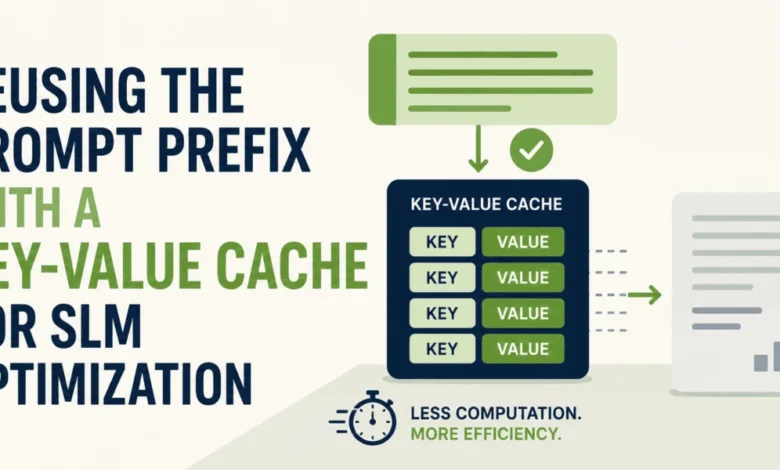
Rather than discarding these intermediate representations after a single forward pass, developers can leverage a dynamic key-value cache (DynamicCache in modern transformer libraries) to store the computed prefix vectors in memory. Once the static prompt has been processed once, subsequent inference calls bypass the expensive pre-fill computation for the instruction block. Instead, the model ingests only the new, dynamic tokens—the specific customer ticket—while passing the cached key-value tensors through the network.
Implementing this optimization requires careful attention to token boundary alignment. Developers must construct prompts using explicit chat templates (such as ChatML formats) rather than relying entirely on high-level abstraction wrappers. This ensures that splitting the prompt into a static prefix and a dynamic suffix yields a token-clean boundary. If the tokenization of the separated halves differs in any way from the tokenization of the concatenated prompt, the cached key-value states will misalign with the expected position embeddings, leading to mathematical errors or degraded model outputs.
Empirical Benchmarks and Performance Gains
Comparative benchmarks illustrate the profound efficiency gains achieved through prefix caching. In standard execution loops where the entire prompt is re-encoded for every record, processing a 167-token prompt (comprising a 145-token static prefix and a 22-token variable suffix) across 600 records requires approximately 184.85 seconds. This translates to roughly 308.1 milliseconds per ticket on local CPU execution.
When the inference pipeline is refactored to populate the KV cache once with the static instruction block and subsequently crop and reuse the cache for each incoming ticket, the total runtime drops dramatically. Under identical hardware conditions, processing the same 600 records requires 80.07 seconds, yielding an average of 133.5 milliseconds per ticket. This represents an overall runtime reduction of approximately 57 percent.
Crucially, this performance improvement is achieved without altering the model’s behavioral outputs. Because prefix caching is a pure computational optimization rather than a model approximation technique, the classification predictions remain byte-for-byte identical to those produced by the naive, unoptimized loop. Furthermore, the efficiency gains scale directly with the ratio of static to dynamic content. As enterprise instruction sets grow longer and more detailed—incorporating extensive domain-specific taxonomies and numerous edge-case examples—the relative computational savings expand, turning what was once a performance penalty into an architectural advantage.
Industry Implications for Edge and Cloud Deployment
The transition toward optimized small language model deployment carries significant implications for enterprise software architecture. As organizations seek to reduce their reliance on costly, high-latency cloud-based foundation models for routine operational tasks, local and edge deployment of sub-billion-parameter models becomes increasingly viable.
By eliminating redundant pre-fill computations, developers can achieve the throughput required for real-time automation pipelines without scaling up infrastructure costs. This optimization strategy bridges the gap between theoretical model capability and practical production readiness. When software systems are engineered to respect the static nature of prompt prefixes, small language models cease to be viewed as compromised alternatives to larger architectures and instead emerge as precise, highly efficient tools tailored for narrow automation at scale.