OpenAI GPT-6 Astra is Now Generally Available on Amazon Bedrock, Marking a Major Milestone in Enterprise Artificial Intelligence Integration

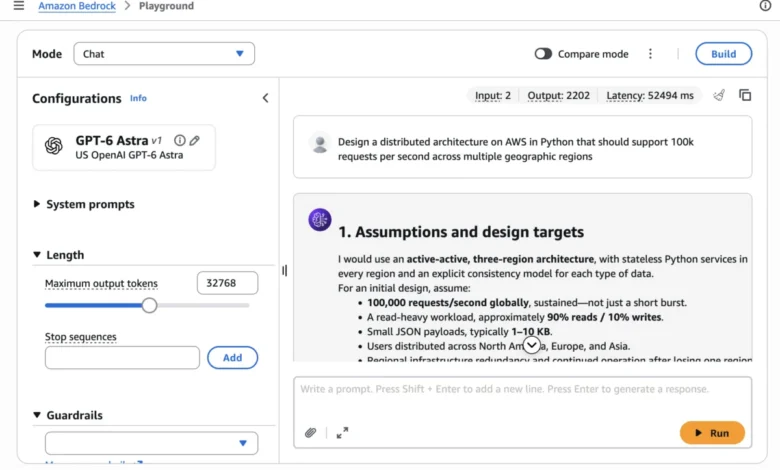
The landscape of enterprise artificial intelligence experienced a significant shift this week as Amazon Web Services (AWS) announced the general availability of OpenAI’s GPT-6 Astra on Amazon Bedrock. This development brings OpenAI’s most advanced foundational model to date directly into the managed cloud infrastructure of AWS, offering enterprise customers a powerful new instrument for handling complex cognitive workflows, extensive codebases, and massive multi-document data repositories.
The integration of GPT-6 Astra into Amazon Bedrock signifies a convergence of leading-edge AI research and secure, scalable cloud architecture. As organizations increasingly move beyond exploratory AI projects toward mission-critical deployments, the demand for models capable of high-level reasoning, nuanced judgment, and robust operational security has never been higher. This release addresses those enterprise demands by combining OpenAI’s breakthrough reasoning capabilities with the rigorous governance, compliance, and privacy controls long established by AWS.
Main Facts of the Launch
Under the terms of the deployment, GPT-6 Astra is now accessible to all Amazon Bedrock users through supported APIs, as well as via configurations for ChatGPT Work and Codex. One of the most defining technical specifications of the new model is its massive context window, which supports up to 1 million input tokens. This expansive capacity allows users to upload entire software repositories, multi-volume legal contracts, or extensive corporate documentation archives into a single prompt session, enabling the model to analyze, reconcile, and synthesize competing inputs with unprecedented coherence.
Beyond raw text processing, GPT-6 Astra introduces advanced computer and browser-use capabilities. To leverage these features safely in corporate environments, OpenAI is concurrently rolling out enterprise plugins for ChatGPT Work. These plugins allow Astra to interact seamlessly with common business applications and browser-based workflows while operating within strict authorization parameters. Furthermore, AWS has integrated the model into its comprehensive security ecosystem, ensuring that enterprise inference data remains entirely isolated and is never utilized for foundational model training by either OpenAI or AWS.
Background and Technical Evolution
The journey toward deploying frontier models like GPT-6 Astra on managed cloud platforms represents years of architectural refinement across the cloud computing and artificial intelligence sectors. Historically, organizations utilizing cutting-edge LLMs faced a difficult trade-off between harnessing state-of-the-art intelligence and maintaining strict data sovereignty. Early generative AI tools often required organizations to cede control over data governance or rely on fragmented, unmanaged API endpoints that lacked enterprise-grade security oversight.

Amazon Bedrock was engineered specifically to solve this dilemma. By providing a unified API gateway to multiple high-performance foundational models—ranging from Anthropic’s Claude series to Meta’s Llama and now OpenAI’s flagship offerings—AWS has established a centralized hub for enterprise generative AI development. The addition of GPT-6 Astra represents the pinnacle of this multi-model strategy. Unlike its predecessors, Astra is purpose-built for autonomous execution, multi-step problem solving, and complex software engineering tasks, bridging the gap between conversational chat interfaces and autonomous agentic workflows.
Chronology of Integration and Deployment
The pathway to bringing GPT-6 Astra to Amazon Bedrock follows an accelerated timeline characteristic of the rapid pace of artificial intelligence deployment over the past several years.
Initial collaborative engineering efforts between AWS and OpenAI focused on optimizing latency, throughput, and memory management to support Astra’s massive 1-million-token context window within cloud server environments. Managing input spaces of this magnitude requires sophisticated hardware acceleration and memory caching strategies to ensure response times remain commercially viable for enterprise applications.
Following internal validation and beta testing phases with select enterprise partners throughout the summer, the rollout culminated in this week’s general availability announcement. Concurrently, software developers and IT administrators were granted access to updated API endpoints, SDKs, and infrastructure monitoring tools designed to track model invocation activity, manage cost controls, and enforce role-based access permissions.
Supporting Data and Architectural Capabilities
To understand the practical impact of GPT-6 Astra on Amazon Bedrock, industry analysts have pointed to several key technical metrics that separate this release from previous generations of language models:
- Context Window Capacity: The 1-million-token input threshold allows approximately 750,000 words of text to be processed simultaneously. This translates to entire software application directories comprising hundreds of individual files, or years of financial auditing records examined in a single query.
- Reasoning and Judgment Scores: Benchmark evaluations indicate substantial improvements in multi-step deductive reasoning, formal logic resolution, and professional-grade technical writing compared to previous flagship models.
- Computer and Browser Use: Native capability to interpret graphical user interfaces, navigate web applications, and execute multi-phase digital tasks under human supervision or via automated agent protocols.
- Data Privacy Guarantees: Strict adherence to AWS zero-retention and zero-training data policies, assuring corporate legal and compliance teams that proprietary inputs will not leak into public model checkpoints.
Official Responses and Stakeholder Perspectives
While specific direct statements from executive leadership varied across corporate channels, industry observers and technical spokespersons have highlighted the strategic alignment behind the launch.

Cloud computing analysts view the integration as a masterclass in ecosystem synergy. By hosting OpenAI’s most capable model on Amazon Bedrock, AWS reinforces its position as the premier destination for enterprise cloud workloads, regardless of which underlying AI vendor an enterprise prefers. For OpenAI, partnering with AWS expands the reach of GPT-6 Astra into deeply entrenched enterprise accounts that rely heavily on AWS infrastructure for their core data warehousing, serverless computing, and security operations.
Enterprise software architects have similarly expressed optimism regarding the elimination of friction between development environments and AI tools. By allowing tools like Codex and ChatGPT Work to interface directly with Bedrock-hosted models, development teams can maintain a unified security posture across all AI-assisted coding and document analysis pipelines.
Broader Industry Impact and Implications
The general availability of GPT-6 Astra on Amazon Bedrock is expected to accelerate several broader trends in the enterprise technology sector:
- The Rise of Autonomous Agentic Workflows: With advanced reasoning and native computer-use capabilities, organizations can move beyond simple text generation toward deploying autonomous software agents capable of executing multi-step business processes, such as automated compliance auditing, software refactoring, and cross-platform data migration.
- Standardization of Hybrid Multi-Model Strategies: Enterprises are increasingly rejecting single-vendor lock-in. The availability of top-tier models from competing AI developers within a single managed cloud platform like Bedrock empowers organizations to route specific tasks to the most cost-effective and capable model for the job.
- Heightened Focus on Data Sovereignty and Compliance: As regulatory scrutiny surrounding artificial intelligence intensifies globally, cloud-native deployments that guarantee data isolation and auditability—such as those provided by AWS security controls—will likely become the baseline requirement for enterprise AI adoption in finance, healthcare, and government sectors.
As autumn operations resume at full speed across major technology hubs, the release of GPT-6 Astra on Amazon Bedrock serves as a clear indicator of where the enterprise software market is heading. The focus has decisively shifted from experimental AI implementation to deep, secure, and operationally mature integration capable of transforming core business workflows at scale.