New Data-Driven Publisher League Tables for U.S. and U.K. Markets Map Digital Engagement and Loyalty Beyond Traditional SEO


The digital publishing landscape has long relied on raw web traffic metrics and search engine optimization (SEO) performance as the primary benchmarks for success. However, as the digital ecosystem matures and audience behaviors shift, industry analysts increasingly argue that sheer visitor volume fails to capture the true health, influence, or commercial viability of a media brand. In response to this evolving paradigm, digital strategist Harry Clarkson-Bennett has compiled comprehensive, data-driven publisher league tables for both the United States and the United Kingdom. Utilizing robust data sets from digital market intelligence platform Similarweb, these newly introduced rankings shift the industry conversation away from vanity metrics toward a holistic evaluation of audience engagement, brand loyalty, and overall site experience.
The Evolution of Digital Measurement in Publishing
For decades, the metrics governing online publishing were straightforward: rank high on search engine result pages, drive high volumes of click-through traffic, and monetize those eyeballs through programmatic advertising. Yet, the rapid transformation of search algorithms, the rise of zero-click searches, and the saturation of digital content have rendered traditional SEO insufficient on its own. Industry experts emphasize that while attracting traffic remains a foundational necessity, traffic alone no longer guarantees audience retention or long-term financial stability.
Modern digital publishing demands a deeper connection with readers. Engagement has emerged as the ultimate currency of the web, requiring publishers to foster genuine audience loyalty and deliver superior on-site experiences. Clarkson-Bennett’s initiative seeks to address this measurement gap by bringing transparency to metrics that are frequently obscured behind corporate paywalls or isolated within private analytics dashboards. By leveraging Similarweb’s granular traffic and behavior data, the newly released league tables provide a clearer picture of how top-tier publishers in the U.S. and U.K. truly perform when measured by user dedication rather than simple visitor counts.
Anatomy of the Publisher League Tables: Quadrants and Traditional Rankings

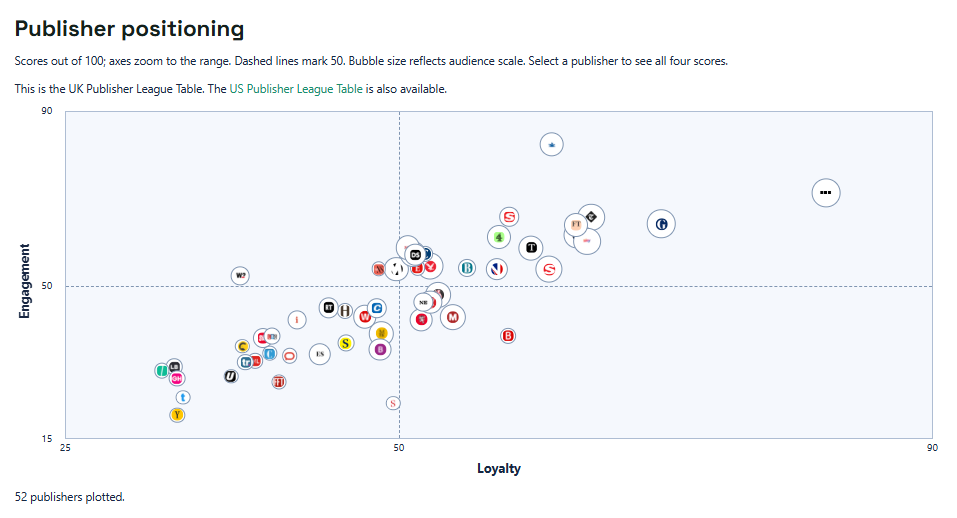
To accommodate different analytical preferences, the newly published framework offers two distinct visualization models. The first is a quadrant-style positioning graph designed to plot publishers across multiple axes simultaneously. This sophisticated model maps media brands based on a synthesis of audience scale, engagement levels, and user loyalty. By utilizing a four-quadrant layout, industry observers can instantly identify which outlets successfully balance massive reach with deep reader commitment, and which ones punch above their weight class through exceptionally loyal niche audiences despite having a smaller overall footprint.
For traditionalists, the release also features a classic, tabular leaderboard reminiscent of standard industry league tables. This straightforward format ranks publishers numerically, allowing media buyers, strategists, and digital marketers to quickly scan performance metrics in a familiar, analogue-friendly structure.
Clarkson-Bennett has confirmed that these rankings are not static; the league tables are scheduled for monthly updates. Furthermore, the scope of the project is slated for expansion. Future iterations will incorporate an increasing number of publishers into the baseline data and will soon integrate social media performance metrics to paint an even more comprehensive picture of cross-platform brand presence.
Redefining Discoverability in the Modern Web Era
The launch of these publisher leaderboards touches upon a broader, ongoing debate within the digital marketing and SEO communities regarding the true definition of discoverability. In contemporary digital strategy, discoverability is no longer confined to a single channel, nor is it limited to active search queries.
True discoverability encompasses a multifaceted ecosystem of on-site and off-site touchpoints. It includes passive discovery—such as algorithmic content recommendations and RSS feeds—active discovery driven by traditional search engine queries, and owned channels like newsletters and direct navigation. By attempting to factor these diverse behavioral pathways into future leaderboard updates, the project aligns with a growing consensus that modern publishing success requires a diversified audience acquisition strategy. Publishers can no longer rely solely on search engine algorithms to sustain their operations; they must cultivate direct relationships with readers across the entire digital landscape.
Industry Implications and Future Outlook
The introduction of these U.S. and U.K. publisher league tables arrives at a critical juncture for the digital media industry. As advertising budgets tighten and brands demand greater accountability and return on investment from their media placements, the granularity of Similarweb’s data offers a valuable resource for media planners. Advertisers are increasingly looking beyond top-line reach to ensure their messages appear on platforms where users actively engage with content rather than merely bouncing away.
Furthermore, the monthly cadence of the newly established rankings promises to introduce a healthy competitive dynamic among publishers. Media organizations will be able to track their trajectory over time, measuring the direct impact of editorial pivots, user experience redesigns, and audience development strategies against their market peers.
As the digital publishing sector continues to navigate algorithmic volatility and shifting consumer habits, tools that demystify audience behavior will remain indispensable. By shedding light on the intricate balance between scale and loyalty, Harry Clarkson-Bennett’s publisher league tables offer a timely and sophisticated roadmap for the future of digital media evaluation in two of the world’s most competitive publishing markets.