Blind Taste Test Reveals Gemini 4 Neon Outperforms Hydrogen and Flash in Specialized SEO AI Workloads

In the rapidly evolving landscape of artificial intelligence and search engine
optimization, developers and practitioners are constantly evaluating new foundation models to determine which architecture delivers the highest practical utility. Recently, prominent search and AI researcher Marie Haynes conducted a rigorous, blind three-way evaluation comparing three distinct Google Gemini iterations—Gemini 3.8 Flash, Gemini 4 Hydrogen, and Gemini 4 Neon—integrated within her proprietary Open Knowledge Format (OKF) research library, commonly referred to as "Marie’s Brain."
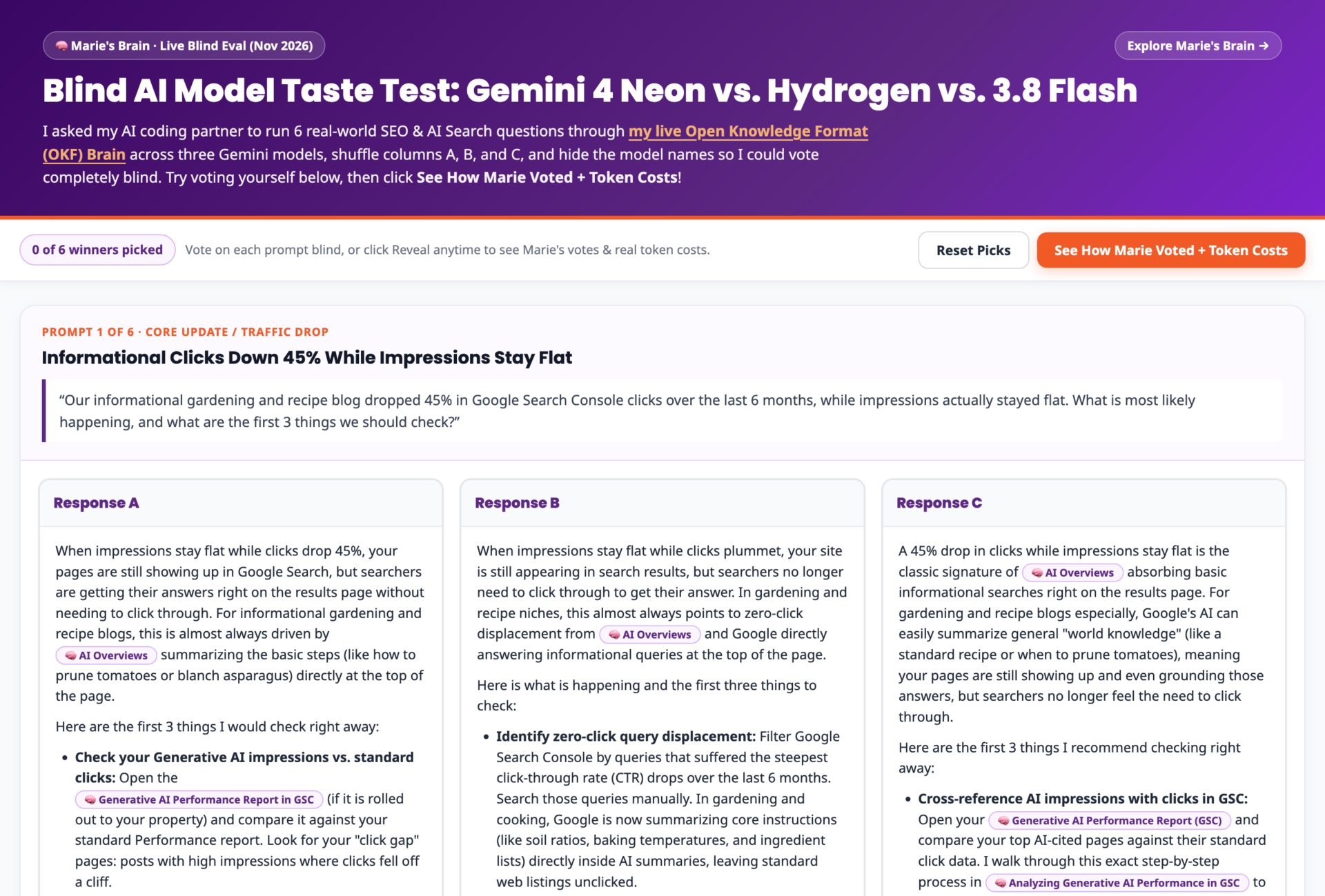
The experiment, designed to eliminate confirmation bias by utilizing randomized and shuffled output columns, sought to answer a fundamental question: Do newer, more resource-intensive AI models genuinely provide superior functional answers for complex, real-world search engine optimization queries, or do practitioners simply assume that generational upgrades equal better performance? The results of the blind test revealed a decisive victory for Gemini 4 Neon, which secured five out of six category wins despite operating under rigorous testing parameters.
Background and Context of the Evaluation
The integration of advanced large language models into specialized vertical libraries has become standard practice for technical consultants who need instant access to curated research, patent analyses, and algorithmic documentation. Haynes had spent several months constructing "Marie’s Brain," a private AI co-pilot grounded specifically in a hand-curated library of search and AI literature utilizing the Open Knowledge Format.
Initially operating on earlier model architectures, the system was recently upgraded to Google’s newer Gemini 4 Hydrogen model. However, despite the technical prestige of the newer release, an initial qualitative review prompted lingering skepticism regarding whether the output justified potential changes in computational expenditure and verbosity. To establish an objective baseline, Haynes structured a blind taste test encompassing six real-world search and AI optimization challenges. The evaluation subjects spanned critical contemporary issues, including diagnosing traffic drops associated with AI Overviews, deciding whether to delete or rewrite legacy informational content, assessing Main Content requirements for commercial buyer’s guides, evaluating thin location pages, testing agent readiness through /llms.txt protocols, and developing realistic operational workflows for modern search professionals.
The public evaluation interface was engineered to maintain strict impartiality. For each of the six prompts, the responses generated by the three models—Gemini 3.8 Flash, Gemini 4 Hydrogen, and Gemini 4 Neon—were randomly assigned to columns labeled A, B, and C. These column assignments were dynamically reshuffled for every question to prevent pattern recognition by the evaluator.

Initial Discovery: The Prompt Engineering and Over-Eager Research Dilemma
Before finalizing the blind evaluation votes, the initial phase of testing exposed a significant operational inefficiency related to prompt engineering and agentic behavior. An inspection of the API logs revealed that Gemini 4 Hydrogen was exhibiting hyper-extensive exploratory loops, reading an average of 21 distinct OKF files per single user prompt.
This autonomous research behavior resulted in an average processing time of 68 seconds per query, lengthy essays averaging 1,600 words, and a base cost of $0.44 per prompt turn—making Hydrogen notably more expensive per interaction than even Gemini 4 Neon in certain configurations. Furthermore, the extensive retrieval loops caused the model to surface deep internal Google engineering nomenclature, such as MAGIT and FastSearch documentation, which added unnecessary complexity for busy business owners seeking straightforward diagnostic advice.
To rectify these operational anomalies before casting final blind votes, system administrators implemented three core optimizations to streamline the assistant’s behavior:
- Enforcing strict conciseness constraints to eliminate unnecessary narrative padding.
- Calibrating file-retrieval thresholds to prevent redundant deep-dives into auxiliary research documents.
- Filtering out hyper-technical engineering jargon in favor of actionable, business-oriented recommendations.
Following these adjustments, the exact battery of six real-world queries was re-run across all three models to ensure a level playing field.
Blind Evaluation Results and Performance Metrics
With model identifiers completely concealed and output columns randomized, the evaluator reviewed all 18 resulting answers to select a definitive preference for each prompt. When the blind test concluded and the underlying model tags were revealed, Gemini 4 Neon emerged as the dominant performer, capturing five out of the six available wins.
The decisive factor separating Gemini 4 Neon from its counterparts was not an advantage in raw factual retrieval—as all three models drew from the exact same underlying OKF concept library—but rather its communication style and synthesis. Reviewers noted that Neon’s responses mirrored the cognitive cadence of a strategic human consultant methodically reasoning through a complex problem, offering heightened clarity, readability, and immediate conceptual comprehension.
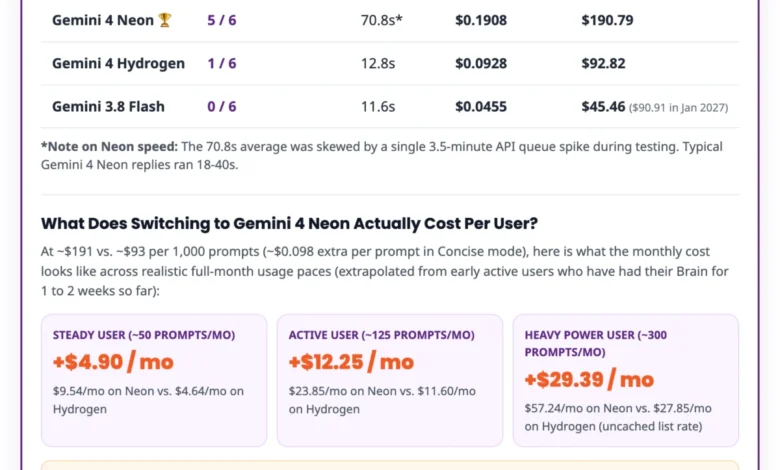
To provide granular transparency, the performance metrics and financial costs associated with each model were documented using real Gemini API usage metadata, incorporating thinking tokens evaluated at conservative uncached list rates:
| Model | Average Speed | Average Length | Estimated Cost / Turn | Estimated Cost / 1,000 Turns |
|---|---|---|---|---|
| Gemini 3.8 Flash | 11.6 seconds | 292 words | $0.0455 | $45.46 |
| Gemini 4 Hydrogen | 12.8 seconds | 239 words | $0.0928 | $92.82 |
| Gemini 4 Neon (Winner) | 70.8 seconds | 275 words | $0.1908 | $190.79 |
Note on Latency: The reported 70.8-second average speed for Gemini 4 Neon was heavily skewed by a single 3.5-minute API queue spike encountered during testing. Typical operational response times for Neon ranged between 18 and 40 seconds, with text streaming dynamically as the model formulated its output.
Economic Implications and Cost-Benefit Analysis
While raw performance metrics clearly favor Gemini 4 Neon, enterprise deployment requires a rigorous economic assessment to determine whether the qualitative improvements justify the financial expenditure.
At face value, scaling from Gemini 3.8 Flash to Gemini 4 Neon represents an increase from approximately $45 to nearly $191 per 1,000 prompts—roughly a 15-to-20-cent premium per interaction. However, when extrapolated across realistic monthly usage tiers derived from active professional workflows, the financial impact per user remains manageable:
- For light users generating approximately 20 queries per month, the difference amounts to minor fractional operational overhead.
- For heavy daily practitioners generating hundreds of queries monthly, the premium scales linearly but correlates directly with time saved in editorial synthesis and strategic decision-making.
Furthermore, industry analysts note that these cost projections rely on conservative, uncached estimations. Because specialized co-pilots like "Marie’s Brain" consistently reference a static master index—such as the ~55,000-token OKF Master Index—implied context caching mechanisms across modern API infrastructures significantly discount repeated input tokens during multi-turn conversational threads. Consequently, real-world operational bills are expected to trend noticeably lower than baseline uncached calculations indicate.
Broader Implications for AI Integration in Professional Workflows
The outcome of this blind evaluation underscores a broader evolution in how artificial intelligence is deployed across specialized technical sectors. As foundation models achieve parity in raw data access and information retrieval, the competitive differentiator increasingly shifts from sheer volume of data processed to qualitative synthesis, tone, and communicative efficiency.
For search engine optimization professionals and digital consultants, the findings suggest that defaulting to the newest or most resource-intensive model without empirical testing can lead to bloated token consumption and diminished user experience. Conversely, systematic blind testing allows organizations to identify models that strike the optimal balance between high-level analytical reasoning, human-like readability, and cost efficiency. As API providers continue to refine their pricing models and context-caching capabilities, rigorous comparative testing will remain an essential practice for maintaining efficient, high-performance AI integration.