The industrial infrastructure sector is facing a quiet crisis, driven by chronic labor shortages, soaring operational demands, and an aging workforce. From massive oil refineries to municipal water treatment plants, the backbone of modern civilization relies on vast networks of interconnected pipes. Holding these sprawling networks together are millions of bolted flange joints—a critical component that requires intense physical labor to assemble, maintain, and overhaul. Enter Lindsey Elliott, a former ExxonMobil engineer and planner who has spent years analyzing the inefficiencies of heavy industry. Recognizing that traditional pipefitting is physically punishing and increasingly unsustainable due to declining labor pools, Elliott founded Nexterity to engineer a paradigm shift. Selected as one of the Startup Battlefield 200 participants at TechCrunch Disrupt, Nexterity is introducing a remote-controlled robotic solution designed to take the heavy lifting out of bolting, promising a future of heightened safety, enhanced productivity, and minimized physical strain for blue-collar workers.
The Anatomy of a Labor-Intensive Industry
To understand the scope of Nexterity’s innovation, one must examine the daily realities of the industrial trade workforce. Pipefitters across North America are tasked with maintaining the structural integrity of complex piping systems that transport oil, gas, petrochemicals, water, and various manufacturing inputs. A standard maintenance cycle often involves loosening and tightening thousands of heavy-duty industrial bolts in high-pressure, high-temperature, or confined environments.
According to industry practitioners, the physical toll of this work is immense. Workers routinely endure punishing 12-hour shifts spanning weeks or months at a time, leading to cumulative fatigue, ergonomic injuries, and chronic musculoskeletal issues. Furthermore, the North American trade sector has been grappling with a widening labor deficit. As veteran tradespeople retire, recruitment pipelines struggle to keep pace with demand, leaving fewer workers to manage an ever-growing maintenance backlog.
Elliott’s firsthand experience within major energy operations illuminated these systemic vulnerabilities. Conversations with pipefitters throughout the United States and Canada consistently revealed that regional productivity metrics remain stubbornly low, largely constrained by the physical limitations of human labor when performing repetitive, high-torque manual tasks. By targeting the most physically demanding aspect of the pipefitter’s daily routine—bolted flange joint maintenance—Nexterity aims to alleviate workforce burnout while addressing structural inefficiencies that have plagued the industry for decades.
From ExxonMobil to the Bolting Symposium: The Genesis of Nexterity
Elliott’s journey toward founding Nexterity was forged through rigorous industry immersion and technical collaboration. Her professional background as an engineer and planner at ExxonMobil provided a front-row seat to the operational bottlenecks inherent in large-scale energy production and petrochemical refining. However, conceptualizing a viable engineering solution required deep dives into specialized technical communities.
A self-described enthusiast for industrial hardware, Elliott became a regular attendee at the annual Bolting Symposium, an event dedicated to the science, safety, and technology of industrial fastening. It was at the 13th annual gathering that she found herself participating in games of "Bolting Bingo" alongside self-proclaimed "torque dorks"—engineers, metallurgists, and fastening specialists who live and breathe fastener integrity.
Beyond the camaraderie of industry conferences, Elliott actively engaged with members of the Pressure Vessels & Piping Division of the American Society of Mechanical Engineers (ASME). Through these extensive consultations, she uncovered a crucial data point that would ultimately define Nexterity’s product strategy: approximately 80% of all industrial piping infrastructure falls within the nominal pipe size (NPS) range of two to eight inches (NPS2 to NPS8).
This remarkable uniformity across diverse industrial sectors transformed a broad, seemingly intractable problem into a prime candidate for automation. With such a high degree of dimensional repeatability, a standardized robotic intervention suddenly became mathematically and mechanically feasible.
Engineering the Solution: Inside Nexterity’s Robotic System
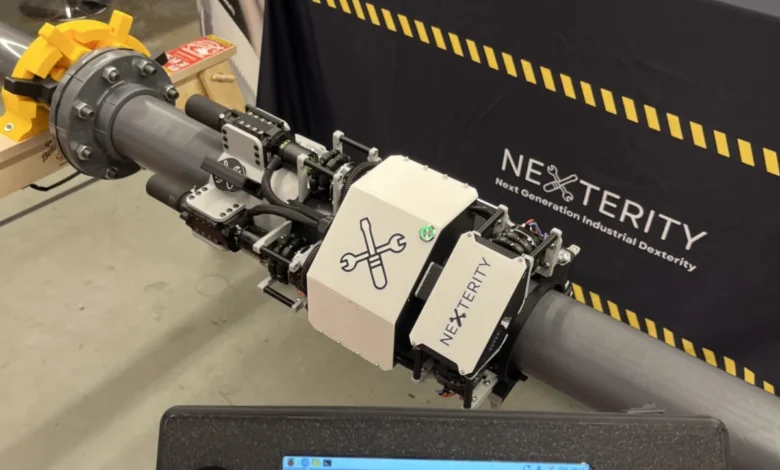
The hardware developed by Nexterity is built around simplicity, modularity, and field deployability. Rather than requiring massive, immobile robotic gantries or complex permanent installations, the startup’s flagship device is designed as a nimble, portable assistant for the modern pipefitter.
The robot is engineered in two primary modular components that easily clamp around a standard industrial pipe. Once secured, the device utilizes an onboard electric drive system powered by rechargeable batteries to traverse the circumference of the pipe. As it navigates the joint, the automated system simultaneously coordinates the loosening or tightening of four bolts at a time, drastically reducing the time required to service a single flange connection.
Portability was a foundational design constraint for the engineering team. Recognizing that industrial maintenance crews frequently operate in remote, cramped, or elevated spaces—such as offshore oil platforms, subterranean utility tunnels, and multi-level refinery racks—Nexterity ensured that the entire robotic apparatus is compact enough to fit inside a standard Pelican protective case. A single technician can easily transport, deploy, and operate the system without the need for heavy lifting equipment or specialized robotics training.
Furthermore, Nexterity has structured its business model around operational flexibility. Rather than selling the units outright as capital-intensive machinery, the startup deploys a rental equipment model. This approach allows industrial facilities to scale their adoption of robotic tooling based on immediate project demands, lowering the barrier to entry for plant managers hesitant to commit to permanent capital expenditures.
The Surprising Breadth of the Industrial Piping Market
While Nexterity’s initial inspiration stemmed from the oil, gas, and petrochemical sectors—industries famously dependent on extensive piping networks—the addressable market extends far beyond traditional fossil fuels. The fundamental mechanics of fluid transport remain consistent across nearly every major heavy industry, creating massive opportunities for horizontal market expansion.
During her research, Elliott noted that observers frequently underestimate the sheer scale of the global piping infrastructure market. Water and wastewater treatment facilities, municipal utilities, food and beverage processing plants, mining operations, nuclear energy facilities, and emerging green manufacturing plants all utilize the same foundational classes of bolted flange joints.
In water treatment infrastructure, for instance, aging municipal systems require constant valve replacements and joint maintenance. In the food and beverage sector, hygiene and precise torque application are paramount to prevent contamination and leakage. Nuclear and renewable energy installations demand rigorous quality assurance and traceability during assembly to prevent catastrophic containment failures. By engineering a tool adaptable to NPS2 through NPS8 piping—which constitutes the vast majority of industrial fluid lines—Nexterity has positioned its technology as a universal utility across multiple critical verticals.
Addressing the Labor Shortage Through Strategic Automation
The introduction of robotics into traditional blue-collar trades often sparks apprehension regarding workforce displacement. However, industry analysts and startup leadership emphasize that automation in the context of pipefitting is designed to augment, rather than replace, human expertise.
With North America facing a persistent shortage of skilled trade labor, facilities are increasingly forced to do more with fewer personnel. By offloading the most grueling, repetitive, and injury-prone tasks—such as torquing hundreds of heavy bolts in awkward overhead or confined positions—robots protect workers from physical degradation and acute strain injuries.
This shift allows skilled pipefitters to redirect their time and cognitive energy toward higher-value tasks that require critical thinking, complex troubleshooting, quality control, and system design. In an industry where chronic physical exhaustion contributes to high turnover and safety incidents, introducing ergonomic automation can serve as a powerful retention tool, making the trade more sustainable and attractive to a younger generation of prospective workers.
Broader Implications for Industrial Tech and Startup Innovation
Nexterity’s emergence at TechCrunch Disrupt’s Startup Battlefield 200 highlights a broader evolution in the venture capital and tech startup ecosystems. For years, venture funding was heavily skewed toward software-as-a-service (SaaS), consumer applications, and digital platforms. However, macroeconomic shifts, supply chain vulnerabilities, and a renewed appreciation for physical infrastructure have catalyzed a surge of interest in "hard tech" and industrial automation.
Founders with deep domain expertise—such as former engineers from legacy energy and manufacturing giants—are increasingly launching startups that address unglamorous, foundational problems. These entrepreneurs understand the regulatory hurdles, safety standards, and operational realities of heavy industry, allowing them to build products that integrate seamlessly into existing workflows without requiring radical overhauls of legacy facilities.
As Nexterity moves from prototype refinement and field testing toward broader commercial deployment, its trajectory will serve as a bellwether for how niche industrial automation can scale. By combining deep technical insights gathered from ASME divisions and specialized symposia with a pragmatic grasp of workforce dynamics, the startup exemplifies how targeted engineering can modernize legacy industries.
Ultimately, the vision championed by Nexterity can be summarized by a simple, guiding philosophy: more dork, less torque. By substituting mechanical ingenuity for brute physical force, the company is not only reimagining how a bolt is turned, but also laying the groundwork for a safer, more productive, and more resilient industrial workforce of the future.
Related posts: