BlueNoroff Deploys Sophisticated ClickFix Phishing Kit Utilizing AI-Generated Deepfakes to Target Global Cryptocurrency Sector

The North Korean state-sponsored threat actor known as BlueNoroff has significantly advanced its cyber-espionage capabilities with the deployment of a highly automated and sophisticated phishing kit designed to impersonate major videoconferencing platforms. According to a comprehensive technical analysis released by the cybersecurity firm JUMPSEC, the group is currently orchestrating "ClickFix" style campaigns that leverage typosquatted domains for Zoom and Microsoft Teams. This operation is not merely a collection of isolated attacks but represents a refined, repeatable victim acquisition pipeline that integrates social engineering, wallet reconnaissance, and AI-driven deepfake technology to compromise high-value targets within the cryptocurrency and decentralized finance (DeFi) sectors.
BlueNoroff, a subgroup of the notorious Lazarus Group, has long been associated with financially motivated cyberattacks aimed at generating revenue for the Democratic People’s Republic of Korea (DPRK). This latest development marks a transition toward "operationalized trust abuse," where the threat actors hijack legitimate communication channels to deliver malware under the guise of professional interactions. By compromising industry contacts and utilizing advanced technical lures, BlueNoroff has created a self-propagating attack chain that presents a significant challenge to traditional cybersecurity defenses.
The Anatomy of the ClickFix Pipeline
The ClickFix campaign operates through a meticulously structured multi-stage process. Unlike traditional broad-spectrum phishing, BlueNoroff’s approach is operator-driven and highly targeted. The initial access vector typically involves the hijacking of a legitimate Telegram account belonging to a trusted individual within the cryptocurrency community—often someone the target has interacted with in a professional capacity or met in person.
Once an account is compromised, the attackers use it to message high-ranking employees, venture capitalists, or founders of major firms. The lure usually revolves around a business proposition or an invitation to a professional meeting, facilitated through a Calendly link. When the victim clicks the link, they are redirected to a typosquatted domain that closely mimics the legitimate interface of Zoom or Microsoft Teams. Examples of such domains include variations like "us.zoom.06webin.us," which are designed to evade casual scrutiny by appearing as legitimate subdomains.

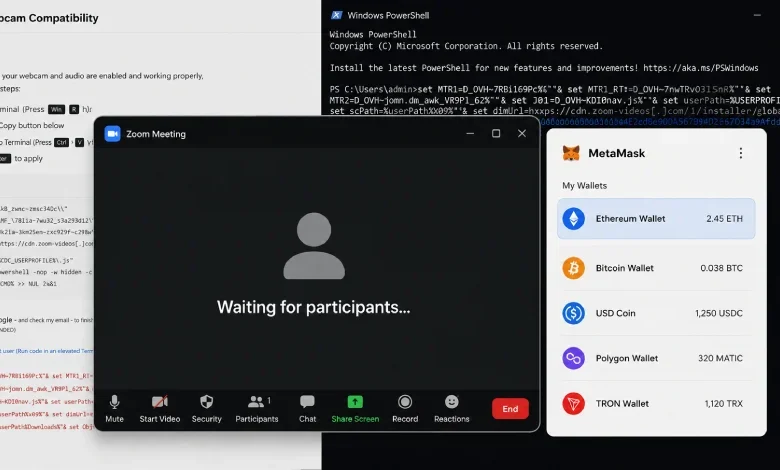
Upon landing on the fraudulent page, the victim is prompted to enter their name and grant the website permission to access their webcam. JUMPSEC’s research reveals that these permissions are not used for a legitimate video call but are instead hijacked via mediasoup WebRTC. This allows the attackers to stealthily stream the victim’s webcam feed directly to an operator’s control panel, providing the threat actors with real-time visual confirmation of their target.
AI-Generated Deepfakes and Real-Time Manipulation
One of the most alarming aspects of this campaign is the integration of artificial intelligence to bolster the credibility of the social engineering lure. As the victim waits in a fake "waiting room" for other participants to join, they are presented with a video feed that appears to be the meeting host. However, this video is not a live stream.
The attackers utilize AI-generated headshots, created using tools like OpenAI’s ChatGPT and DALL-E, which are then superimposed over authentic body movements captured from previous successful compromises. This "composite" video creates a plausibly familiar face that moves with natural body language, making it nearly impossible for the victim to detect the deception. This technique ensures that each successful attack provides fresh source material for the next, creating a self-sustaining cycle of high-fidelity deepfake assets.
While the victim is distracted by the fake video and the message "waiting for other participants," the phishing kit performs a background fingerprinting step. This process inventories the cryptocurrency wallets installed as browser extensions, such as MetaMask, Phantom, or Coinbase Wallet. This reconnaissance allows the BlueNoroff operators to selectively target individuals with significant digital asset holdings, ensuring that their efforts are focused on the most lucrative victims.
Technical Execution and Malware Delivery
The "ClickFix" moniker refers to the final stage of the attack, where the user is convinced to execute a malicious command to "fix" a perceived technical issue. The operator, monitoring the victim through the administrative panel, triggers fake error messages such as "your mic isn’t working" or "Zoom SDK Update required."

To resolve these fabricated issues, the victim is prompted to download and run a payload. The attack chains are compatible with both Windows and macOS, demonstrating the group’s cross-platform capabilities. In many instances, the payload involves the victim copying and pasting a malicious PowerShell or Terminal command, which then installs a sophisticated stealer or a remote access trojan (RAT).
Further analysis of the infrastructure has identified a specific operator using the alias "John" (@alchemy_john_mac) on Telegram. The exfiltration function within the malware is hard-coded with specific Telegram bot tokens and chat IDs, allowing the stolen data—including session tokens, private keys, and browser data—to be sent directly to the attackers. Investigators observed this same "John" persona active in cryptocurrency-related groups as recently as May 2026, inquiring about vesting contracts and fund withdrawals, further linking the technical infrastructure to active financial theft operations.
Chronology of Development and Infrastructure Evolution
The evolution of the ClickFix kit indicates a high level of investment and continuous refinement by DPRK developers. JUMPSEC and other cybersecurity entities, including Sekoia, have tracked the progression of these campaigns since early 2025.
- Early 2025: Initial reports of "ClickFake Interview" clusters emerge, targeting job seekers in the tech and crypto space with malicious meeting invites.
- April 2026: Security researchers document the social engineering of major media and finance entities using similar typosquatted lures.
- May 2026: The operator "John" is identified within the MAIV cryptocurrency group, attempting to social engineer administrators.
- May 31 – July 14, 2026: JUMPSEC identifies five distinct versions of the phishing kit, showing rapid iterations in code polish, emoji reaction support, and mobile/tablet blocking features.
- July 2026: Analysis reveals the Microsoft Teams variant of the kit has reached a higher level of sophistication than the Zoom variant, including advanced wallet probes that occur before the malware is even delivered.
Strategic Selection of Zoom and Microsoft Teams
The specific focus on Zoom and Microsoft Teams over platforms like Google Meet is a calculated tactical choice. Sean Moran, head of threat research and enablement at JUMPSEC, noted that the "out-of-date SDK" pretext is only effective on platforms that users associate with heavyweight desktop applications.
"Google Meet is browser-first and doesn’t have a prominent desktop application, so the ‘update’ lure doesn’t make sense there," Moran explained. Furthermore, Zoom and Teams are the established standards for high-stakes financial calls, venture capital pitches, and partnership meetings. The domain structure of these platforms also lends itself more easily to typosquatting. While "meet.google.com" is difficult to spoof convincingly, the complex subdomain structure of Zoom allows for more deceptive URLs that appear legitimate to the untrained eye.

Interestingly, the source code of the phishing kit contains unimplemented stubs for Google Meet, suggesting that BlueNoroff is prepared to expand its platform reach if current methods lose efficacy.
Broader Implications for the Cryptocurrency Industry
The activities of BlueNoroff represent a critical threat to the security of the global digital asset ecosystem. The group’s ability to combine technical prowess with psychological manipulation demonstrates that identity and professional relationships have become primary attack surfaces. By targeting the individuals who control access to institutional funds—rather than just the underlying blockchain infrastructure—DPRK actors are finding a path of least resistance to bypass sophisticated cold-storage and multi-signature security protocols.
The use of AI-generated deepfakes in real-time social engineering marks a watershed moment in cybercrime. As these tools become more accessible, the barrier to entry for high-fidelity impersonation continues to drop. For the cryptocurrency industry, where "trustless" systems are a foundational concept, the irony is that the greatest vulnerability remains the inherent trust placed in human communication channels like Telegram and LinkedIn.
Defensive Recommendations and Industry Response
In response to these findings, cybersecurity experts are urging organizations, particularly those in the Web3 and finance sectors, to re-evaluate their security posture regarding external communications. Key recommendations include:
- Hardware-Based Authentication: Moving beyond SMS or app-based 2FA to FIDO2-compliant hardware keys to prevent session hijacking.
- Verified Communication Protocols: Implementing strict internal policies regarding the transition from text-based chat (Telegram) to video calls, including verifying the identity of participants through secondary channels.
- Endpoint Protection: Utilizing advanced endpoint detection and response (EDR) solutions that can identify the execution of suspicious PowerShell or Terminal commands triggered by browser activity.
- Network Filtering: Proactively blocking known typosquatted domains and monitoring for unusual WebRTC traffic patterns.
As BlueNoroff continues to refine its "victim acquisition pipeline," the industry must recognize that the threat is no longer just about malicious code, but about the sophisticated orchestration of identity theft and AI-enhanced deception. The convergence of state-sponsored resources with the lucrative targets of the decentralized finance world suggests that these campaigns will only increase in frequency and complexity.
Related posts: