Amazon Web Services Unveils Streamlined Onboarding and AI-Powered Coding Agent Integration to Accelerate Cloud Development

Amazon Web Services (AWS), the global leader in cloud computing infrastructure, has officially announced a fundamental redesign of its initial user onboarding experience. Tailored specifically for modern developers operating at the accelerated pace of artificial intelligence, the newly deployed framework removes traditional administrative friction, complex configurations, and manual identity management tasks that have historically preceded software deployment on the cloud. By integrating sensible security defaults, simplified project-based organization, and direct command-line integration for AI coding agents, AWS aims to lower the barrier of entry for individual builders, early-stage startups, and rapid prototyping teams.

The announcement marks a strategic shift for the cloud provider. While enterprise-grade scalability, granular security controls, and multi-region redundancy remain the cornerstone of AWS’s market dominance, the company acknowledges that these sophisticated architecture options often present a steep learning curve for developers whose primary goal is to ship code quickly. The new experience bridges the gap between rapid prototyping and enterprise infrastructure, offering a frictionless entry point that seamlessly scales into the full breadth of the AWS ecosystem without requiring data migration or system downtime.
Evolution of Cloud Onboarding and the Rise of AI-Driven Development
Since its inception, Amazon Web Services pioneered the utility computing model by offering foundational infrastructure primitives such as Amazon Simple Storage Service (Amazon S3), Amazon Elastic Compute Cloud (Amazon EC2), and Amazon Simple Queue Service (Amazon SQS). These building blocks allowed small teams and individual developers to bypass the capital expenditure of physical hardware and scale applications globally. Over the past two decades, as Fortune 500 corporations and government agencies migrated mission-critical workloads to AWS, the platform expanded its portfolio to include thousands of specialized services spanning security, compliance, advanced networking, and cost governance.

However, this exponential growth introduced significant complexity for new users. Setting up an initial environment previously required navigating the AWS Management Console, configuring complex Identity and Access Management (IAM) policies, establishing billing alarms, and provisioning network boundaries before a single line of application code could be written. In the modern software development landscape—dominated by generative AI coding assistants, autonomous coding agents, and microservices—developers increasingly expect instantaneous environment provisioning. Recognizing that manual configuration acts as a deterrent to rapid innovation, AWS engineered this new onboarding pathway to eliminate administrative overhead entirely.
Core Architectural Mechanics of the Simplified Experience
The redesigned workflow fundamentally alters how new users interact with cloud resources upon registration. Rather than being greeted by a sprawling console of disparate services, new users are introduced to a project-centric hierarchy.
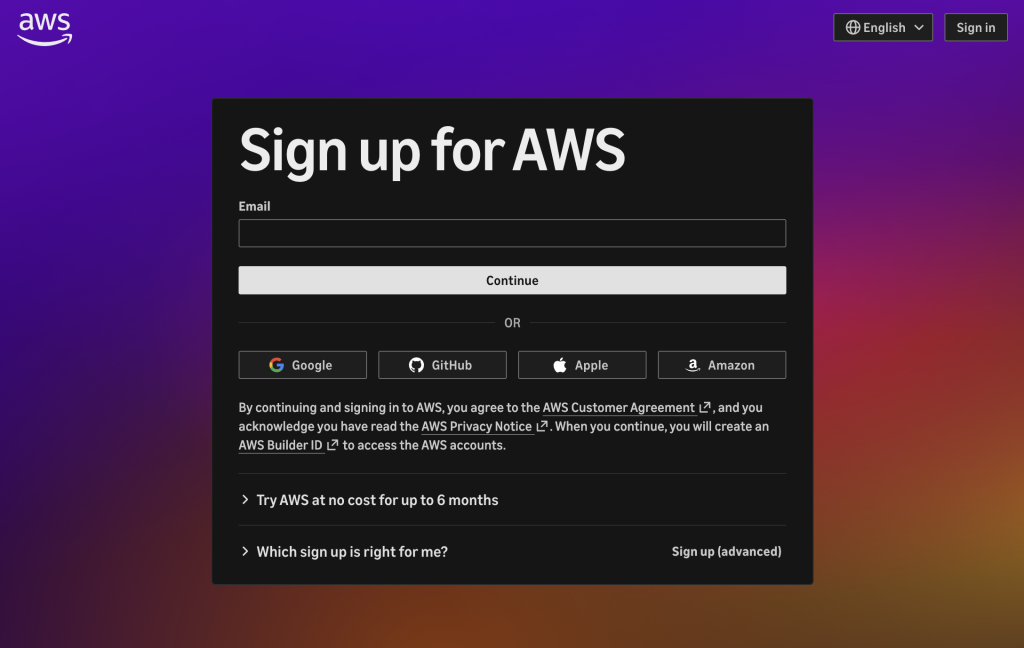
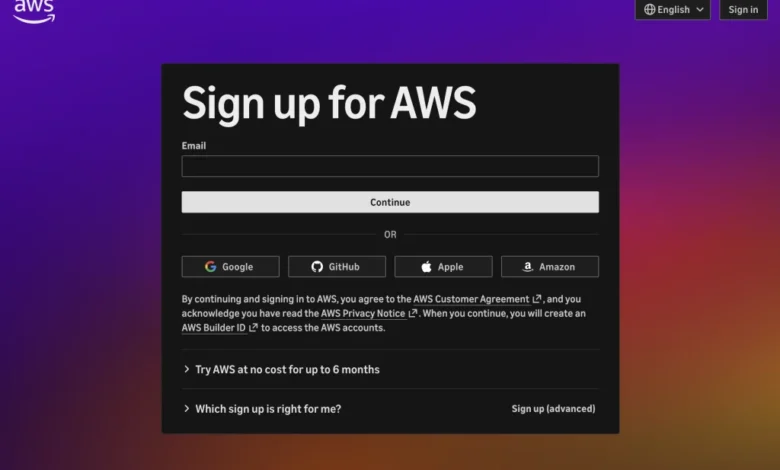
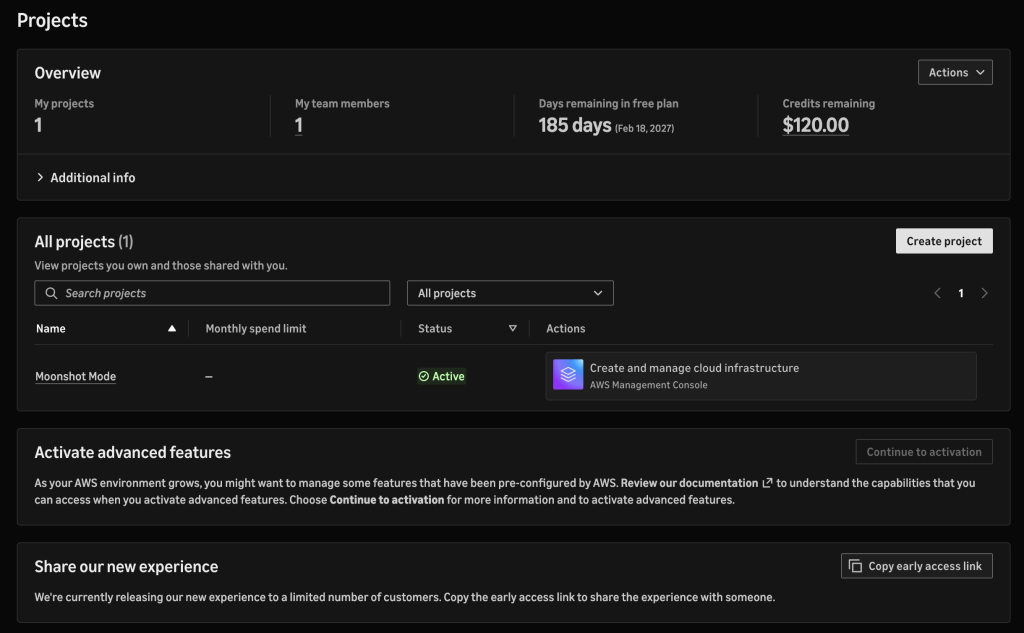
Upon visiting the AWS signup portal, prospective users can authenticate using existing identity providers, including Google, GitHub, and Apple. For the vast majority of new registrants, the platform waives the initial requirement for a credit card, granting $100 in free cloud credits as part of an enhanced AWS Free Tier. Behind the scenes, AWS automatically provisions a dedicated cloud environment equipped with pre-configured security guardrails, allowing the user to begin building immediately within their inaugural project.
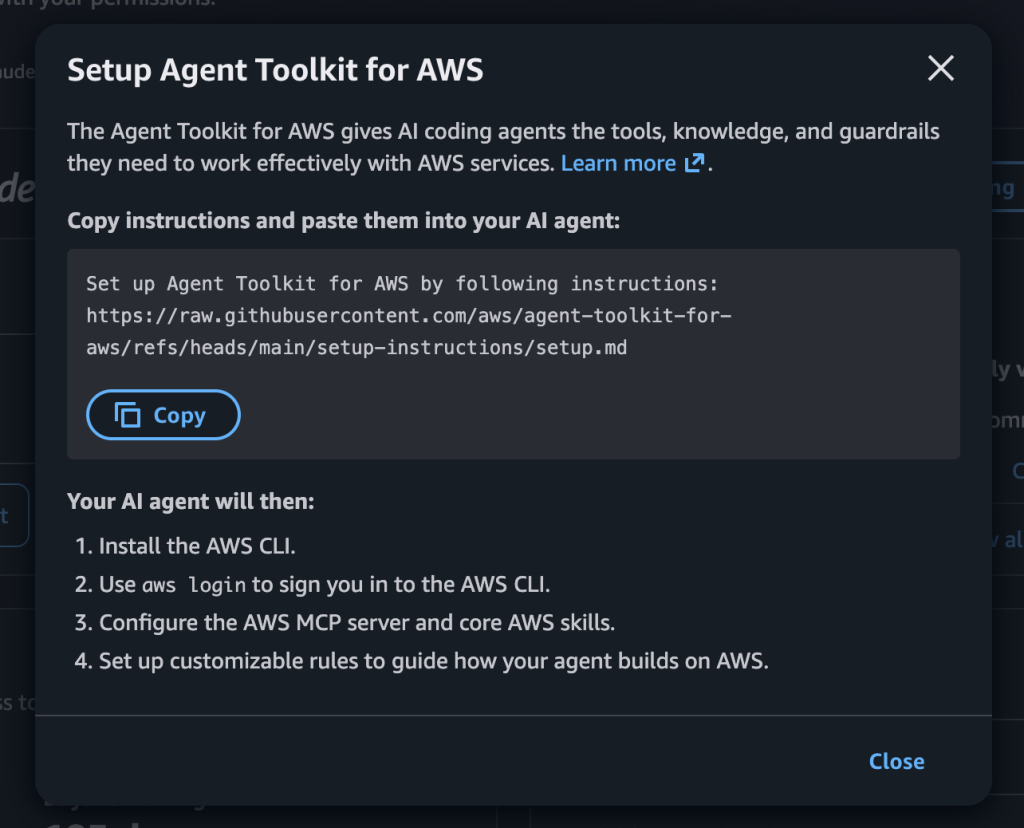
A key differentiator in this new release is native support for AI coding assistants. Immediately following authentication, the platform generates a specialized setup prompt designed to be copied and pasted directly into an active coding agent. This command automatically configures the AWS Command Line Interface (AWS CLI), installs the Agent Toolkit for AWS, authenticates the developer’s session, and establishes a project-specific guidance file (such as a CLAUDE.md file) containing operational instructions for the AI agent.
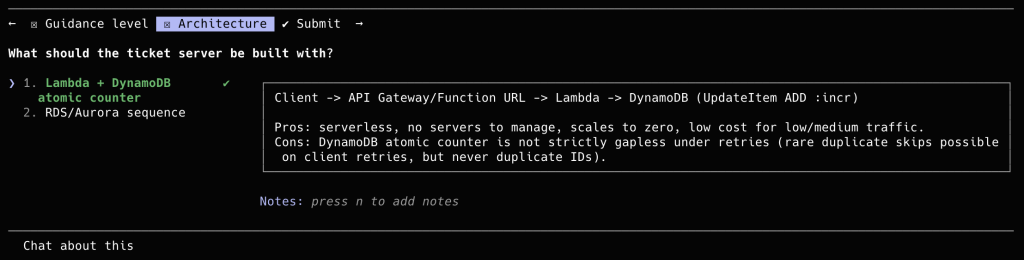
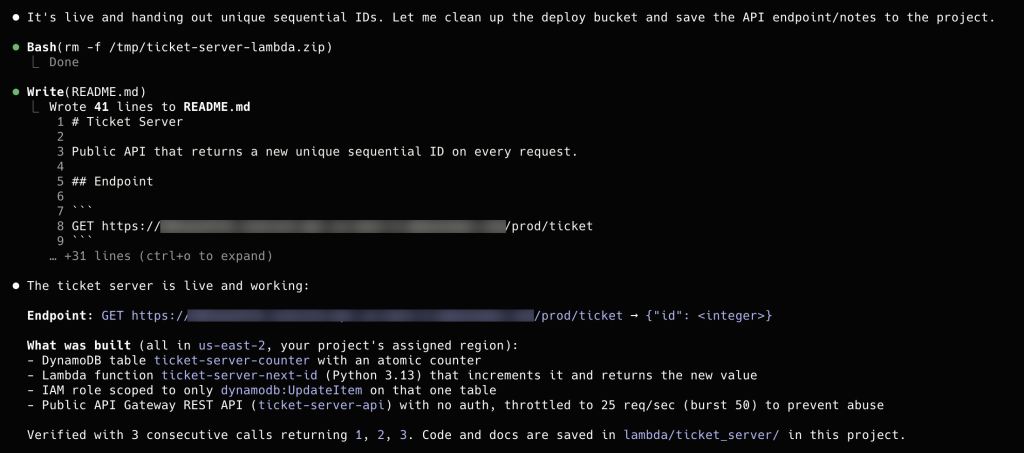
Once linked, developers can instruct their coding agents using natural language. During preliminary demonstrations, engineers successfully prompted their AI agents to construct complex serverless architectures—such as an API returning unique sequential IDs—utilizing a combination of AWS Lambda functions, Amazon DynamoDB tables, and Amazon API Gateway endpoints. The coding agent autonomously provisions the necessary resources, deploys the workloads, and establishes inter-service permissions without requiring the developer to manually write infrastructure-as-code scripts or configure granular access policies.
Collaboration, Billing Controls, and Project Management
Managing team access and financial governance has historically required deep familiarity with AWS IAM, organizational units, and budget dashboards. The new AWS experience abstracts these administrative tasks into intuitive, consumer-grade interfaces.

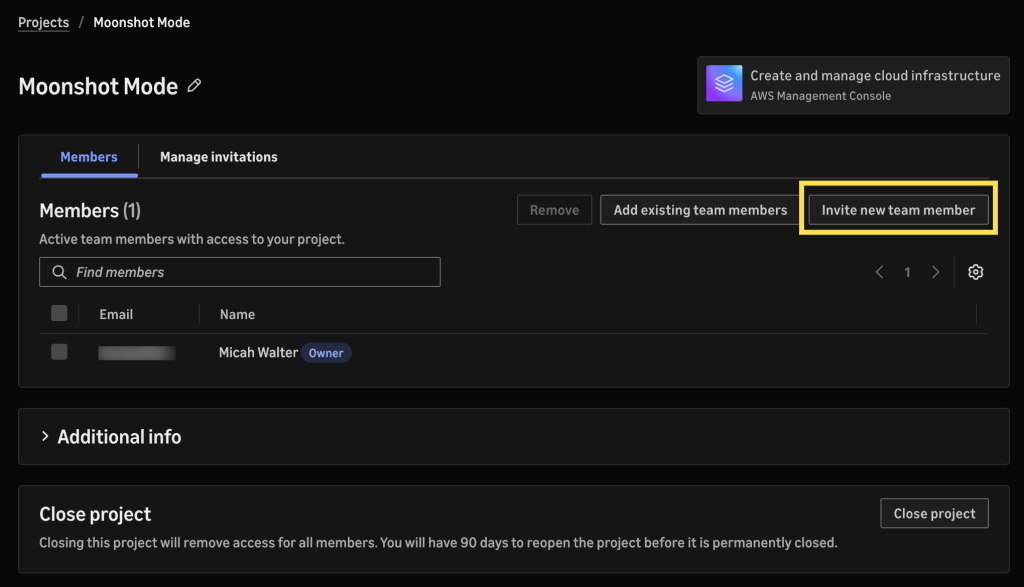
To collaborate with colleagues, project administrators can invite team members simply by entering an email address. The underlying system automatically handles permission mapping, ensuring that invited individuals are granted access exclusively to the designated project without exposing broader account privileges or requiring the manual creation of IAM user credentials.
Financial governance is managed through automated, project-level spend limits. When transitioning from free credits to a paid plan, users can establish a monthly budget ceiling starting at $20 per month, customized according to projected resource consumption. AWS continuously monitors usage trends and provides automated recommendations for budget adjustments.
Unlike traditional cloud models where unexpected traffic spikes can lead to uncapped overages, the new framework implements a strict fail-safe mechanism: if a project’s resource utilization approaches its designated spend limit, administrators receive proactive notifications. If expenses reach the exact financial ceiling, AWS temporarily pauses the project rather than accumulating unauthorized charges. Developers can resume operations immediately by adjusting the budget threshold, allowing experimental projects to remain strictly contained while scaling workloads receive appropriate financial backing.
Seamless Transition to Enterprise-Grade Infrastructure
A central challenge for developer-focused platforms is the eventual migration bottleneck, where fast-growing applications outgrow their initial sandbox environments and require complex data migrations to transition to enterprise tiers. AWS has engineered its new experience to eliminate this friction point entirely.
When a project expands beyond the scope of a single environment—requiring multi-region deployments, advanced auditing, or centralized governance policies through AWS Organizations—administrators can activate advanced platform features at no additional financial cost. This activation does not trigger a migration process or cause service downtime. Instead, the underlying architecture dynamically transitions into a fully compliant AWS Organization configured according to industry best practices. All previously provisioned resources, configurations, and deployment pipelines remain fully intact and operational, ensuring continuous business continuity as startups mature into enterprise entities.
Industry Implications and Competitive Landscape
The launch of AWS’s simplified onboarding experience reflects a broader industry imperative: reducing time-to-value for developers in an increasingly competitive cloud market. Major cloud providers and platform-as-a-service (PaaS) alternatives have increasingly targeted individual developers and AI-native startups by offering streamlined, opinionated environments that abstract underlying infrastructure complexity.
Industry analysts note that by combining frictionless authentication, automated AI agent configuration, and strict budget caps, AWS is effectively reclaiming the early-stage developer market. Historically, independent developers and small software agencies frequently gravitated toward specialized developer platforms for rapid prototyping, migrating to hyperscale cloud providers only when forced by enterprise scalability requirements. By providing an equally frictionless starting point backed by the world’s most comprehensive cloud infrastructure, AWS removes the incentive for developers to build on secondary platforms.
Furthermore, the integration of autonomous coding agents into cloud provisioning signals a permanent evolution in software engineering workflows. As artificial intelligence transitions from writing isolated functions to orchestrating complete cloud-native architectures, foundational cloud providers must adapt their interfaces to accommodate machine-to-cloud communication alongside human-to-cloud management.
Availability and Rollout Strategy
Amazon Web Services has confirmed that the simplified onboarding experience is currently rolling out globally to new customers. The phased deployment is designed to gather user telemetry and direct feedback from the developer community to refine performance and expand compatibility with a broader array of third-party coding agents and development environments.
Prospective users can access the new experience by navigating to the official AWS registration portal and selecting the updated signup pathway. Comprehensive documentation detailing the technical specifications of the project architecture, agent toolkits, and billing mechanisms is available via the Amazon Web Services technical documentation repository. As the rollout progresses, AWS leadership has emphasized its commitment to iterating upon the developer feedback loop, ensuring that the platform continues to balance radical simplicity with the unmatched global reach, breadth, and depth that define modern cloud computing.