Amazon Web Services Introduces AWS Emulator to Streamline Local Cloud Development and AI Coding Workflows

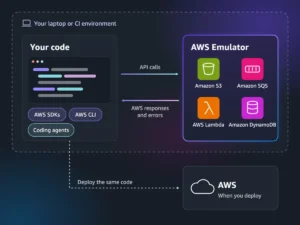
Amazon Web Services (AWS) has announced the general availability of AWS Emulator, a free local emulation tool designed to run directly on developers’ local machines. By bridging the gap between local development environments and cloud infrastructure, the tool allows the AWS Command Line Interface (AWS CLI), AWS Software Development Kits (SDKs), and automated coding agents to communicate with a local HTTPS endpoint using standard AWS APIs. This release addresses long-standing challenges in cloud-native software engineering, specifically minimizing deployment latency and reducing cloud resource expenditure during the early stages of application development and testing.
The introduction of AWS Emulator marks a significant shift in how developers interact with cloud ecosystems, particularly as AI-driven coding assistants become increasingly prevalent in modern software engineering workflows. Built entirely in Rust to ensure high performance and minimal CPU and memory consumption, the emulator is available at no additional service charge, with developers incurring costs only when resources are deployed in live AWS environments.
Main Facts and Core Functionality
AWS Emulator operates by providing a local replica of AWS service behaviors. When launched, the emulator generates localized credentials, configuration files, and security certificates within a designated directory on the host machine. By configuring specific environment variables—such as pointing the endpoint URL to a local address—developers can redirect AWS SDK traffic away from the cloud and toward their personal computers without modifying their application source code.
The tool is distributed across multiple platforms. Linux users can install it via standard RPM or Debian packages, while macOS and Windows users can deploy and execute the emulator within a Docker container. Additionally, the software features an embedded mode for languages such as Rust, allowing the emulator to run directly inside a test process via an HTTP client rather than relying on a separate network server. This in-process execution ensures complete isolation between test suites, preventing state leakage and enabling parallelized unit testing.
A cornerstone of the emulator’s architecture is its reliance on official AWS API models. By leveraging the same API specifications utilized by the official AWS SDKs, the emulator ensures that requests, response structures, and error codes mirror those encountered in a production AWS environment. If an operation has not yet been implemented, the emulator explicitly returns an HTTP 501 (Not Implemented) status code, allowing developers to immediately identify capability gaps.
Background Context and the Rise of AI Coding Agents
For years, local development in cloud environments presented a friction-heavy workflow. Developers typically had to choose between mocking AWS services—which often failed to capture the nuances of actual cloud behavior—or continuously deploying code to remote cloud regions for integration testing. The latter approach introduced notable latency, disrupted coding focus, and, in many cases, accumulated unnecessary cloud infrastructure costs during the trial-and-error phases of development.
The urgency for robust local emulation has accelerated sharply with the rise of autonomous and semi-autonomous coding agents, such as Kiro and Claude Code. These AI systems frequently write, test, and iterate on cloud-integrated code. When reliant on remote cloud environments, coding agents face bottlenecks while waiting for network round-trips, infrastructure provisioning, and remote region deployments. By utilizing AWS Emulator, coding agents can locally provision resources—such as Amazon DynamoDB tables or Amazon S3 buckets—execute operations, review outputs, and refine code in milliseconds rather than minutes.
Chronology and Development Methodology
The development of AWS Emulator represents a departure from traditional software engineering pipelines, relying heavily on automated agentic systems. AWS constructed and maintains the emulator using Amazon Bedrock AgentCore Runtime Instances, AWS CodePipeline, and AWS CodeCommit.
Under this automated framework, specialized AI agents continuously scan for parity gaps between the emulator and real AWS services by comparing execution responses and statically evaluating source code against published Smithy API models. Once a gap is identified, an automated agent generates a formal issue, writes targeted tests, implements the required behavior, and conducts internal code reviews focusing on correctness, performance, and security.
Before any update is pushed to the public GitHub repository, the code undergoes automated evaluation within an AWS CodePipeline workflow, where a rigorous suite of fidelity tests is executed. An independent security agent also reviews modifications adversarially to ensure safety before the code enters the release pipeline.
Supporting Data and Fidelity Testing
To quantify the reliability of AWS Emulator, AWS utilizes a standardized metric known as fidelity testing. A fidelity test is a defined workflow—such as creating an Amazon S3 object, reading it, and subsequently deleting it—executed via an AWS SDK to evaluate how closely the emulator matches production cloud behavior.
Fidelity scores are reported publicly as a ratio (for example, 40 of 50), indicating the exact number of passing tests out of the total evaluation suite available in the open-source aws-emulator-evaluation-suite repository on GitHub. Because the evaluation suite is continuously expanded to cover edge cases and complex service interactions, historical fidelity scores may occasionally fluctuate downward as rigorous new tests are introduced, reflecting an ongoing process of refinement rather than regression.
Broader Impact and Industry Implications
The release of AWS Emulator is expected to reshape developer productivity metrics across enterprises utilizing cloud infrastructure. By enabling complex, multi-service local testing loops, engineering teams can achieve higher test coverage prior to committing code to shared development or staging branches. This decentralization of testing reduces the load on shared cloud sandbox environments, lowers cloud operational expenses, and accelerates software delivery lifecycles.
However, industry analysts and AWS security architects emphasize that local emulation is not a complete substitute for pre-production cloud verification. AWS Emulator operates under a single-account paradigm, lacking cross-account and cross-region behaviors, and it does not evaluate AWS Identity and Access Management (IAM) policies or resource-based policies with production-grade fidelity. Consequently, an overly permissive configuration that might be flagged or blocked in a live AWS environment could successfully execute locally. AWS maintains that security policies and full application stacks must still be validated in real cloud environments prior to production deployment.
Availability and Future Outlook
AWS Emulator is generally available to the developer community. The source code is hosted publicly on GitHub, and installation packages are accessible for Linux distributions, with containerized options available for Windows and macOS. As AWS continues to update the tool based on community feedback and automated agent iterations, the scope of supported services and fidelity scores is expected to expand steadily, further cementing local emulation as a foundational pillar of modern cloud architecture.