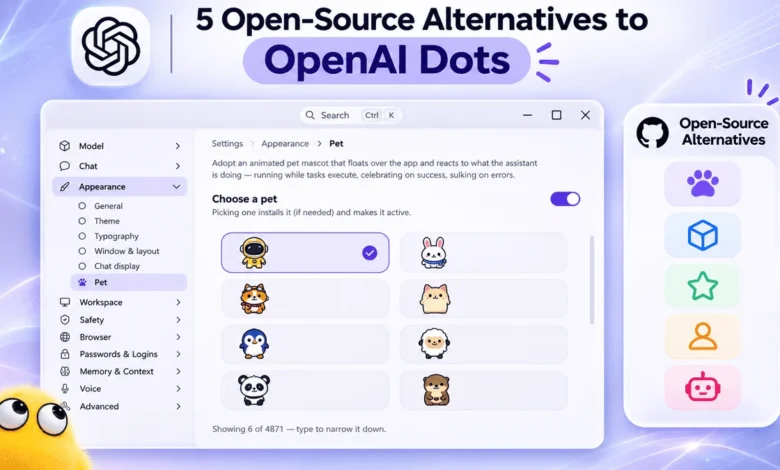
The rapid evolution of artificial intelligence has shifted the technological landscape from static, reactive chatbots to proactive, autonomous digital assistants capable of operating 24 hours a day, seven days a week. Central to this paradigm shift is the concept of the persistent AI agent—a system that does not merely wait for user prompts, but actively manages workflows, executes background computations, maintains continuous memory, and interacts with external applications independently. Recent industry announcements regarding proprietary solutions such as OpenAI Dots have popularized this autonomous assistant model, demonstrating the immense utility of an AI that can work seamlessly in the background while users are offline.
However, this growing reliance on centralized, proprietary ecosystems has simultaneously ignited a parallel movement within the developer and enterprise communities. A significant segment of users, organizations, and security-conscious engineers are increasingly demanding sovereignty over their data, infrastructure, and choice of underlying language models. For these stakeholders, depending entirely on a single corporate vendor introduces critical vulnerabilities related to vendor lock-in, data privacy, subscription costs, and a lack of customizability. Consequently, the open-source community has responded rapidly, engineering sophisticated, self-hosted alternatives that replicate—and in some cases surpass—the capabilities of commercial solutions.
This comprehensive analysis examines five leading open-source frameworks designed to empower users to build, deploy, and customize their own always-on AI assistants. By exploring the architectures, unique strengths, and operational profiles of OpenClaw, Hermes Agent, QwenPaw, OpenHuman, and nanobot, developers and enterprises can navigate the emerging landscape of decentralized autonomous agents.
The Rise of Autonomous Persistent AI Agents
To understand the significance of open-source alternatives, it is essential to examine the architectural evolution of modern AI assistants. Traditional large language model (LLM) interfaces operate on a stateless, request-and-response model. A user inputs a prompt; the model evaluates the context window; a response is generated; and the session effectively resets. While powerful for drafting text, writing code, or answering discrete questions, this architecture fails when applied to long-horizon, complex tasks that require ongoing oversight, multi-app integration, and temporal awareness.
Persistent AI agents bridge this gap by integrating three core technological pillars: persistent memory stores, scheduled execution engines (often referred to as heartbeats or cron-like jobs), and tool-use capabilities. A persistent agent possesses a structured database or vector store that retains long-term information regarding user preferences, past project milestones, and contextual history. Furthermore, by coupling this memory with scheduled automation, the agent can periodically wake up, check email inboxes, monitor software repositories, execute web scraping tasks, or send proactive notifications via messaging platforms like Slack, Discord, or WhatsApp without requiring human intervention for every step.
As enterprises and power users increasingly adopt these autonomous systems for critical operations—ranging from financial data analysis to automated software deployment—the imperative for transparent, auditable, and self-hosted infrastructure has become paramount. Open-source frameworks offer the ideal solution, providing the flexibility to run models locally via inference engines like Ollama, integrate custom Python scripts, and ensure that sensitive enterprise data never traverses third-party commercial APIs without explicit authorization.
- OpenClaw: The Pioneer of Always-On Messaging Integration
Positioned at the forefront of the open-source agent movement, OpenClaw has established itself as one of the most prominent frameworks for deploying a personal AI assistant directly onto local hardware or private cloud servers. With an expansive community adoption rate exceeding 394,000 GitHub stars and an MIT license, OpenClaw bridges the gap between conversational interfaces and background system automation.
Unlike standard applications that remain dormant until launched, OpenClaw is architected for continuous execution. It connects natively to a wide array of ubiquitous messaging platforms, including WhatsApp, Telegram, Slack, and Discord. This integration allows users to converse with their agent naturally, issuing complex commands or receiving status reports through the exact same channels they use for human communication.
A defining technical characteristic of OpenClaw is its scheduled task engine and heartbeat monitoring system. Users can program the agent to execute routines at fixed intervals—such as scanning RSS feeds every morning, checking server health metrics hourly, or reminding stakeholders of impending deadlines. Furthermore, OpenClaw supports persistent memory architectures, browser automation tools, and a modular skill system that enables the execution of complex, multi-step workflows. Management of these disparate components is centralized through a robust web-based Control UI, giving administrators clear visibility into ongoing operations.
Despite its extensive capabilities, OpenClaw presents distinct operational hurdles. Because the software runs entirely on user-managed infrastructure, deployment requires technical proficiency in server administration, network security configuration, API key management, and resource allocation. For organizations with dedicated IT personnel, however, OpenClaw offers an unparalleled degree of autonomy.
- Hermes Agent: Nous Research’s Experience-Driven Framework
Developed by Nous Research, an organization widely recognized for its contributions to open-weight model fine-tuning and agentic evaluation, Hermes Agent approaches personal AI assistance through the lens of continuous learning and cognitive adaptation. While many agents rely solely on static prompt engineering and vector databases to retain context, Hermes Agent is engineered to learn dynamically from accumulated operational experience.
The core innovation of Hermes Agent lies in its ability to synthesize successful task completions into reusable procedural skills. When the agent executes a complex workflow—such as parsing a complex dataset, formatting a report, and deploying an application—it can encapsulate the successful steps into a modular skill package. Over time, the agent consults these learned skills, refining its efficiency and reducing token overhead for repetitive tasks.
Hermes Agent incorporates a sophisticated multi-tier memory architecture that retains conversation histories, tracks user preferences, and indexes ongoing project files. To facilitate user interaction, the project provides Hermes Desktop, a dedicated native interface designed for seamless chat management, file manipulation, and real-time visualization of tool execution activity. A browser-based dashboard is additionally supported for remote administration.
Supporting scheduled jobs, subagent delegation, and compatibility with a diverse ecosystem of open and commercial language models, Hermes Agent is particularly well-suited for developers and researchers who require an assistant that evolves in capability alongside their professional workflows. Its MIT license ensures broad commercial and academic adaptability.
- QwenPaw: Multi-Agent Collaboration and Advanced Memory Systems
Formerly known as CoPaw, QwenPaw is an open-source personal assistant framework built from the ground up to address the limitations of single-agent architectures. Developed within the AgentScope ecosystem, QwenPaw emphasizes three core pillars: structured persistent memory, robust workflow automation, and collaborative multi-agent execution.
Managing approximately 37.4K GitHub stars and distributed under the Apache 2.0 license, QwenPaw introduces a sophisticated three-layer memory system. This architecture systematically separates working context (immediate task parameters), conversation history (short-to-medium-term dialogue logs), and a personal knowledge base (long-term semantic memory that evolves dynamically as new information is ingested). This layered approach ensures that the agent retains high contextual relevance without suffering from context window saturation or catastrophic forgetting.
A standout feature of QwenPaw is its native support for multi-agent collaboration. Rather than forcing a single monolithic assistant to handle every conceivable responsibility, users can instantiate multiple specialized agents—each configured with distinct memory stores, specialized system prompts, and tailored toolsets—and orchestrate them to work collaboratively on complex, multi-faceted projects. For instance, a research agent can gather data, pass its findings to a writing agent for synthesis, and hand off the final output to an execution agent for deployment.
QwenPaw supports scheduled task execution, messaging platform integrations, browser interaction tools, and advanced document processing pipelines. It offers both a web console and a desktop application (currently in beta), providing flexible deployment options. Users can leverage cost-effective commercial AI APIs or run entirely locally hosted models, granting organizations granular control over operational expenditures and data privacy.
- OpenHuman: Local-First Computer Automation in Rust
For users seeking deep integration with local hardware and operating system environments, OpenHuman offers a radically different architectural philosophy. Built primarily using Rust—a systems programming language renowned for its memory safety, concurrency, and high execution efficiency—OpenHuman takes a strictly local-first approach to persistent memory, agent orchestration, and system automation.
Garnering approximately 42.6K GitHub stars under the GPL-3.0 license, OpenHuman is engineered to minimize infrastructure overhead while maximizing the depth of computer interaction. Through its dedicated desktop application, the agent can interact directly with local files, execute terminal commands, manage local software workflows, and perform browser-based automation tasks.
A critical design consideration in OpenHuman is safety and human-in-the-loop oversight. Because autonomous agents operating at the operating system level possess the technical capability to modify files, execute code, or transmit data, OpenHuman incorporates strict approval gates. When the agent encounters a high-stakes decision or attempts an action that exceeds pre-configured safety parameters, it pauses execution and prompts the user for explicit authorization.
Although OpenHuman is currently classified as an early-beta project—meaning developers should anticipate occasional architectural friction, incomplete documentation, or edge-case bugs—its focus on Rust-based performance and deep local automation makes it a compelling option for power users and systems engineers who want an AI assistant deeply embedded within their local computing environment.
- nanobot: Lightweight, Python-Based Flexibility
Rounding out the open-source landscape is nanobot, a minimalist, Python-based personal AI agent designed for maximum simplicity, extensibility, and deployment flexibility. Securing roughly 49.8K GitHub stars under an MIT license, nanobot proves that highly capable autonomous agents do not require bloated software architectures or massive infrastructure footprints.
Despite its lightweight design, nanobot compromises little on functionality. It fully supports persistent memory stores, scheduled automation routines, web-scraping utilities, file system operations, and standard messaging platform integrations. The framework is accompanied by a clean, browser-based interface where administrators can monitor active conversations, inspect low-level tool executions, configure model parameters, and oversee scheduled tasks.
One of nanobot’s primary competitive advantages is its seamless integration with local model runners such as Ollama, alongside its native compatibility with commercial LLM providers. This dual capability allows developers to experiment with zero-cost, fully offline local inference or seamlessly scale up to frontier commercial models when maximum reasoning capability is required. For software developers, computer science students, and enthusiasts looking to examine, modify, and extend the core codebase of their personal AI assistant without wading through millions of lines of complex enterprise software, nanobot provides an ideal, transparent starting point.
Comparative Analysis of Open-Source Agent Frameworks
| Project | GitHub Stars | Interface Options | Primary Architectural Strength | Software License |
|---|---|---|---|---|
| OpenClaw | ~394K | Web + Mobile Apps | Always-on messaging integration and scheduled background tasks | MIT |
| Hermes Agent | ~260K | Web + Desktop App | Dynamic memory retention and self-improving reusable skills | MIT |
| QwenPaw | ~37.4K | Web + Desktop (Beta) | Collaborative multi-agent workflows and tiered memory systems | Apache 2.0 |
| OpenHuman | ~42.6K | Desktop + Web | High-performance local computer automation built in Rust | GPL-3.0 |
| nanobot | ~49.8K | Web + Terminal | Lightweight, highly extensible Python-based architecture | MIT |
Implications and Future Outlook of Decentralized AI Agents
The proliferation of open-source frameworks like OpenClaw, Hermes Agent, QwenPaw, OpenHuman, and nanobot signals a fundamental democratization of advanced artificial intelligence. While commercial entities continue to refine proprietary cloud-based assistants like OpenAI Dots, the open-source community is establishing a robust parallel ecosystem. This decentralized approach addresses critical industry concerns that extend far beyond simple convenience.
Data privacy remains the primary driver behind enterprise and individual adoption of self-hosted agents. When an AI assistant operates on a local server or private cloud instance, proprietary business logic, personal communications, and sensitive source code remain entirely within the user’s perimeter. Furthermore, open-source architectures mitigate the financial unpredictability of commercial API rate limits and subscription models, allowing organizations to optimize costs by routing trivial tasks to smaller, locally hosted open-weight models while reserving expensive frontier models for complex cognitive reasoning.
Nevertheless, challenges persist within the open-source agent domain. Security vulnerabilities—such as prompt injection attacks targeting autonomous web-browsing agents or unauthorized file modifications—require rigorous configuration and sandboxing. Moreover, the technical barrier to entry for self-hosting, securing, and maintaining these systems remains significantly higher than logging into a commercial web application.
As the underlying technology matures, developers can anticipate tighter integration between local operating systems, standardized agent-to-agent communication protocols, and increasingly efficient small language models capable of running seamlessly on consumer hardware. For engineers, researchers, and organizations seeking absolute control over their digital assistants, the expanding array of open-source frameworks provides a powerful, transparent, and highly customizable path forward.